
Sheet Metal
Types of Sheet Metal: Thickness, Gauge and Weight — The Complete Technical Guide
Sheet metal is the most widely used raw material in metal fabrication.
Yet choosing the right type and thickness remains one of the most common points of failure on a project.
The difference between 2 mm and 3 mm sheet looks trivial on paper. In practice it means roughly a 50% difference in weight and cost.
It can also mean the difference between a structure that performs and one that distorts within months.
This guide covers the types of sheet metal available in the Saudi market, their thicknesses and standard sizes, how to calculate weight, and practical rules for choosing correctly.
It is written for engineers, purchasing managers and contractors, and draws on the experience Alnafie Metal Industries has built in sheet metal forming since 1979.
What Is Sheet Metal?
Sheet metal is a flat metal product manufactured by rolling steel down to a defined thickness.
It is classified as sheet when the thickness is below 6 mm, and as plate when it exceeds that figure.
Both are commonly grouped under a single trade name in day-to-day purchasing, which is exactly where specification errors begin.
Three Axes You Must Define When Ordering
First: the manufacturing route — hot rolled or cold rolled.
Second: the surface protection — uncoated, galvanized, pre-painted, stainless or aluminium.
Third: the final form — plain, corrugated, checker, perforated or decking.
Ordering “2 mm sheet” without defining all three is the single most frequent cause of incorrect supply.
Types of Sheet Metal by Manufacturing Route
Hot Rolled Sheet
Produced by rolling steel above 900 °C.
This makes forming easier and the material cheaper. The trade-off is a relatively rough surface, less regular edges and wider dimensional tolerance.
Common thicknesses: 1.5 mm up to 100 mm and beyond.
Specifications: ASTM A36 · ST37-2 · ST52-3.
Used for: steel structures, base plates, beams and storage tanks.
In short, anything where the finished surface is not visible.
Cold Rolled Sheet
Produced by re-rolling hot rolled sheet at room temperature.
The result is tighter dimensional accuracy, a smoother surface and higher hardness. It costs more and is less forgiving in deep forming.
Common thicknesses: 0.3 mm to 3 mm.
Specifications: DC01 · DC03 · DC04 · ASTM A1008.
Used for: doors, electrical panels and metal furniture.
In short, anything requiring a clean surface ready for paint.
The Practical Rule
If the surface will be clad or coated with a heavy industrial paint system, hot rolled is sufficient and saves cost.
If the surface forms part of the finished product, cold rolled is the correct choice.
Types of Sheet Metal by Surface Protection
Uncoated Mild Sheet Metal
Plain carbon steel with no protective coating, widely referred to in the market as black steel.
It begins to rust as soon as it meets moisture, and it is the cheapest option available.
Best suited to: structural work that will later be painted or enclosed.
Galvanized Steel Sheet (GI)
Coated with a zinc layer applied by hot dipping, to ASTM A653.
Best suited to: roofing, ducting, security fencing and humid environments.
Pre-Painted Galvanized Steel (PPGI)
Galvanized, then coated with a colour layer under factory conditions.
Best suited to: warehouse and hangar cladding, and exposed roofing.
Stainless Steel
An alloy containing 10.5% chromium or more, which resists corrosion inherently.
Best suited to: food and pharmaceutical facilities, and coastal installations.
Aluminium
Roughly one third the weight of steel, and naturally corrosion resistant.
Best suited to: cladding and weight-sensitive applications.
An Important Note on Galvanized Sheet
Zinc coating weight is measured in grams per square metre, counted across both faces of the sheet. It is designated by the letter Z.
Z100 means 100 g/m².
Z275 means 275 g/m².
The higher the figure, the longer the service life in coastal conditions such as Jeddah and Yanbu.
Always specify the coating weight, not simply the word “galvanized”.
Types of Sheet Metal by Form
Plain sheet — the base product, supplied in cut lengths or coils.
Corrugated sheet — repeated profiling that dramatically increases stiffness in one direction without adding thickness. The standard choice for hangar and warehouse roofing.
Checker plate — raised pattern that prevents slipping. Used for industrial flooring, stair treads and walkways.
Perforated sheet — regular openings for ventilation, screening or decoration, produced through metal perforation.
Metal decking — trapezoidal profiles that act as permanent formwork and bottom reinforcement for concrete slabs.
Standard Sheet Metal Sizes in the Saudi Market
1000 × 2000 mm — 2 square metres. A common metric size.
1220 × 2440 mm — 2.98 square metres. Known as the 4×8 ft size, and the most widely stocked.
1250 × 2500 mm — 3.13 square metres. The European size.
1500 × 3000 mm — 4.5 square metres. For larger panels.
1500 × 6000 mm — 9 square metres. For heavy structural work.
2000 × 6000 mm — 12 square metres. For tank and vessel shells.
Non-standard sizes are available to order, but carry a longer lead time.
What Does Sheet Metal Gauge Mean?
Gauge is an American unit for expressing sheet thickness.
The rule runs counter to intuition: the lower the number, the thicker the sheet.
Gauge to Millimetre Conversion for Steel Sheet
26 gauge → 0.45 mm
24 gauge → 0.61 mm
22 gauge → 0.76 mm
20 gauge → 0.91 mm
18 gauge → 1.21 mm
16 gauge → 1.52 mm
14 gauge → 1.90 mm
12 gauge → 2.66 mm
11 gauge → 3.04 mm
10 gauge → 3.42 mm
8 gauge → 4.18 mm
7 gauge → 4.55 mm
Take note: gauge tables differ between steel, aluminium and stainless. Never apply one conversion to all three.
How to Calculate Sheet Metal Weight
The Formula
Weight in kilograms = length (m) × width (m) × thickness (mm) × 7.85
The figure 7.85 is the density factor for carbon steel.
Worked Example
A sheet measuring 1.22 × 2.44 metres, at 3 mm thickness.
The calculation: 1.22 × 2.44 × 3 × 7.85
The result: 70.1 kilograms
Density Factors for Other Metals
Carbon steel → 7.85
Stainless 304 → 7.93
Stainless 316 → 8.00
Aluminium → 2.70
Copper → 8.96
Weight per Square Metre by Thickness
0.5 mm → 3.93 kg
0.8 mm → 6.28 kg
1 mm → 7.85 kg
1.5 mm → 11.78 kg
2 mm → 15.70 kg
3 mm → 23.55 kg
4 mm → 31.40 kg
5 mm → 39.25 kg
6 mm → 47.10 kg
8 mm → 62.80 kg
10 mm → 78.50 kg
12 mm → 94.20 kg
15 mm → 117.75 kg
20 mm → 157 kg
A Shortcut Worth Memorising
Weight per square metre of steel sheet = thickness in millimetres × 7.85.
With that rule you can estimate any weight mentally, without a calculator.
How to Choose the Right Type and Thickness of Sheet Metal
Start from the load, not the thickness.
Define the expected load and the span between supports, then derive the thickness. Starting from a familiar thickness figure is the source of most errors.
Form can replace thickness.
A 1 mm corrugated sheet can outperform a 2 mm flat sheet in stiffness, at half the weight and cost. Consider profiling before you increase thickness.
Define the environment first.
Coastal, industrial or enclosed? In Jeddah and the Western Region, unprotected mild steel has a very short outdoor life.
Account for cutting waste.
Choose the standard size closest to your cutting dimensions to reduce offcuts. A 5 cm change in design can sometimes save 15% of the material.
Confirm the thickness is actually stocked.
Non-standard thicknesses such as 3.5 mm or 7 mm may require a special order and a longer lead time.
Ask for the mill certificate.
It is the only proof that chemical composition and mechanical properties match the specification.
Five Common Mistakes When Buying Sheet Metal
Confusing nominal thickness with actual thickness.
Every specification allows a tolerance. A sheet sold as 2 mm may measure 1.85 mm and still be within limits. On sensitive projects, state the tolerance in writing.
Ordering “galvanized” without specifying zinc weight.
The gap between Z100 and Z275 is the gap between five years and fifteen in a coastal environment.
Ignoring rolling direction.
Bending against the grain increases the risk of cracking at tight bend radii. This is accounted for on our metal bending line.
Cutting galvanized sheet and leaving the edges untreated.
Cut edges lose their zinc layer, and corrosion starts there. They need treatment or edge coating.
Leaving transport out of the comparison.
A favourable price per tonne can be entirely absorbed by the freight difference.
Sheet Metal Services at Alnafie
We take in sheet metal of every type and convert it into a finished product inside our own steel fabrication facility.
Plate works — complete fabrication to your drawings.
Iron cutting and laser metal cutting — high-precision cutting with clean edges.
Slitting — coils cut down to specified widths on request.
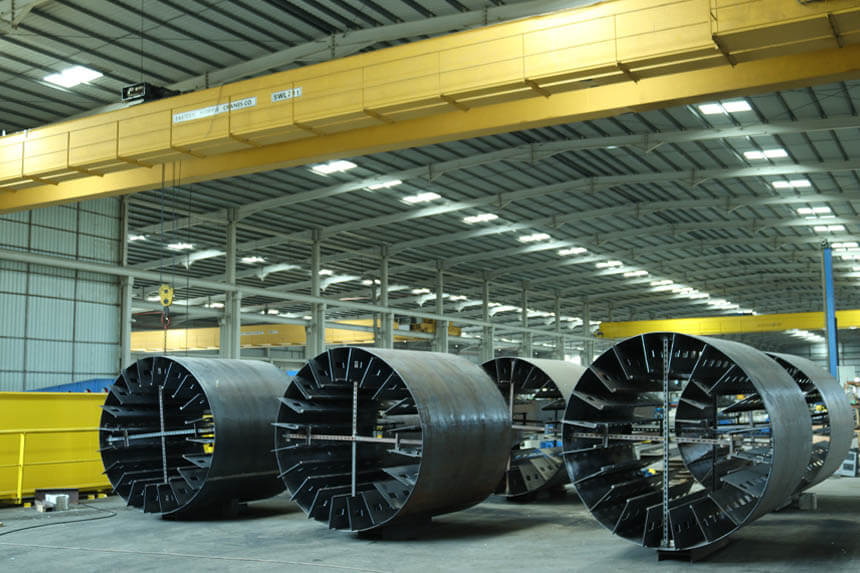
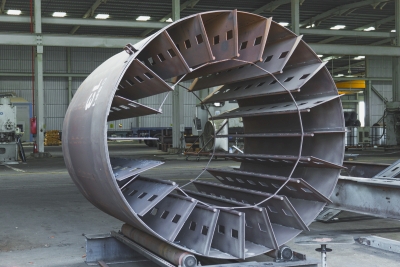
Metal rolling — forming cylinders and curved sections.
Blasting and metal finishing — surface preparation, painting and galvanizing.
Delivery service — dispatch to every region of the Kingdom.
All our work is backed by accredited quality certifications.
You can review delivered examples on our projects page, or browse our full products and services range.
Frequently Asked Questions About Sheet Metal
How do I calculate the weight of a metal sheet?
Multiply length in metres × width in metres × thickness in millimetres × 7.85 for carbon steel. For example, a 1.22 × 2.44 metre sheet at 3 mm weighs 70.1 kg. Use 7.93 for stainless 304 and 2.70 for aluminium. The quickest shortcut: weight per square metre equals thickness in millimetres × 7.85.
What is the difference between mild steel sheet and galvanized sheet?
Uncoated mild steel is plain carbon steel that begins rusting as soon as it meets moisture. It is cheaper and used where the surface will later be painted or enclosed. Galvanized sheet carries a zinc coating applied to ASTM A653 that protects against corrosion, making it suitable for roofing, ducting and outdoor or humid applications.
What are the standard sheet metal sizes in Saudi Arabia?
The most widely stocked sizes are 1220 × 2440 mm, known as the 4×8 ft sheet, along with 1000 × 2000 mm and 1250 × 2500 mm. For heavy structural work, 1500 × 3000 mm, 1500 × 6000 mm and 2000 × 6000 mm plates are available. Non-standard sizes can be ordered with a longer lead time.
What does gauge mean in sheet metal?
Gauge is an American unit for sheet thickness, and the lower the number the thicker the material, which runs counter to intuition. For instance, 26 gauge equals 0.45 mm while 10 gauge equals 3.42 mm. It is important to know that conversion tables differ between steel, aluminium and stainless steel, so one table cannot serve all three.
Which is better, hot rolled or cold rolled sheet?
Neither is better in absolute terms; each suits different work. Hot rolled is cheaper, available in greater thicknesses, and suits structural applications where the surface is not visible. Cold rolled is more dimensionally accurate, smoother and harder, and suits products where the surface forms part of the finished appearance, such as doors and electrical panels.
What does Z275 mean on galvanized sheet?
Z275 means the zinc coating weighs 275 grams per square metre, counted across both faces of the sheet. The higher the number, the greater the protection and service life. Z100 is adequate for indoor use, while Z275 and above is the correct choice for coastal regions such as Jeddah, Yanbu and Jubail because of humidity and airborne salt.
What thickness suits hangar and warehouse roofing?
Hangar roofing typically uses 0.5 to 0.8 mm corrugated galvanized or pre-painted sheet, because the profiling itself provides the required stiffness without extra thickness. Structural metal decking usually falls between 0.8 and 1.2 mm, depending on the span between beams and the design load.
Why does galvanized sheet rust at the cut edges?
Because cutting removes the zinc layer from the edge and exposes the bare steel beneath. Zinc provides cathodic protection across only a very short distance from the edge, which is not enough on thicker material or in coastal environments. The remedy is to treat the edges with a zinc-rich paint, or to re-galvanize after cutting.
Need Technical Advice or a Quotation?
Choosing the right sheet metal saves more cost and time than most buyers expect.
The Alnafie engineering team is ready to review your drawings, recommend the type and thickness that make the most sense technically and commercially, and carry out the full fabrication in house.
Get in touch through our contact page, or call 920006420 directly.
