
Security Fencing
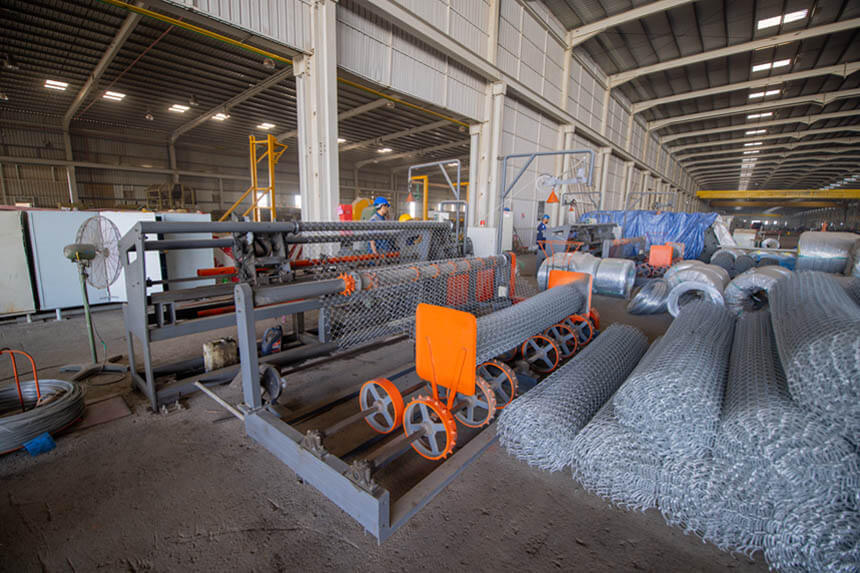
The security of any facility is not measured by what sits inside it — it begins at the boundary. Security fencing is the first line of defence for any factory, warehouse, power plant or residential compound, and it is the single element that determines whether a site is genuinely protected or merely surrounded by a token barrier.
At Alnafie Metal Industries we manufacture every category of security fencing at our facility in Jeddah — from raw material selection through to final finishing and on-site installation — in compliance with ASTM specifications and recognised international standards. This guide walks through each type of perimeter fencing system, its technical specification, and the applications it suits best, so that project engineers and purchasing managers can make the right decision the first time.
What Is Security Fencing, and When Does It Become Essential?
Security fencing is a perimeter protection system engineered to prevent unauthorised access, define property boundaries, and delay or defeat intrusion attempts. It differs fundamentally from ordinary fencing in three respects: cut resistance, climb resistance, and structural capacity to withstand impact and lateral loads.
Security fencing becomes a requirement rather than an option in the following situations:
- Industrial facilities and factories holding high-value equipment or materials.
- Critical sites such as power stations, oil refineries and water treatment plants.
- Active construction sites, both to protect plant and equipment and to limit legal liability for unauthorised entry.
- Public facilities, schools and gated residential compounds.
- Highways and embankments, where the protection is directed at vehicles rather than people.
Selecting the wrong system means either overspending on protection the site does not need, or leaving a genuine security gap. For that reason we always begin by assessing the nature of the site and its threat level before recommending a system.
Chain Link Fence: The Most Widely Used and Most Adaptable Solution
The chain link fence — also known as diamond mesh — is the most widely specified type of security fencing in the Saudi market, combining reasonable cost, fast installation, and the ability to enclose very large areas efficiently. Ours is manufactured from steel wire woven in a diamond pattern, with multiple surface protection options that determine its service life in the Kingdom’s hot and coastal conditions.
Technical specification:
| Item | Specification |
|---|---|
| Type | Galvanized or PVC-coated |
| Wire diameter | 2.0 mm · 3.0 mm · 3.75 mm · 4.0 mm |
| Galvanizing | Class I and Class II to ASTM A392 |
| PVC coating | Thicknesses from 2.5/3.55 mm to 3.76/4.88 mm |
| Finish | Fused or fusion-bonded coating up to 4.4 mm |
| Mesh aperture | 50×50 · 60×60 · 70×70 mm, diamond pattern |
| Height | 0.5 m up to 4 m |
How do you choose the right specification? The larger the wire diameter, the greater the cut resistance; and the smaller the mesh aperture, the harder it becomes to insert fingers or hand tools — which is why a 50×50 mm aperture is preferred for security applications, while 70×70 mm is sufficient for simple boundary demarcation. Choosing Class II galvanizing over Class I roughly doubles the weight of the zinc layer, a decisive difference in coastal areas such as Jeddah and Yanbu. PVC coating can also be applied over galvanizing to obtain two protective layers in sequence — a process we carry out on our own metal finishing line.
Welded Wire Mesh Fencing (BRC Fence): Greater Rigidity, Cleaner Appearance
Welded wire mesh fencing is also known as 3D fence panel, and across the Gulf and Southeast Asian markets it is commonly called BRC fence — a name inherited from an early manufacturer of welded reinforcing mesh that has since become a generic label for the product category. Its defining feature is a series of “V”-shaped bends running along the length of each panel.
Those bends are not decorative. They act as stiffening ribs that prevent the panel from buckling under pressure or lateral load, giving it considerably greater rigidity than woven mesh at the same height.
The panels are manufactured from low-carbon or pre-galvanized steel wire, then protected by one of three systems: hot-dip zinc galvanizing, powder coating, or PVC coating for weather resistance.
When should you choose it over a chain link fence? When external appearance forms part of the project requirement — residential compounds, government facilities and public parks — or when you need a fence that will not sag over time. Prefabricated panels install faster, and ours are cut and formed in-house using our laser metal cutting and metal bending lines, to a tolerance that guarantees every panel matches the next.
Anti-Climb Fencing: Maximum Protection for Sensitive Facilities
When the threat is real and deliberate, no ordinary security fencing will do. Anti-climb fencing is designed with apertures so narrow that fingertips and the toe of a boot cannot be inserted, making climbing all but impossible without specialist equipment. The same narrow aperture also prevents lightweight hand-held cutting tools from being introduced into the mesh.
Core characteristics:
- An elegant design that permits clear visibility through the fence — a genuine security advantage, because open sightlines allow guards and CCTV to monitor the perimeter without blind spots.
- Exceptional durability and virtually maintenance-free in service.
- Resistance to cutting with lightweight hand tools.
- Anti-climb and corrosion-resistant construction.
- Straightforward installation despite the high protection level.
Ideal applications:
- Prisons, military bases, power stations, oil refineries and airports.
- Telecommunications and utility stations, financial and commercial centres.
- Car parks, landscaped areas, factories, warehouses and industrial sites.
- Hypermarkets, central markets, stadiums and recreational parks.
- Gated residential compounds, apartment blocks and residential buildings.
Because facilities of this kind are usually governed by the requirements of bodies such as Saudi Aramco and the Saudi Electricity Company, documentation matters as much as the product itself — which is precisely what our accredited quality certifications cover.
Highway Guardrail and Cable Crash Barrier
This category differs fundamentally from everything above: it is not designed to stop people, but to absorb the kinetic energy of vehicle impact.
Highway guardrail is purpose-designed to prevent vehicles from leaving the carriageway or veering off course. It consists of line posts connected to heavy steel beams that redirect a vehicle back onto its path rather than bringing it to an abrupt halt — which is what reduces the severity of injuries. It is deployed on highways, embankments, bridges and the approaches to industrial facilities.
The cable crash barrier, by contrast, is a robust system built to stop vehicles and plant from penetrating restricted areas. It comprises line posts and hollow steel beams incorporating steel cables to a special specification, which act as a tension element that absorbs impact energy and distributes it along the length of the system. Because its performance depends entirely on the dimensional accuracy of the steel sections, its components are produced on our metal rolling and iron cutting lines to tightly controlled tolerances.
This system is widely used around fuel stations, sensitive zones inside manufacturing plants, and the entrances to government buildings.
Crowd Control Barrier and Temporary Security fencing: Fast, Removable Solutions
Not every security requirement is permanent. The crowd control barrier is manufactured either welded to a frame or fully removable, and is supplied galvanized, coated with electrostatic polyester powder, or hot-dip galvanized. It is the standard solution for events, seasonal activity, entrance management and temporary work sites.
Temporary fencing, meanwhile, is a high-quality welded mesh system that delivers a solution which is both robust and visually acceptable:
- Suitable for schools, car parks, public buildings and commercial projects.
- Easy to install and secure, with the ability to adapt to varied terrain and uneven ground.
- Manufactured from 5 mm galvanized steel wire, with a polyester powder topcoat for weather protection.
- Available in a range of RAL colours and heights of up to 3 metres.
The real advantage here is economic: a temporary fencing system can be dismantled and redeployed at another site, making it an asset that travels with the project rather than one that ends with it. Our delivery service handles relocation between sites across the Kingdom.
Industrial Gates: The Most Vulnerable Point in Any Perimeter
Any security fencing is only as strong as its weakest point — and that point is always the gate. We therefore manufacture industrial gates to standards no lower than those applied to the fence itself:
- Available as manual or automated systems in a range of designs and sizes.
- We manufacture all types of sliding gates to the required specification.
- Reinforced frames that withstand repeated operation without sagging or running off track.
On automated gates, the control system matters as much as the steel structure itself — which is why we also manufacture the electrical panels that house the operating and control gear.
Steel Fencing: When Appearance Carries the Same Weight as Protection
Many clients ask for steel fencing without first defining the level of protection they need, and the distinction matters.
Solid or ornamental steel fencing is chosen when visual privacy and architectural appearance take priority, while still delivering a solid level of protection. It is fabricated from steel sections and tubes that are cut, perforated and welded to the design — and intricate decorative patterns can be produced through metal perforation and plate works.
Its one drawback is that it blocks the line of sight, which creates blind spots for guarding and camera coverage.
The practical rule: if the objective is to stop a determined intruder, you need anti-climb security fencing with open visibility. If the objective is architectural screening and privacy, ornamental steel fencing does the job — but it should not be relied on as the primary security layer on a high-risk site.
How to Choose the Right Security Fencing for Your Project
A practical checklist to work through before requesting a quotation:
- Define the threat level. A temporary construction site is not an oil refinery. Do not pay for protection you do not need, and do not economise where the site cannot afford it.
- Measure the perimeter accurately, including curves and changes in level, since these directly affect the number of posts required.
- Match the surface protection to the environment. Hot-dip galvanizing for coastal and industrial locations, powder coating where appearance matters, and both together where the site demands each. Review our sandblasting service as the essential preparation stage before any coating.
- Do not overlook the foundations. Posts are set into reinforced concrete bases, and the quality of the rebar used in them determines how the fence holds up against wind loading over the long term.
- Plan the gates early. Their number, position and clear width must be fixed at design stage, not during execution.
- Ask for the documentation. Material certificates and specification compliance are not a luxury — they are what protects you at audit and handover.
Why Alnafie Metal Industries?
Since 1979 we have served the industrial and construction sectors across the Kingdom, with accumulated expertise in heavy metal fabrication spanning steel structures, storage tanks, static equipment and piping works.
What distinguishes our security fencing systems:
- Fully integrated in-house manufacturing. Cutting, forming, welding, galvanizing and coating all take place under the roof of our own steel fabrication facility, with no subcontractors — which means complete control over both quality and schedule.
- Documented specifications. Compliance with ASTM, ASME, AWS and ISO standards, with full material certificates issued for every supply.
- A real project record. Trusted by major organisations including Saudi Aramco, SABIC and the Saline Water Conversion Corporation; delivered examples are available on our projects page.
- Kingdom-wide coverage. Supply and installation in Jeddah, Riyadh, Dammam and remote sites.
To view the full range, browse our products and services pages, or learn more about the company on our about page.
Frequently Asked Questions About Security Fencing
What is security fencing?
Security fencing is a steel perimeter protection system built to prevent unauthorised access and define property boundaries. It differs from ordinary fencing in three characteristics: cut resistance, climb resistance, and the capacity to withstand lateral loads and impact. The main types are chain link fence, welded wire mesh fencing, anti-climb fencing, and highway guardrail.
What is a BRC fence?
BRC fence is the common market name for welded wire mesh fencing in the Gulf and Southeast Asia. The term derives from an early manufacturer of welded reinforcing mesh and became a generic label for the product. It consists of prefabricated panels with wires welded at every intersection, usually with V-shaped stiffening bends, and is supplied galvanized, powder-coated or PVC-coated.
What is the difference between chain link fence and welded wire mesh fencing?
A chain link fence is made from wire woven into a diamond pattern; it is flexible, lower in cost, and covers large areas quickly. Welded wire mesh fencing consists of prefabricated panels with wires welded at each intersection and V-shaped stiffening bends, making it more rigid, more dimensionally stable and better looking — but more expensive per metre.
Which galvanizing class is best for coastal sites in Saudi Arabia?
Class II galvanizing to ASTM A392 is the appropriate choice for coastal locations such as Jeddah, Yanbu and Jubail, because it delivers a heavier zinc coating weight than Class I and therefore a longer service life against humidity and airborne salt. For higher protection still, combine galvanizing with a PVC coating to obtain two sequential protective layers.
How high should a security fence be?
Height depends on the required protection level: 0.5 to 1.5 metres for boundary demarcation and landscaping, 1.8 to 2.4 metres for commercial and residential use, and 3 to 4 metres for sensitive facilities such as factories, power stations and airports. Our chain link systems are available in heights up to 4 metres.
How is the price of security fencing calculated?
Pricing is driven by six main factors: system type, total perimeter length, fence height, wire diameter or steel section thickness, surface protection type (galvanizing, powder coating or PVC), and the number and type of gates. Concrete foundations, transport and installation are added on top. Rates are therefore quoted per linear metre after a site survey, not before.
What type of security fencing suits factories and warehouses?
For factories and warehouses we recommend anti-climb fencing, or Class II galvanized chain link fence at 3 metres height with 50×50 mm apertures, together with an automated sliding gate at the main entrance. This combination balances intrusion resistance against the open visibility CCTV requires, at a cost that remains viable over a long perimeter.
Does security fencing require regular maintenance?
Hot-dip galvanized or powder-coated fencing is effectively maintenance-free, requiring only an annual visual inspection of posts, fixings and gates. Conventionally painted surfaces need repainting every few years. Any scratch that penetrates to bare metal should be treated immediately to stop corrosion from starting and spreading beneath the coating.
Can security fencing be installed on uneven ground?
Yes. Temporary fencing and welded mesh systems adapt to varied terrain and slopes, either by adjusting post heights or by using stepped installation. Woven chain link fence can follow the ground contour in a continuous raked line, which makes it particularly well suited to hillside locations and uneven sites.
What is the difference between a crowd control barrier and a highway guardrail?
A crowd control barrier manages pedestrian movement at events and entrances; it is lightweight, removable and portable. A highway guardrail is engineered to absorb vehicle impact energy and redirect the vehicle back onto its path, and is built from heavy steel posts and beams fixed permanently in place. The first directs people; the second protects lives on the road.
Request a Quotation for Your Project
Whether you need to enclose an entire factory, install crash protection along an internal road, or commission an automated gate to a bespoke specification, Alnafie engineering team is ready to assess your site and recommend the system that makes the most sense technically and commercially.
Send your site drawings or perimeter dimensions through our contact page, or call 920006420 directly, and receive a detailed quotation.
For Inquiries:
Eng. Yaseer Ali
+966 54 298 5862
