
Across Saudi Arabia’s factories and warehouses, the overhead crane has become one piece of equipment no serious industrial operation can do without. As the Kingdom’s industrial base keeps expanding under Vision 2030, and as sectors like petrochemicals, steel, ports, and logistics keep scaling up, having a fast, reliable, and safe lifting system stopped being a nice-to-have a long time ago — it’s now a core operational requirement.
Industrial cities such as Jeddah, Dammam, Riyadh, Yanbu, and Jubail have all seen a sharp rise in the number of factories and warehouses in recent years, and that growth has pushed demand for modern material-handling systems right along with it. Plants still relying on outdated lifting methods or undersized equipment tend to run into slower production, higher risk to workers on the floor, and steeper running costs compared to facilities that invest in a properly engineered overhead crane.
Manufacturers lean on overhead cranes to move heavy loads and equipment through the production line quickly and safely, cut down on manual labor, and save real time and money over the long run. They also help free up floor space, since a lot of the material handling that would otherwise need forklifts or ground-based equipment gets shifted overhead instead, leaving more room for workers and materials to move around at ground level.
This guide walks through everything you need to know about overhead cranes: what they are and how they’re built, the main types used across the Saudi market, how to pick the right one for your project, where they’re used across different industries, the advantages of installing one, maintenance basics, and the factors that shape pricing in Saudi Arabia. At Alnafie Metal Industries, we follow this industrial growth closely and support it with complete lifting and material-handling solutions.
What Is an Overhead Crane?
An overhead crane — also called a bridge crane — is an industrial lifting system built around one or more girders that travel horizontally along two elevated rails mounted high inside a factory or warehouse. It’s used to lift and move heavy loads from one point to another inside the facility with precision and a high level of safety.
This is fundamentally different from mobile cranes that operate on the ground or from vehicles. An overhead crane is fixed within the building’s own structure and runs along a pre-defined path that covers all or part of the plant floor. That makes it the go-to choice for facilities that need repeated, daily lifting within the same footprint — unlike mobile cranes, which are more common on open construction sites. At Alnafie Metal Industries, we keep this distinction in mind on every lifting project we take on.
How does an overhead crane actually work? The crane travels along a fixed overhead runway that runs the length of the building, while the trolley mounted on it moves across the girder, and at the same time the hoist raises and lowers the load vertically. This three-axis movement lets the crane cover essentially the entire working area of the plant.
Core components of an overhead crane:
- Girder — the horizontal beam that carries the trolley.
- Crane runway — the rails fixed to the columns or walls.
- Trolley — moves along the girder and carries the hoist.
- Hoist — the unit responsible for raising and lowering the load.
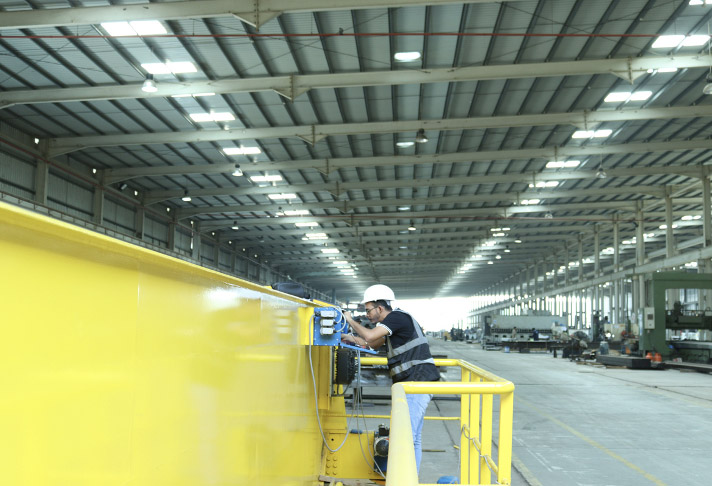
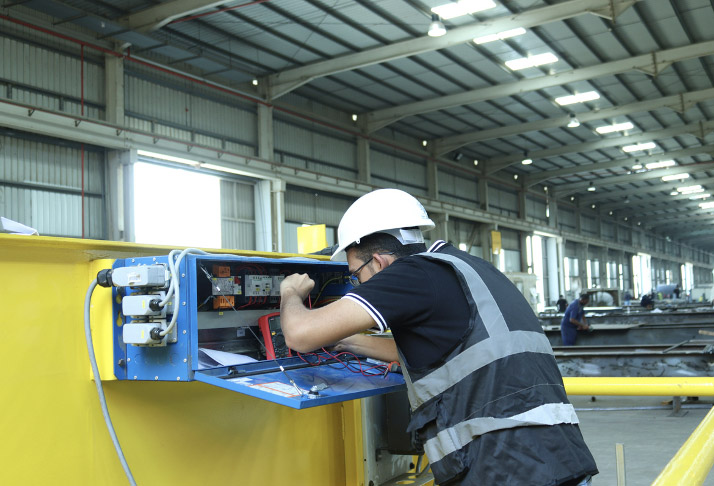
- Control system — anything from a simple pendant control to a wireless remote or, on larger cranes, a full operator cabin.
- Lifting attachments — chains, wire ropes, hooks, and rigging hardware used to secure the load.
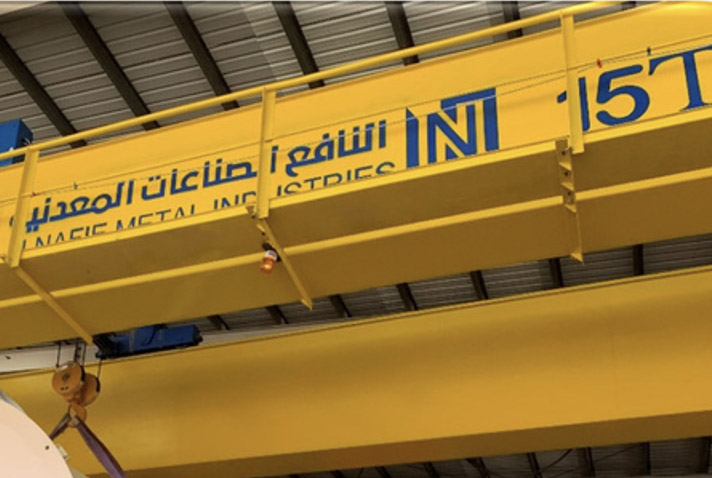
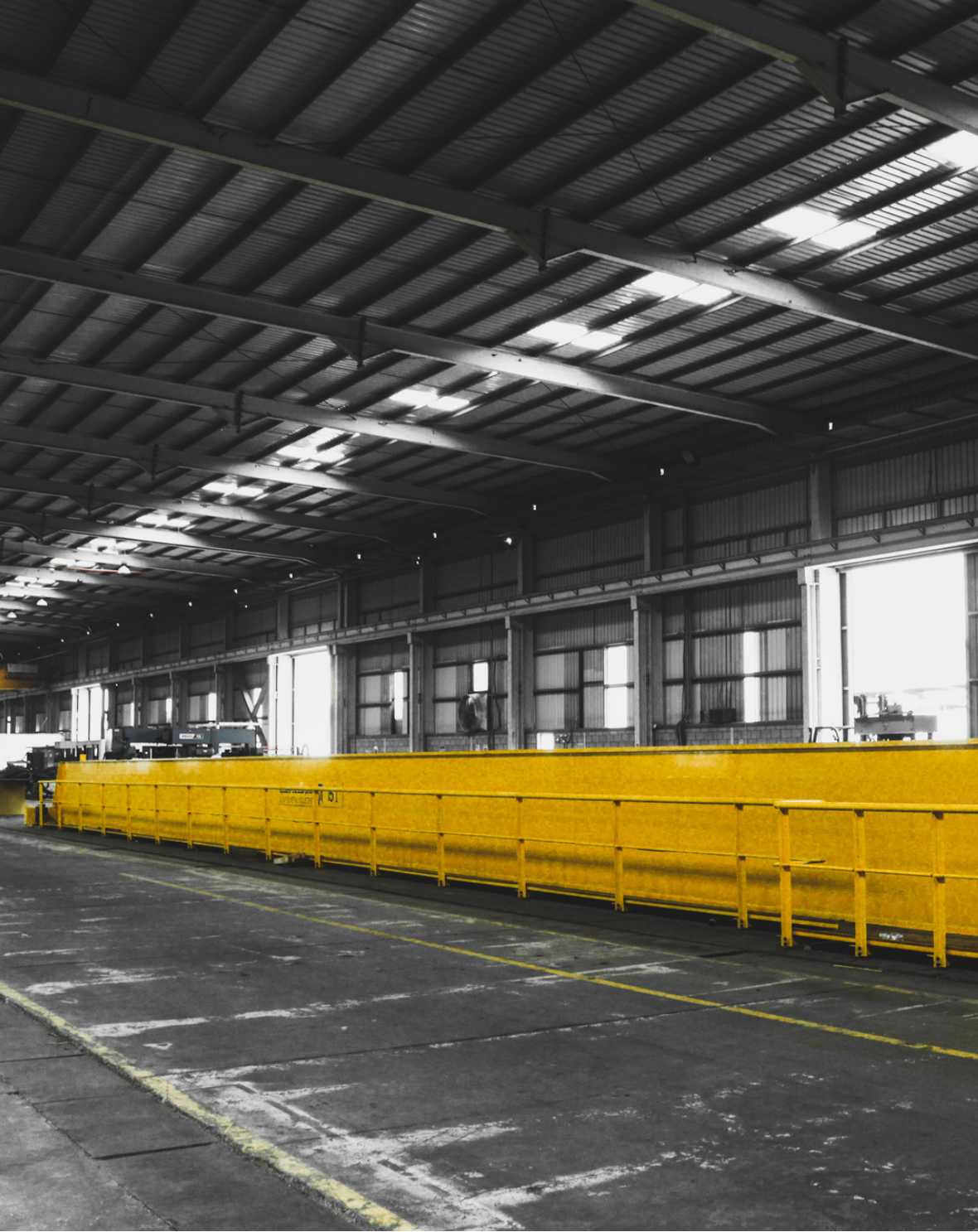
As for what an overhead crane looks like, it varies by type: some run on a single girder, others on two parallel girders (double girder), and some are suspended directly from the building’s roof structure with no independent support columns at all. In general, the shape is a long horizontal span (the girder) running between two end trucks that ride on the rails, with the trolley and hook hanging below or in the middle of that span.
Overhead crane classifications also vary by control system. Some plants stick with simple manual pendant controls, while larger facilities rely on wireless controls or dedicated operator cabins that give a full view of the work area.
Main Types of Overhead Cranes in Saudi Arabia
The Saudi industrial crane market covers several distinct types, and each one is built for a specific need based on the activity, load, and available space. Picking the wrong type doesn’t just mean overspending — it can hurt production efficiency and worker safety over the long term. Here’s a rundown of the main overhead crane types used across Saudi factories and warehouses:
Single Girder Overhead Cranes
This is the most common crane type in Saudi Arabia, largely thanks to its reasonable cost and straightforward installation. The design relies on a single girder — usually an I-beam or a lightweight box section — that carries the trolley and hoist. Alnafie Metal Industries supplies this type with specifications tailored to your specific operation.
- Advantages: Relatively light weight, faster installation, lower upfront cost, and a smaller roof footprint required.
- Applications: Mid-size production lines, maintenance workshops, general warehouses.
- Typical capacity: Usually from 1 up to around 10 tons.
- Best-suited industries: Light manufacturing, packaging, parts assembly, logistics warehouses.
Double Girder Overhead Cranes
This design runs on two parallel girders instead of one, which gives it significantly higher lifting capacity. The trolley rides directly on top of both girders, which allows for a larger, more powerful hoist and reduces mid-span deflection when lifting very heavy loads.
- Difference from single girder: Double girder cranes spread the load across two beams, giving greater stability, higher capacity, and taller lift heights.
- Heavy loads: Capacities can reach dozens of tons — often well over 100 tons in heavy industrial applications.
- Industrial applications: Steel and iron plants, power stations, shipbuilding, large petrochemical facilities. At Alnafie Metal Industries, we handle double girder crane projects for heavy industry with hands-on manufacturing and installation experience.
Suspended Cranes
This type mounts directly to the building’s roof or existing structural frame, with no independent support columns needed. It requires a precise structural assessment to confirm the roof can safely carry both the crane’s own weight and the maximum expected load. The Alnafie Metal Industries team studies the roof structure carefully before installing any suspended crane.
- Installation approach: The girder hangs from the roof trusses or steel frame at engineered attachment points calculated to handle both weight and movement.
- Best-suited environments: Warehouses with limited floor space, small to mid-size workshops, and any facility that wants to make full use of its floor area without columns getting in the way.
Large Cranes
Built to handle the heaviest loads in the toughest industrial environments.
- Heavy industrial plants: Used in manufacturing large equipment and heavy machinery.
- Petrochemical plants: For lifting large tanks and static equipment during installation and maintenance.
- Metal plants: For moving metal blocks and hot steel through smelting and rolling lines.
Medium Cranes
A balanced option between capacity and cost, and one of the most requested types in the Saudi market.
- Warehouses: For loading, unloading, and organizing inventory.
- Production lines: For moving semi-finished products between workstations.
Small Cranes
Sized for smaller facilities with more limited lifting needs.
- Workshops and small factories: Lifting light parts and equipment, vehicle maintenance, carpentry and metalworking shops.
How Do I Know Which Crane Type Fits My Project?
Choosing the right overhead crane comes down to several engineering and operational factors that deserve careful thought before you buy or install anything. A lot of factories end up buying a crane that’s either under- or over-specified for what they actually need — and either way, the result is either poor performance or wasted investment. Our engineers at Alnafie Metal Industries can walk you through these factors before you make a decision. Here’s what matters most:
- Load weight: The maximum weight you’ll be lifting on a regular basis — it determines hoist size, girder design, and even the thickness of the runway and support structure.
- Lift height: The distance between the lifting point and the highest point the load needs to reach, which directly affects the length of rope or chain required.
- Plant footprint: The length and width of the building determine runway length and how many cranes you’ll need to cover the space.
- Operating hours: Heavy, near-continuous use calls for a stronger design and motors rated for a higher duty cycle under recognized international service-class standards.
- Budget: Balancing upfront cost against long-term operating and maintenance costs — the cheapest option isn’t always the most economical one over time.
| Crane Type | Approximate Capacity | Best For | Relative Cost |
|---|---|---|---|
| Single Girder | 1 – 10 tons | Light industry and warehouses | Low to medium |
| Double Girder | 10 – 100+ tons | Heavy industry, steel and iron | High |
| Suspended | 0.5 – 5 tons | Limited-space facilities and workshops | Low |
| Medium | 5 – 20 tons | Warehouses and production lines | Medium |
What’s the Strongest Type of Crane?
When you compare the main crane types by raw capacity, double girder cranes come out on top by a clear margin:
- Single Girder: Relatively limited capacity, well-suited to light and medium-duty applications, lower cost.
- Double Girder: The highest capacity, better stability, and taller lift heights — though installation and cost are more involved.
- Suspended Cranes: Light-to-medium capacity, but the most economical choice for spaces that can’t support ground-mounted columns.
In short, if your top priority is maximum load capacity, double girder cranes are the strongest industrial option, while if cost and flexibility matter more, single girder or suspended designs are usually the better fit. From our experience at Alnafie Metal Industries, real crane strength isn’t just about the weight it can lift — it’s also about stability during movement, precision of load control, and how well it holds up under continuous long-hour operation, which is exactly where double girder cranes shine in heavy industrial settings.
What’s the Tallest Crane in the World?
Some of the best-known examples of giant cranes worldwide are fixed tower cranes used on skyscraper construction projects, which can reach heights of over 100 meters, along with massive floating cranes used in shipbuilding and offshore oil platform installation, with lifting capacities that run into the thousands of tons.
These giant cranes are a completely different category from the industrial crane used inside Saudi factories, in terms of both scale and purpose. They’re built for one-off construction or offshore projects, while an overhead crane is engineered for continuous, high-precision indoor work inside a plant or warehouse, day in and day out. The real difference comes down to purpose: giant cranes are built once for a specific project, while an industrial lifting system is designed for repeated daily use, thousands of cycles over many years — which calls for a completely different design standard around component durability, positioning accuracy, and ease of routine maintenance.
Overhead Crane Applications in Saudi Arabia
Overhead cranes show up across a wide range of industrial sectors in the Kingdom, driven by the diversity of industrial activity and the ongoing expansion of industrial cities. Each sector has its own requirements around crane type, capacity, and safety standards, but the common goal is always the same: move material faster and reduce operational risk. Alnafie Metal Industries serves this full range of industrial sectors across Saudi Arabia:
- Factories: On production and assembly lines, moving raw materials and finished products within metal fabrication plants.
- Warehouses: For loading, unloading, and organizing goods efficiently.
- Oil and gas: For routine maintenance of heavy equipment, pumps, and valves, alongside piping works tied to processing facilities.
- Iron and steel: Moving hot steel blocks and metal ingots between processing stations, starting from the iron cutting stage through to final forming.
- Ports: In loading, unloading, and container-handling operations, an area where Alnafie Metal Industries has supported several facility upgrades.
- Food industries: Moving raw materials and products under high safety standards.
- Logistics: At large distribution centers to speed up sorting and loading operations.
This range of applications reflects how flexible an overhead crane is as an industrial solution — it can be designed and configured to fit almost any working environment, from a small workshop all the way up to a round-the-clock petrochemical plant. We recently took part in the Saudi Warehousing & Logistics Expo to showcase our latest lifting and industrial storage solutions.
Advantages of Installing an Overhead Crane
Investing in an overhead crane gives an industrial facility several direct operational benefits:
- Higher productivity: Faster material movement between workstations cuts downtime and speeds up the production cycle.
- Improved safety: Less manual handling of heavy loads means noticeably fewer workplace injuries.
- Lower labor needs: Less reliance on large crews to move heavy materials by hand.
- Faster operations: Lifting and moving tasks get done with more precision and speed than traditional methods allow.
Beyond these direct benefits, an overhead crane helps keep the plant floor better organized, reduces damage from mishandled materials, and gives plant management more flexibility to reconfigure production lines when needed. This is exactly the kind of measurable improvement Alnafie Metal Industries customers consistently report after crane installation. Take a look at some of our overhead crane installation projects to see these benefits applied in practice.
Overhead Crane Maintenance
Routine maintenance is essential to keeping an overhead crane running safely and to getting the full service life out of it. Skipping maintenance doesn’t just risk sudden production stoppages — it puts workers near the crane at direct risk, which is why every crane should run on a clear, documented preventive maintenance schedule based on the manufacturer’s recommendations. Alnafie Metal Industries offers routine maintenance programs to keep your crane running reliably.
Routine maintenance covers inspecting wire ropes and cables, checking the hoist and gearbox, inspecting runway wheels, and regularly lubricating moving parts on a schedule set by the manufacturer.
Safety procedures include periodic load testing, checking braking and emergency-stop systems, and confirming the crane meets recognized safety standards in the Kingdom. It’s also important that the crane and its components carry certified quality and safety credentials to guarantee safe, stable operation over the long term.
Common failures are usually tied to wire rope wear, hoist motor issues, worn runway wheels, or faults in the electrical control system.
Service life depends heavily on build quality, usage intensity, and how consistently the crane is maintained — and can stretch across decades when maintained properly and on schedule.
Overhead Crane Prices in Saudi Arabia
Overhead crane pricing varies significantly from one project to the next based on several technical factors, and there’s no fixed price you can quote without a detailed project assessment. The main factors that shape the price include:
- Load capacity: The higher the required capacity, the higher the cost of the hoist, girder, and structural components.
- Crane type: Double girder cranes cost more than single girder or suspended designs due to design complexity.
- Runway length: A longer runway means more structural materials and equipment.
- Installation requirements: Building layout, roof height, and any structural reinforcement work all affect the total cost.
To get an accurate price for your project, it’s best to speak with a specialized team for a technical assessment and a quote based on your actual needs. Get in touch with Alnafie Metal Industries for an accurate quote, and check out our full range of industrial services to see the scope of work we cover, from fabrication through to installation. When comparing quotes, compare on full technical specifications, not just the bottom-line price — a small difference in component quality or control system can show up later in maintenance and operating costs.
Frequently Asked Questions
What’s the difference between an overhead crane and a bridge crane?
In practice they’re the same thing — “bridge crane” is simply another term sometimes used for an overhead crane, and both refer to a lifting system that travels along an elevated track inside the facility.
How do I choose the right crane?
Selection comes down to load weight, required lift height, facility footprint, daily operating hours, and available budget.
How much weight can an overhead crane handle?
Capacity varies by type, ranging from under a ton for small cranes up to dozens or even hundreds of tons for double girder cranes used in heavy industry.
Are suspended cranes suitable for warehouses?
Yes — suspended cranes are an excellent choice for warehouses with limited floor space since they don’t require ground-mounted support columns and make full use of the available floor area.
How much maintenance does a crane need?
Monthly inspection of core components is recommended, along with a comprehensive annual check covering cables, the hoist, and the braking and control systems.
What’s the strongest type of crane?
Double girder cranes have the highest load capacity and are used in heavy industries such as steel, iron, and petrochemicals.
What are the main types of overhead cranes?
The main types are single girder, double girder, and suspended cranes, along with size-based classifications like large, medium, and small.
What’s another name for an overhead crane?
In industry terminology it’s also called a bridge crane, and both terms describe the same category of lifting system.
How can I identify a crane type by its appearance?
You can tell by the number of girders (one or two), the mounting method — on independent columns versus suspended from the roof — and the size of the hoist visible on the trolley.
Does installing an overhead crane in Saudi Arabia require a permit?
Installation generally needs to meet approved safety requirements and specifications, so it’s best to work with a specialized company that can guarantee the installation meets the required standards.
Are overhead cranes suitable for small factories?
Yes — small and medium-sized cranes are specifically designed to fit the space, load, and budget needs of workshops and small factories.
What determines a crane’s service life?
Service life depends on build quality, daily operating hours, and how consistently the routine maintenance program is followed.
Get a Free Consultation to Choose the Right Overhead Crane for Your Project
Whether you need an overhead crane for a new factory or you’re looking to upgrade the lifting system in your existing warehouse, the Alnafie Metal Industries engineering team is ready to assess your actual needs and recommend the right solution in terms of capacity, type, and cost. Contact us today for a free technical consultation and a custom quote for your project in Saudi Arabia.
recent projects
Crafting the high quality products you can trust, Serving you better since 1979!
