Galvanized steel does not resist corrosion because it covers the steel. It resists because the zinc corrodes in its place.
That single fact explains why it lasts for decades where paint fails within years.
And the difference always shows up late. Corrosion does not begin suddenly; it starts at a single point of moisture on an unprotected surface, then spreads silently beneath the paint film until it surfaces years later as distortion or partial failure.
In an environment that combines high heat, coastal humidity and airborne dust, that sequence is the norm rather than the exception.
Corrosion protection for steel is therefore no longer an optional line item in a specification. It is a condition of the asset surviving its design life.
This guide explains what galvanizing is, the coating types available, where each is used, and what genuinely drives cost — drawing on the surface treatment experience Alnafie Metal Industries has built since 1979.
What Is Galvanized Steel?
Galvanized steel is steel that has been coated with zinc to protect it from corrosion.
That coating does not behave like paint sitting on top of a surface. The zinc reacts chemically with the steel and forms bonded alloy layers, so the protection becomes part of the metal rather than a film over it.
Terms Worth Distinguishing
Galvanizing — applying zinc to steel by any method.
Hot dip galvanizing — immersing the part in a bath of molten zinc. The thickest and most durable route.
Electro-galvanizing — depositing zinc electrically. A very thin layer, intended for indoor use.
Cold galvanizing — zinc-rich paint. Not true galvanizing, but a useful localised repair.
Thermal spray (metallizing) — spraying molten zinc through a gun. For oversized parts that cannot enter a bath.
Confusing these terms at the enquiry stage is the most common source of misunderstanding between supplier and client.
How the Protection Actually Works
Zinc protects steel in two ways at once.
First, as a physical barrier. The layer keeps moisture and oxygen away from the steel beneath.
Second, as cathodic protection. Zinc is chemically more active than iron, so it corrodes preferentially in place of the steel.
The second mechanism matters most in practice. If a scratch reaches bare metal, the surrounding zinc continues to protect the exposed area instead of allowing rust to start there.
That is the essence of long-term corrosion protection for steel, and the real difference between galvanizing and conventional paint.
Types of Zinc Coating
Hot Dip Galvanizing
The part is chemically cleaned, then immersed in molten zinc at roughly 450 °C.
Typical coating thickness: 45 to 100 microns, depending on the steel section thickness.
Specifications: ASTM A123 for structural products · ASTM A153 for fasteners and fittings · ISO 1461 internationally.
Best suited to: steel structures, columns, and anything with permanent outdoor exposure.
This is the route the overwhelming majority of engineering specifications actually mean.
Continuous Coil Galvanizing
Sheet passes through a zinc bath on a continuous production line, then is recoiled.
Specification: ASTM A653, with coating weight designated by the letter Z.
Z100 means 100 grams of zinc per square metre across both faces.
Z275 means 275 grams — the appropriate choice for coastal conditions.
Best suited to: plate and sheet works, roofing and ducting.
Electro-Galvanizing
A thin layer, usually between 5 and 25 microns.
The finish is brighter and smoother, but the outdoor service life is far shorter.
Best suited to: indoor components, electrical panels and metal furniture.
Which One Should You Specify?
Hot dip galvanizing is not the only answer, but it is the safest one whenever outdoor exposure is permanent.
The rule is simple: the greater the exposure, the greater the zinc coating thickness required.
Galvanized Steel Uses
Galvanized steel uses vary widely, but they share one common factor — exposure to moisture or open air.
Structural fabrication — columns, beams, external frames, stairs and walkways.
Perimeter protection — security fencing, gates and road barriers.
Water systems — storage tanks, piping works and drainage lines.
Power and utilities — transmission towers, solar mounting frames and cable trays.
Industrial facilities — static equipment, pump bases and platforms.
Roofing and cladding — corrugated sheet for hangars and warehouses.
Distance From the Coast Changes Everything
Salt-laden air along the Red Sea consumes zinc several times faster than dry inland conditions.
This is why the requirements for galvanizing services in Jeddah and other coastal cities differ fundamentally from those inland.
Coastal projects need a heavier coating, and often a dual system: galvanizing underneath with paint over the top. That combination is known as a duplex system, and its service life exceeds the sum of the two layers taken separately.
Inland projects face a different challenge altogether — dust and wide day-to-night temperature swings, which cause mechanical fatigue more than chemical attack.
That climatic contrast is what makes galvanizing in Saudi Arabia a location-specific decision rather than a single blanket specification.
Benefits of Galvanizing
The benefits of galvanizing extend well beyond simply preventing rust, into economic and operational territory.
Decades of Service Without Maintenance
This is the leading advantage by a wide margin.
A properly treated component performs for decades untouched, while conventionally painted surfaces require periodic repainting.
The honest calculation: compare cost over twenty years, not on the day of purchase. Every repaint cycle carries materials, labour and downtime.
Complete Coverage of Hidden Surfaces
Full immersion reaches internal corners, cavities and faces that a paint brush never touches.
Those are precisely the locations where painted systems fail first.
Mechanical Durability
The alloyed zinc layer is harder at the surface than the steel underneath.
That translates into better resistance to scratching and abrasion during transport and erection.
Fast, Simple Verification
Coating quality is measured with a thickness gauge in seconds.
There is no need for complex testing or waiting days for successive layers to cure.
Recyclability
Zinc and steel are both fully recyclable without loss of properties.
That has become a stated requirement in a growing number of modern tender documents.
Where Galvanizing Is Not the Right Answer
Technical honesty requires stating the limits as well.
Components requiring very tight dimensional tolerances may be affected by the coating thickness.
Long, slender members can distort thermally inside the bath.
Parts larger than the bath require double dipping or an alternative such as thermal spray.
Galvanized vs Stainless Steel: Which Should You Specify?
The galvanized vs stainless steel question comes up constantly, and the answer is rarely close once the numbers are on the table.
Galvanized steel is carbon steel with a sacrificial zinc layer. It costs a fraction of stainless and performs excellently in atmospheric exposure.
Stainless steel resists corrosion inherently through its chromium content, with no coating to consume. It handles chemical attack, immersion and food-contact environments that zinc cannot.
The practical division: for structural work, fencing, towers and cladding, galvanized steel delivers the better cost-to-performance ratio by a wide margin. For chemical processing, submerged service, or food and pharmaceutical applications, stainless is the correct specification and the price difference is justified.
Choosing stainless where galvanizing would suffice is one of the more expensive specification errors in industrial procurement.
Cost and Quality
What Actually Determines Galvanized steel Cost?
Galvanizing cost is usually quoted per kilogram or per tonne, but the final figure is governed by other variables.
Surface-area-to-weight ratio. A thin, wide component consumes more zinc per kilogram than a thick, solid one.
Steel chemistry. Silicon content matters most — steel with silicon between 0.04% and 0.14% produces a thick, dull and more brittle coating. This is the well-documented Sandelin effect, and it explains why two batches of identical sections can finish differently.
Part size versus bath size. Anything requiring a double dip costs more and takes longer.
Order quantity. Larger batches spread the bath operating cost more efficiently.
Preparation required. Heavy rust, paint residue or oil demands additional treatment through blasting before immersion.
Transport. Freight frequently absorbs any saving on the rate per kilogram, particularly on large assemblies.
For these reasons, no serious quotation can be issued before seeing drawings and weights.
How to Judge Quality on Delivery
The quality of galvanized steel is not assessed by eye. It comes down to four specific checks.
Request the coating thickness report. In microns, taken at several points rather than one.
Inspect for uniformity. Significant variation in colour or texture across a component indicates uneven surface preparation.
Verify vent and drain holes. Hollow sections need them, and their absence is a genuine safety hazard in the bath.
Ask for the certificate of conformity. The referenced standard must be documented, not verbal — which is what our accredited quality certifications cover.
A Common and Costly Sequencing Error
Cutting, drilling or welding after treatment strips the coating exactly where the work was done.
The correct order is to complete all iron cutting, metal bending and metal rolling first, then send the finished component for treatment.
Where that is unavoidable, the minimum remedy is local touch-up with a zinc-rich paint.
Surface Treatment at Alnafie Metal Industries
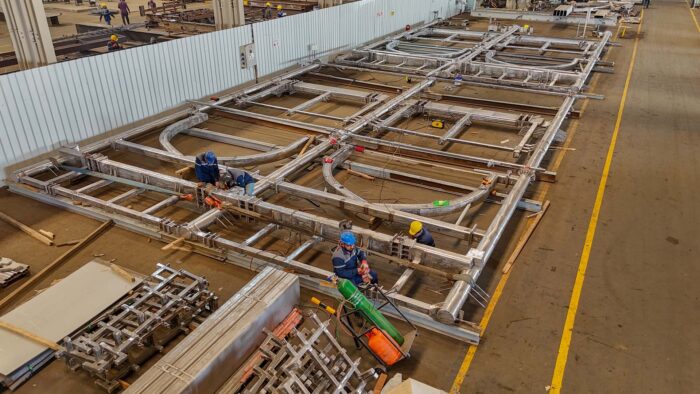
We cover the full cycle inside our own steel fabrication facility.
Fabrication — cutting, forming and welding to your drawings.
Surface preparation — sandblasting to remove rust and mill scale.
Treatment and finishing — metal finishing with the protection system matched to each environment.
Supply — delivery service to every region of the Kingdom.
Delivered examples are available on our projects page, and the full range on our products and services pages.
Frequently Asked Questions
What is the difference between galvanizing and painting?
Paint is a barrier only; once it is scratched, corrosion begins underneath and spreads. Zinc provides both a barrier and cathodic protection, meaning it corrodes in place of the steel and continues protecting exposed areas at scratches. Immersion also reaches internal corners and cavities that a paint brush cannot access at all.
How long does galvanized steel last?
It depends on coating thickness and the severity of the environment. In dry inland conditions, service life can extend for decades with no maintenance. In salt-laden coastal air, zinc is consumed several times faster. As a working rule, any increase in zinc coating thickness translates almost proportionally into additional service life.
Can galvanized surfaces be painted?
Yes, and the result is called a duplex system, which lasts longer than the two layers would separately. The surface needs specific preparation first, because zinc is smooth and non-porous. A tie coat formulated for galvanized substrates is normally required; without it, the paint will delaminate within a short period.
Why does galvanizing cost differ between two parts of equal weight?
Because pricing follows surface-area-to-weight ratio, not weight alone. A thin, wide component consumes far more zinc than a thick, solid one at the same weight. Steel silicon content, part size relative to the bath, and the amount of surface preparation needed before immersion all affect the final figure as well.
Does galvanized steel rust?
The zinc layer oxidises very slowly into a dull grey patina, which is a normal sign the protection is working rather than failing. Red-brown rust only appears once the zinc in that area has been fully consumed. Early rusting usually indicates a fault in surface preparation or a coating thinner than the specification required.
What is the difference between hot dip and electro-galvanizing?
Hot dip galvanizing produces a thick layer, typically 45 to 100 microns, metallurgically bonded to the steel, and is the accepted route for outdoor service. Electro-galvanizing produces a thin layer of 5 to 25 microns with a smoother, brighter appearance, but it is intended for indoor components only and will not survive prolonged outdoor exposure.
Can components be welded after treatment?
They can, but it is not advisable. Welding heat vaporises the zinc around the joint and leaves bare steel exposed, and it generates fumes requiring proper ventilation. The correct sequence is always to finish all welding, cutting and drilling first, then send the completed component for surface treatment.
Do requirements for galvanized steel in Saudi Arabia differ from elsewhere?
Yes, and the reason is climatic. The Kingdom combines two contrasting environments: a humid, saline coastline along the Red Sea and the Gulf, and a dry, intensely hot and dust-laden interior. Specifications for galvanizing services in Jeddah and other coastal cities therefore differ from inland requirements, and coating thickness should follow project location rather than a single generic clause.
Which standard should appear in the tender document?
For structural products, cite ASTM A123 or ISO 1461. For fasteners and fittings, ASTM A153. For rolled sheet, ASTM A653 with the coating weight stated, such as Z275. Writing only the word “galvanized” without a standard and a thickness figure leaves the specification open to interpretation and to disputes at handover.
Need Technical Advice or a Quotation?
Choosing the right protection system at the outset saves many times its cost across the life of the project.
Alnafie Metal Industries engineering team is ready to review your drawings, recommend the system suited to your site environment, and carry out both fabrication and treatment in house.
Get in touch through our contact page, or call 920006420 directly
about
Alnafie Metal Industries
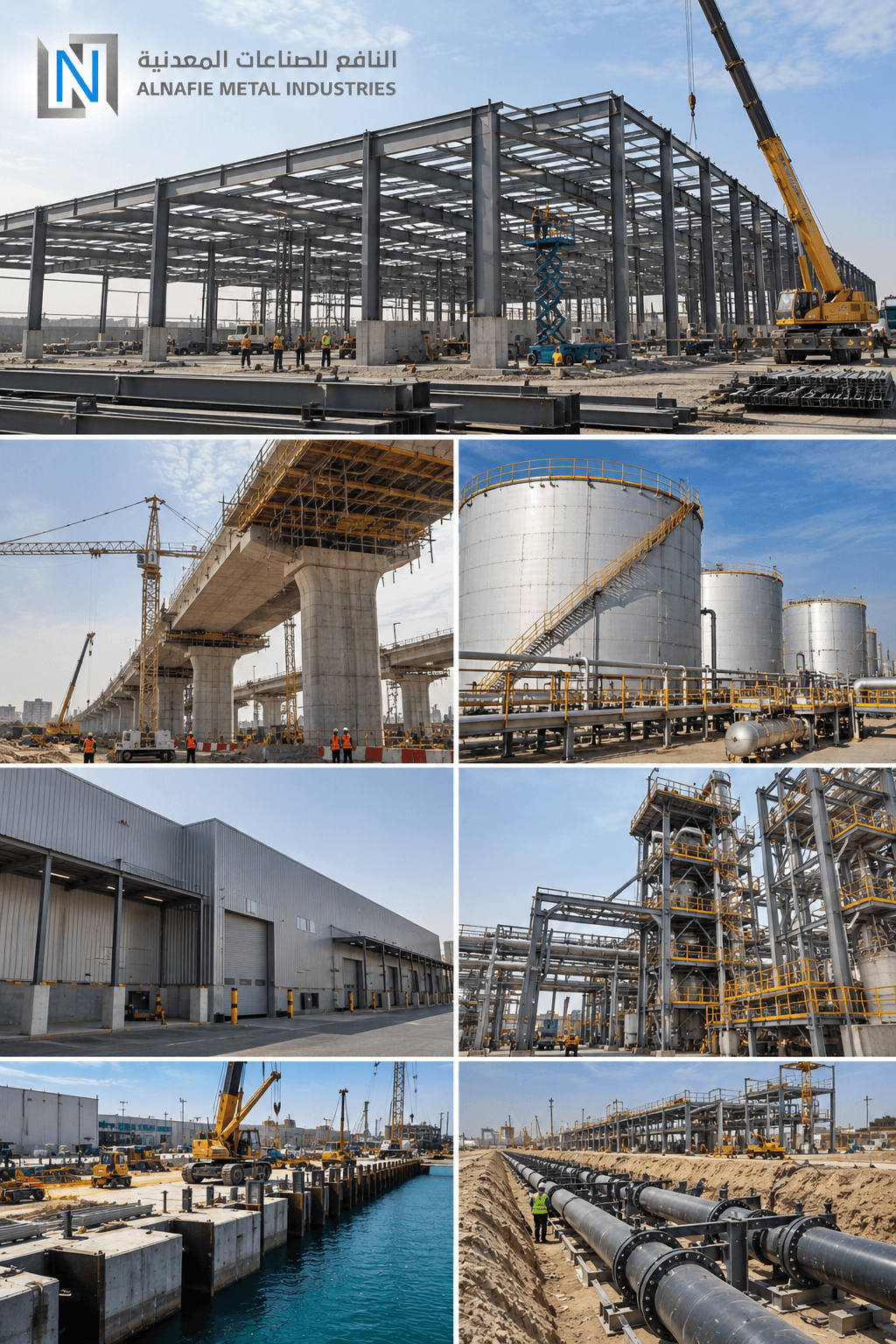
AlNafie Metal Industries is a leading private company with 33 years of experience in Saudi Arabia’s development. Specializing in steel construction and tank rehabilitation, NMI provides full steel fabrication and erection services for major EPC projects, including power, gas, petrochemical, industrial, and commercial sectors.