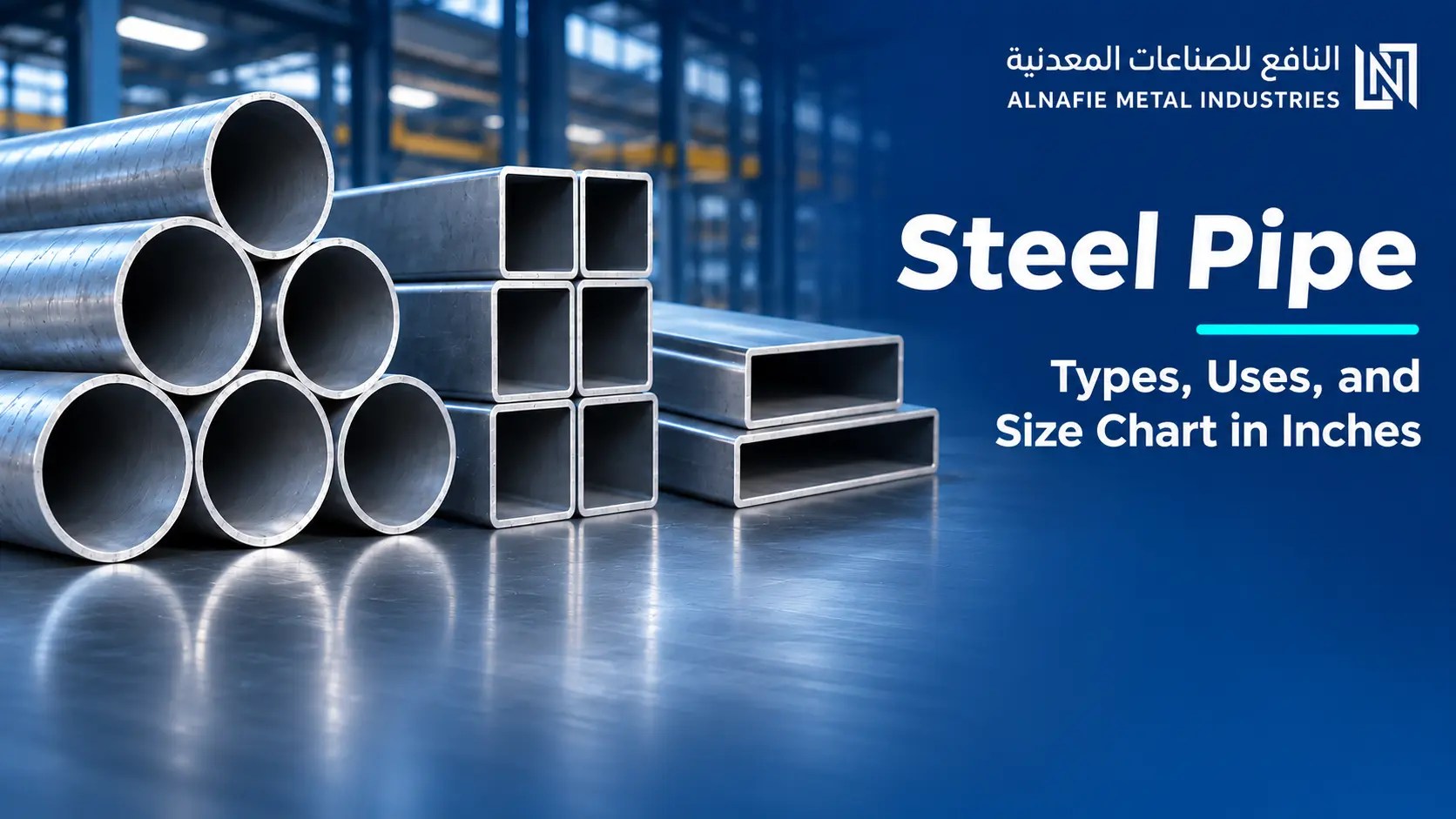
Steel pipe carries water to Saudi cities, protects buildings through fire sprinkler networks, moves hydrocarbons through Jubail and Yanbu, and frames canopies, fences and light structures across the Kingdom. It looks simple, but ordering the wrong type, size or schedule can mean leaks, early corrosion or a failed inspection.
This guide covers the main types of steel pipe, how pipe sizes and schedules really work, how to calculate weight per metre, which standards to specify, GI pipe vs MS pipe, seamless vs welded pipe, and the factors that drive price in Saudi Arabia.
What Is Steel Pipe?
A steel pipe is a hollow tubular product, usually made from carbon steel, used to convey liquids and gases or to protect cables. Pipes can also be made from alloy steel or stainless steel for higher temperatures or corrosive service.
What are steel pipes called? Depending on the context you will hear pipe, tube, tubing, line pipe, hollow section, MS pipe (mild steel), GI pipe (galvanized iron), black pipe, ERW pipe or seamless pipe. They are not all the same thing, as the sections below explain.
Pipe vs Tube
The terms are often mixed up, but there is a practical difference:
- Pipe is specified by nominal pipe size (NPS) and schedule, and its main job is carrying fluids under pressure. The outside diameter is fixed for each nominal size.
- Tube and hollow sections are specified by actual outside diameter (or side dimensions) and wall thickness, and are mainly used for structural or mechanical purposes.
Getting this right matters, because structural hollow sections are not pressure tested the way pressure piping is.
Types of Steel Pipe by Manufacturing Method
What are the types of steel pipe? The most important classification is how the pipe is made.
ERW (Electric Resistance Welded) Pipe
Steel strip is formed into a cylinder and the edges are welded by electric resistance, without filler metal. The weld bead is then trimmed. ERW pipe offers accurate wall thickness at a good price and is the workhorse for water, fire fighting, structural and moderate pressure service.
SAW (Submerged Arc Welded) Pipe
Used for large diameters, with either a longitudinal seam (LSAW) or a spiral seam (HSAW). Common in large water transmission lines, oil and gas pipelines and heavy piling.
Seamless Pipe
A solid steel billet is heated, pierced and drawn into a tube, so there is no weld seam at all. This gives better performance at high pressure and temperature, which is why seamless pipe is specified for steam lines, boilers, refineries and high pressure hydrocarbons.
Seamless vs Welded Pipe: Which Is Better?
| Factor | Welded (ERW / SAW) | Seamless |
|---|---|---|
| Manufacturing | Formed strip, welded seam | Pierced and drawn billet |
| Pressure and temperature rating | Good to moderate | High |
| Wall thickness accuracy | High | Slightly less uniform |
| Cost | Lower | Higher |
| Size range | Small to very large | Small to medium, typically |
| Typical uses | Water, fire, structural, moderate pressure | Steam, refining, high pressure |
Which is better, seamless or welded pipe? Neither is better in general. Welded pipe is the economical choice for most applications, while seamless is better where pressure, temperature or the specification demands it.
Is seamless or welded pipe cheaper? Welded pipe is usually cheaper, especially in larger diameters.
What does welded pipe mean? It simply means the pipe was made by forming plate or strip and joining it with a weld seam, as opposed to seamless pipe made without any seam.
Types by Material
Carbon Steel Pipe
The most common type, available black or galvanized. Strong, easy to weld, cut and thread, and suitable for most water, fire, gas and structural uses. Carbon steel pipe in Saudi Arabia is supplied to standards such as ASTM A53 and API 5L.
Alloy Steel Pipe
Contains chromium and molybdenum for high temperature strength, used in power plants and refineries.
Stainless Steel Pipe
Used for food, beverage, pharmaceutical, pure water and chemical lines, and in coastal environments. Grade 304 is common for general service and 316L for chemical and marine lines.
Ductile Iron Pipe
Not steel, but often compared. Used for large water and sewage networks thanks to its toughness and good corrosion behaviour with suitable linings.
Types by Surface Protection
Black Steel Pipe
Uncoated carbon steel with a dark mill finish or light varnish. Common for fire protection, gas lines and structural work that will be painted later. It rusts if left unprotected in humid air.
Galvanized Steel Pipe (GI Pipe)
Carbon steel coated with zinc, either hot dip galvanized after manufacture (inside and out) or made from pre-galvanized strip. Galvanizing gives much longer life in outdoor and humid conditions, so GI pipe is used for fences, canopies, external water lines and outdoor frames. Our guide to galvanized steel types, uses and cost explains coating options in detail.
Coated and Lined Pipe
External polyethylene or epoxy coatings protect buried pipe, while internal cement mortar or epoxy linings protect water lines. These are standard on large infrastructure projects.
GI Pipe vs MS Pipe
MS pipe means mild steel pipe, usually supplied black. GI pipe is mild steel pipe with a zinc coating.
| Factor | MS pipe (black) | GI pipe (galvanized) |
|---|---|---|
| Coating | None or varnish | Zinc |
| Corrosion resistance | Low without paint | High |
| Weldability | Easy | Needs zinc removal and ventilation |
| Cost | Lower | Higher |
| Best for | Painted structures, fire lines, gas | Outdoor frames, fences, water lines |
Which is more expensive, GI or MS? GI pipe costs more because of the galvanizing process.
Which is better, MS or galvanized steel? Galvanized is better for outdoor and humid exposure. MS is better and cheaper for indoor work, painted structures and lines that will be welded extensively.
How to identify MS and GI pipe? GI pipe has a dull silver-grey or spangled zinc surface, while MS pipe is dark grey or black. A coating thickness gauge confirms the zinc layer.
Which is costly, GI or SS? Stainless steel (SS) pipe is considerably more expensive than GI pipe.
Steel Pipe Sizes Explained
This is where most confusion starts. Pipe is ordered by nominal size in inches, but the nominal size is not the actual diameter. A 2 inch pipe has an outside diameter of 60.3 mm, not 50.8 mm.
What are the standard sizes of steel pipes? Common sizes run from 1/2 inch up to 12 inches and well beyond for large projects. Each nominal size has a fixed outside diameter, and the wall thickness changes with the schedule.
Steel Pipe Size Chart (NPS, mm and Schedules)
| NPS (inch) | DN (mm) | Outside diameter (mm) | SCH 40 wall (mm) | SCH 80 wall (mm) |
|---|---|---|---|---|
| 1/2 | 15 | 21.3 | 2.77 | 3.73 |
| 3/4 | 20 | 26.7 | 2.87 | 3.91 |
| 1 | 25 | 33.4 | 3.38 | 4.55 |
| 1 1/4 | 32 | 42.2 | 3.56 | 4.85 |
| 1 1/2 | 40 | 48.3 | 3.68 | 5.08 |
| 2 | 50 | 60.3 | 3.91 | 5.54 |
| 2 1/2 | 65 | 73.0 | 5.16 | 7.01 |
| 3 | 80 | 88.9 | 5.49 | 7.62 |
| 4 | 100 | 114.3 | 6.02 | 8.56 |
| 6 | 150 | 168.3 | 7.11 | 10.97 |
| 8 | 200 | 219.1 | 8.18 | 12.70 |
| 10 | 250 | 273.0 | 9.27 | 15.09 |
| 12 | 300 | 323.8 | 10.31 | 17.48 |
These dimensions follow ASME B36.10M, which is widely used in Saudi Arabia. Always confirm against the project specification.
What is a 4 inch pipe size? A 4 inch (DN 100) pipe has an outside diameter of 114.3 mm. In SCH 40 the wall is 6.02 mm, giving an inside diameter of about 102.3 mm.
What size is 32 mm pipe? DN 32 corresponds to 1 1/4 inch nominal, with an outside diameter of 42.2 mm.
What is the OD of a 25 mm steel pipe? DN 25 (1 inch nominal) has an outside diameter of 33.4 mm.
What Do SCH 40 and SCH 80 Mean?
The schedule number indicates wall thickness. A higher schedule means a thicker wall, while the outside diameter stays the same, so the bore gets smaller. SCH 40 is the most common for water, fire protection and general service. SCH 80 is used for higher pressures and harsher industrial duty. Other schedules, both lighter and heavier, exist for specific applications.
Square and Rectangular Hollow Sections
Square hollow sections typically range from 20×20 mm up to 400×400 mm, and rectangular sections from about 40×20 mm up to 400×200 mm, with walls from around 1.2 mm to 16 mm. They are ordered by outside dimensions and thickness, for example 100×100×4 mm.
Standard Lengths
The most common lengths are 6 m and 12 m, with other lengths available from some mills. Pipes can also be cut to length before delivery.
How to Calculate Steel Pipe Weight per Metre
Weight drives price, transport and structural loads. With steel density at about 7.85 g/cm³, these formulas give weight in kg per metre (dimensions in mm):
- Round pipe: (OD − t) × t × 0.02466
- Square hollow section (approx.): 0.0314 × t × (side − t)
- Rectangular hollow section (approx.): 0.0157 × t × (width + height − 2t)
Examples:
- 2 inch SCH 40: (60.3 − 3.91) × 3.91 × 0.02466 ≈ 5.44 kg/m, so a 6 m length weighs about 32.6 kg.
- 4 inch SCH 40: (114.3 − 6.02) × 6.02 × 0.02466 ≈ 16.07 kg/m.
- 100×100×4 square section: 0.0314 × 4 × 96 ≈ 12 kg/m, slightly less in reality because of the rounded corners.
Steel Pipe Standards to Specify
| Standard | Type | Typical use |
|---|---|---|
| ASTM A53 | Welded and seamless, black and galvanized | Water, fire, gas, general |
| ASTM A106 | Seamless | High temperature and pressure |
| API 5L | Welded and seamless line pipe | Oil and gas pipelines |
| ASTM A500 | Structural hollow sections | Structures and frames |
| EN 10255 | Medium and heavy tubes | Water and general services |
| EN 10219 / EN 10210 | Structural hollow sections | European structural specifications |
| ASME B36.10M | Dimensions and schedules | Sizing reference |
Ask for a mill test certificate with each delivery, showing the heat number, chemical analysis and test results, and check that the heat number matches the pipe markings.
What Is Steel Pipe Used For?
Water Supply and Distribution
Galvanized, lined and ductile iron pipe serve main lines and networks. Inside homes, plastic piping has largely taken over, while metal pipe remains standard for main, exposed and high strength applications.
Fire Protection
Black or galvanized pipe, usually SCH 40, with threaded, welded or grooved joints, installed to Civil Defense requirements and the project specification.
Oil, Gas and Petrochemicals
Seamless and alloy pipe for high pressure and temperature service. Our guide to petrochemicals in Saudi Arabia explains the sector’s material demands.
Desalination and Water Treatment
Highly corrosive brine and seawater call for stainless, duplex or carefully lined carbon steel. Read our guide to desalination plants in Saudi Arabia.
Cement and Heavy Industry
Compressed air, cooling water and material handling lines. Our cement plant guide lists the components most scopes miss.
Structures, Canopies and Fencing
Square, rectangular and round sections frame canopies, light hangars, walkways and gates, and complement the larger frames in our steel structures range. Galvanized posts and rails also form the backbone of security fencing systems.
Electrical Conduit
Galvanized metal conduit protects cables in plants and exposed locations.
Steel Pipe vs Plastic Pipe
| Factor | Steel | Plastic |
|---|---|---|
| Strength and impact resistance | Very high | Lower |
| Temperature resistance | High | Limited by type |
| Pressure rating | High, rises with wall thickness | Moderate, by class |
| Corrosion | Needs protection | Does not rust |
| Weight | Heavy | Light |
| Fire resistance | High | Poor |
| Best for | Fire, industrial, exposed, structural | Domestic plumbing and drainage |
Joining Methods
- Threading: common up to about 2 inches. Quick to assemble and dismantle but weaker than welding at high pressure.
- Butt welding: the strongest and tightest joint for medium and large diameters, requiring qualified welders and weld inspection.
- Flanges: bolted joints that make valves and equipment easy to remove for maintenance.
- Grooved couplings: popular in fire protection for fast installation and slight flexibility.
Testing Before Commissioning
- Hydrostatic pressure test: the line is filled with water and pressurised above operating pressure for a set period while checking for drops or leaks.
- Weld inspection: visual first, then radiography or ultrasonic testing on critical lines.
- Coating checks: thickness and holiday testing on coated pipe.
- Flushing: removing debris and weld spatter before start-up.
Corrosion Protection in Gulf Conditions
Humidity and salt in coastal cities speed up corrosion. The main defences are:
- Hot dip galvanizing for outdoor frames, fences and canopies.
- Industrial paint systems after proper surface preparation such as abrasive blasting and metal finishing.
- External coatings and cathodic protection for buried lines.
- Sealed ends on hollow sections to stop internal corrosion.
- Regular weld inspection, since welds are the weakest point in any coating system.
Steel Pipe Price in Saudi Arabia: What Drives It?
Prices move with global steel and zinc markets and freight, so a fixed number dates quickly. The main drivers are:
- Diameter and wall thickness: heavier pipe costs more, and price is usually linked to weight.
- Manufacturing method: seamless costs more than welded.
- Finish: galvanized costs more than black, and coated or lined more than both.
- Material: stainless costs far more than carbon steel.
- Standard and certification: higher specifications with full certificates cost more but reduce risk.
- Quantity: larger orders get better rates per tonne.
- Extra fabrication: cutting, bending, threading, welding and painting are priced separately.
To compare quotes fairly, calculate weight per metre with the formula above and multiply by the supplier’s price per kilo or tonne.
How to Read Pipe Markings
Most pipes made to a recognised standard carry a printed or stencilled marking along their length. Reading it tells you a lot before you even open the certificate. A typical marking includes:
- Manufacturer name or logo.
- Standard and grade, for example a general service standard in Grade B.
- Nominal size and schedule or wall thickness.
- Manufacturing type: welded or seamless.
- Hydrostatic test pressure applied at the mill.
- Heat or lot number, which must match the mill test certificate.
- Sometimes the production date.
If a pipe carries no marking, or the marking does not match the certificate, verify further before accepting it, especially for pressure and fire protection lines.
Common Buying Mistakes
- Confusing nominal and actual diameter: ordering 2 inch and expecting 50 mm OD, then finding fittings do not match.
- Ignoring the schedule: the same size in different schedules differs greatly in weight, price and pressure rating.
- Accepting undersized walls: standards allow tolerances, but some products go well beyond them.
- Using structural sections for pressure: hollow sections are not tested like pressure pipe.
- Installing black pipe outdoors unprotected: rust appears within months on the coast.
6 ways to Choose the Right Pipe
- Define the purpose: fluid transport or structural load?
- Define pressure and temperature: to choose welded or seamless and the schedule.
- Define the environment: indoor or outdoor, coastal or inland, buried or exposed.
- Name the standard and grade in the order.
- Specify size precisely: NPS and schedule for round pipe, or dimensions and thickness for sections.
- Ask for certificates: mill test certificate, heat number and galvanizing certificate where relevant.
Pipe Fabrication at Alnafie Metal Industries
Alnafie Metal Industries handles pipe as part of complete fabrication packages, from supply to installation:
- Iron cutting to size and to length.
- Metal bending and metal rolling for curves and specific radii.
- Metal perforation for parts that need precise openings.
- Full piping works for industrial projects.
- Industrial storage tanks and static equipment with their connecting pipework.
Need pipe fabricated to drawing or advice on type and size? Contact our team for a quote.
Looking for a trusted industrial company in Saudi Arabia? Choose Alnafie Industrial for reliable industrial solutions, exceptional quality, and expertise you can count on.
Planning an Industrial Project? Alnafie Can Fabricate and Erect It
Steel structures, storage tanks, piping and static equipment for power, petrochemical and industrial plants.
Alnafie Metal Industries
Metal fabrication in Jeddah · 500+ employees · 144,000 m² of facilities
ISO 9001 • ISO 14001 • ISO 45001 • ASMEFrequently Asked Questions About Steel Pipe
What is steel pipe used for?
Conveying water, gas, oil and chemicals, fire protection, structural frames, fencing and protecting electrical cables.
What are the types of steel pipe?
By manufacture: ERW, SAW and seamless. By material: carbon, alloy and stainless steel. By finish: black, galvanized and coated. By shape: round, square and rectangular.
What are the standard sizes of steel pipes?
Common nominal sizes run from 1/2 inch to 12 inches and larger, each with a fixed outside diameter, while wall thickness is set by the schedule such as SCH 40 or SCH 80.
What is 4 pipe size?
A 4 inch pipe (DN 100) has an outside diameter of 114.3 mm. In SCH 40 its wall is 6.02 mm.
Which is better, seamless or welded pipe?
Welded pipe suits most applications at lower cost. Seamless is better for high pressure, high temperature or when the specification requires it.
Is seamless or welded pipe cheaper?
Welded pipe is generally cheaper.
Which is more expensive, GI or MS?
GI (galvanized) pipe is more expensive than MS (black mild steel) pipe because of the zinc coating.
How to identify MS and GI pipe?
GI pipe has a silver-grey or spangled zinc surface, while MS pipe is dark grey or black. A coating gauge confirms the zinc thickness.
What do SCH 40 and SCH 80 mean?
They are schedule numbers that define wall thickness. SCH 80 has a thicker wall and higher pressure capacity than SCH 40 for the same outside diameter.
about
Alnafie Metal Industries
AlNafie Metal Industries is a leading private company with 33 years of experience in Saudi Arabia’s development. Specializing in steel construction and tank rehabilitation, NMI provides full steel fabrication and erection services for major EPC projects, including power, gas, petrochemical, industrial, and commercial sectors.