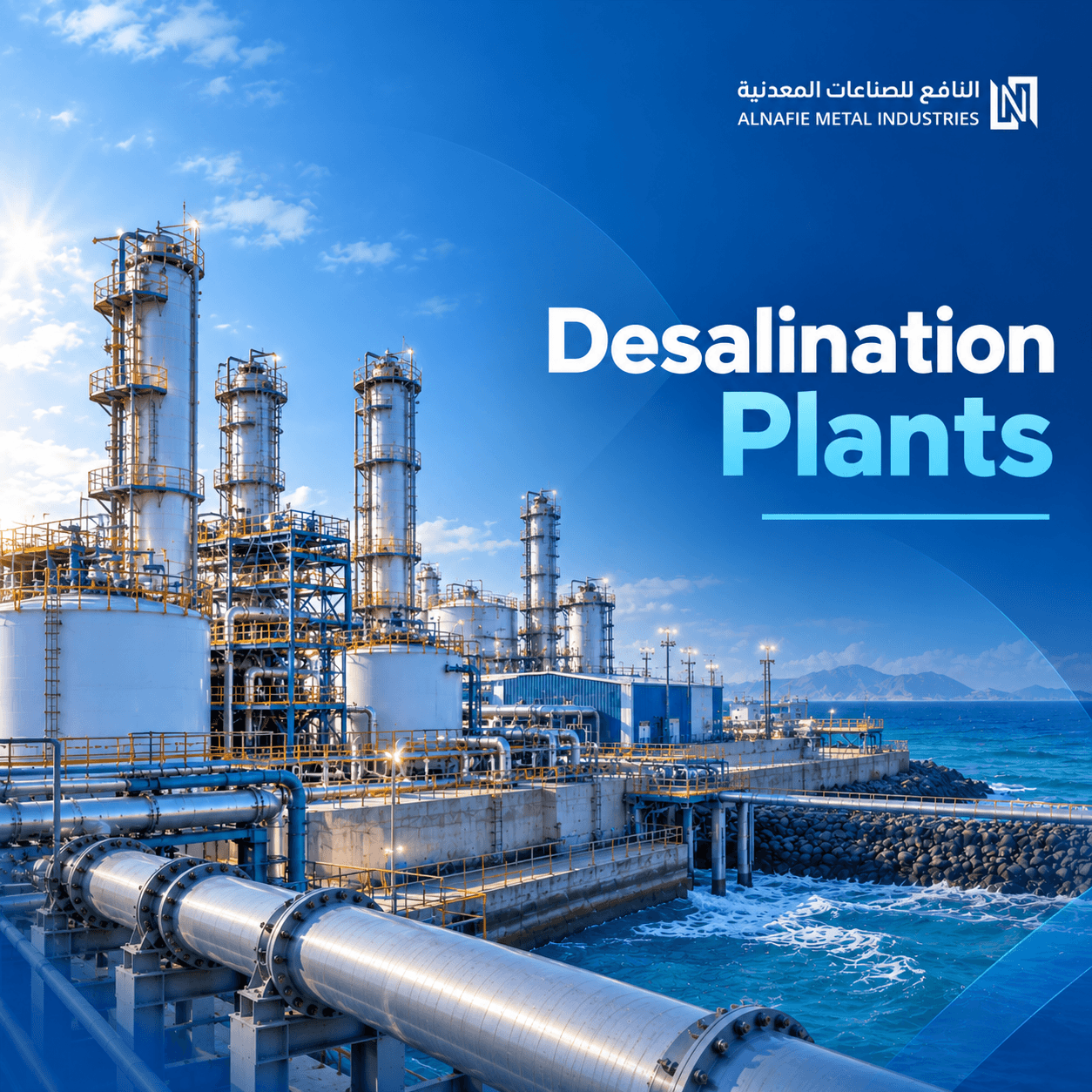
A Desalination Plants are no longer a niche utility asset in Saudi Arabia — it is core national infrastructure. The Kingdom leads the world in desalinated water production, with installed capacity exceeding 16 million cubic metres per day by the end of 2025 and roughly 22% of all seawater desalination output on the planet. As industrial cities expand and giga-projects accelerate under Saudi Vision 2030, building a desalination plant has become a strategic requirement for developers, industrial operators and utility investors alike.
This guide is written for the people who actually commission these projects. It covers what a desalination plant is, the main desalination technologies, how the process works stage by stage, and the real factors that drive capacity and cost. It closes with how Al Nafie Metal Industries fabricates, supplies and installs the metal scope of these projects inside the Kingdom.
What Is a Desalination Plant?
A desalination plant is an integrated industrial facility that separates dissolved salts, minerals and impurities from saline water — seawater or brackish groundwater — and converts it into water fit for drinking, industrial process use or agriculture, to a defined specification.
The underlying principle is simple: separate pure water molecules from dissolved salts, either through thermal energy (evaporation and condensation) or through pressure driven across a semi-permeable membrane. What separates a plant that runs reliably for decades from one that bleeds money on maintenance is rarely the technology licence. It is the quality of the metal fabrication behind it — the pressure vessels, tanks, piping networks and support structures that operate in a highly corrosive marine environment around the clock.
Core Components of a Desalination Plant
| Component | Function | Fabrication Requirement |
|---|---|---|
| Intake system | Draws seawater or brackish water | Corrosion-resistant piping |
| Pre-treatment units | Removes suspended solids and biofouling | Tanks, filters, vessels |
| Desalination core | Separates dissolved salts | Pressure vessels, heat exchangers |
| Post-treatment | Remineralisation and disinfection | Mixing and dosing tanks |
| Storage and pumping | Holds and distributes product water | Large-diameter tanks, piping |
| Control systems | Operates and monitors the plant | Electrical panels, control rooms |
Practical note: more than 60% of the construction value of a typical plant sits in metal works — fabrication, supply and erection. That is precisely Al Nafie’s scope.
Saudi Arabia’s Position in Global Desalination
Saudi Arabia ranks first in the world for desalinated water production. The Kingdom’s desalination story began in 1928, when seawater was first condensed to supply drinking water to Jeddah. Today, installed capacity exceeds 16 million cubic metres per day, serving more than 27 million beneficiaries through transmission networks stretching over 3.7 million linear metres.
Saudi Arabia accounts for roughly 22% of global desalinated seawater output — a figure that reflects sustained capital investment and explains why desalination remains one of the most active industrial procurement markets in the region.
Ras Al Khair — The World’s Largest Desalination Plant
The Ras Al Khair power and water facility in Saudi Arabia is the largest desalination plant in the world. Located in Ras Al Khair Industrial City on the Arabian Gulf coast, it produces approximately 1.025 million cubic metres of desalinated water per day alongside around 2,400 MW of electrical generation capacity, at an investment exceeding SAR 23 billion.
What makes Ras Al Khair technically notable is its hybrid configuration, combining multi-stage flash (MSF) and reverse osmosis (RO) within a single facility. That architecture demands an enormous volume of high-specification steel structures and static equipment.
Three Major Seawater Desalination Plants in Saudi Arabia
Three facilities illustrate the range of technologies and capacities deployed across the Kingdom:
- Ras Al Khair (Arabian Gulf) — the world’s largest, hybrid MSF + RO, 1.025 million m³/day.
- Jubail (Arabian Gulf) — one of the largest desalination complexes globally at roughly 1.4 million m³/day, now also recovering commercially valuable minerals from its brine stream.
- Shuaibah (Red Sea, western region) — the Shuaibah 3 independent water project delivers around 600,000 m³/day using reverse osmosis, and ranks among the lowest energy-intensity plants worldwide, supported by a 65 MW solar photovoltaic facility.
Two further facilities are strategically important: Yanbu, fully converted to natural gas firing, and Dammam, home to the largest reverse osmosis membrane manufacturing plant in the Middle East.
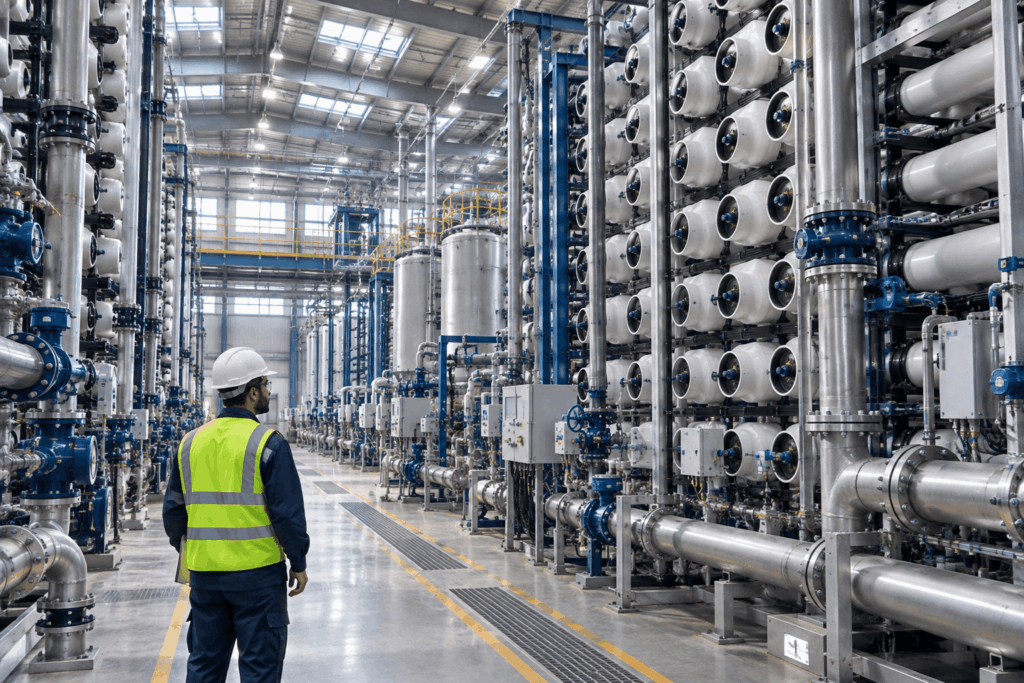
Types of Desalination Plants
Desalination facilities are classified three ways: by technology, by water source, and by production capacity. Getting this classification right is the first step in defining your project scope and budget realistically.
Types of Desalination Plants by Technology
This is the classification that matters most commercially, and it splits into two families.
Membrane processes
- Reverse osmosis (RO): the dominant technology worldwide today. Saline water is forced under high pressure through semi-permeable membranes that pass water molecules and reject dissolved salts. Lower energy consumption and modular expandability are its defining advantages.
- Electrodialysis (ED/EDR): uses an electrical current to draw ions through selective membranes. Typically applied to lower-salinity brackish groundwater.
Thermal processes
- Multi-stage flash (MSF): feedwater is heated, then passed through successive low-pressure stages where it “flashes” into vapour and is condensed. A proven technology for very large plants co-located with power generation.
- Multi-effect distillation (MED): a series of successive evaporators with lower thermal energy demand than MSF, widely used alongside industrial complexes.
- Vapour compression (VC): well suited to small, medium and containerised plants.
| Technology | Energy Use | Best Suited To | Critical Metal Component |
|---|---|---|---|
| Reverse osmosis (RO) | Low | Modern plants at any capacity | Pressure vessels, skid frames |
| Multi-stage flash (MSF) | High | Very large dual-purpose plants | Evaporators, heat exchangers |
| Multi-effect distillation (MED) | Medium | Industrial complexes | Pressure vessels, evaporators |
| Vapour compression (VC) | Medium | Small and mobile plants | Packaged skid units |
Types by Water Source
- Seawater desalination plants (SWRO): the highest salinity and the most demanding corrosion environment, requiring specialised alloys, galvanized steel and advanced surface protection systems.
- Brackish water plants (BWRO): lower salinity and lower operating cost, common in inland agricultural and industrial projects.
- Industrial water reuse plants: treat industrial effluent for recycling within the facility itself.
Types by Production Capacity
- Small plants: below 5,000 m³/day — industrial facilities, residential compounds, farms.
- Medium plants: 5,000–100,000 m³/day — industrial cities and development projects.
- Large-scale plants (IWP): above 100,000 m³/day — independent water projects under government partnership models.
- Containerised plants: packaged units inside steel containers for remote sites and emergency supply.
How a Desalination Plant Works: The Five Process Stages
Understanding how the process works lets you scope the fabrication and supply package accurately rather than guessing at it. The process runs through five sequential stages.
1. Intake and Pre-treatment
The cycle begins with raw water drawn through an intake system of offshore inlets, screens and large-diameter transfer lines. The water then passes through sedimentation and filtration to strip out suspended solids, sand and microorganisms, with chemical dosing to prevent scaling and biological growth. This stage lives or dies on the quality of the piping works and weld integrity — a single leak here shuts the whole plant down.
2. The Desalination Core
This is where salt separation actually happens. In an RO plant, feedwater is pumped at 55–80 bar into pressure vessels housing the membrane elements; in thermal plants, it is heated and routed through evaporator trains. These units fall under static equipment and are fabricated to strict engineering codes such as ASME, demanding tight tolerances in laser metal cutting and metal rolling to form cylindrical shells accurately.
3. Post-treatment
Water leaving the desalination core is too pure to distribute directly. It passes through remineralisation — adding calcium and magnesium — followed by pH correction and disinfection. These operations take place in mixing and dosing tanks fabricated through plate works to potable-water specifications.
4. Storage and Distribution
Product water is held in large storage tanks before being pumped into distribution networks or municipal reservoirs. Storage volume and tank design are among the most consequential engineering decisions in the project, because they determine whether the plant can keep supplying during maintenance outages.
5. Brine Management and Control
Concentrated brine is discharged under strict environmental conditions, while the entire facility is run through SCADA systems from control rooms equipped with electrical panels built and tested to approved standards.
Energy Efficiency and Sustainability: What Really Drives Project Economics
Energy is the largest operating cost line in any plant of this type, typically accounting for 35–50% of the cost per cubic metre produced. That economic reality is why the Saudi market has moved decisively toward reverse osmosis paired with energy recovery devices, which capture pressure energy from the exiting brine stream and return it to the feed — cutting consumption by more than half compared with older configurations.
Renewable integration is now standard practice rather than a future concept. Shuaibah 3 is supported by a 65 MW solar photovoltaic plant, and Yanbu has been fully converted to natural gas firing to reduce emissions.
What does this have to do with metal fabrication? More than most procurement teams assume. Energy efficiency starts at the fabrication shop:
- Joint integrity: any leak in a high-pressure circuit is a direct energy loss, which is where certified welding procedures and non-destructive examination earn their cost.
- Dimensional accuracy: deviation in pressure vessel or heat exchanger fabrication increases friction losses and burns additional power for the life of the plant.
- Corrosion protection: a corroded internal pipe surface reduces flow area and raises pump load, which is why blasting and metal finishing are operating-cost investments rather than construction line items.
Put plainly: the quality of the metal package is not an invoice line. It is a profitability factor that compounds over a twenty-year asset life.
Planning a desalination plant?
We deliver the complete metal package — pressure vessels, storage tanks, piping and steel structures. Fabricated, supplied and erected inside the Kingdom.
How to Choose a Desalination Plant Fabrication Partner: Six Criteria
Selecting the wrong fabricator is the most expensive decision available on a project of this type. These six criteria compress the evaluation.
1. Experience in critical sectors. A supplier that has delivered into power generation, refineries and petrochemical projects works to tolerances tighter than desalination typically demands, and arrives at your project already operating above spec.
2. In-house fabrication capacity. Ask directly: do they fabricate, or subcontract? In-house steel fabrication means control over quality and schedule, and a single point of accountability when something needs correcting.
3. Documented quality systems. Traceable inspection and test procedures, qualified welders and full material certification are not paperwork — they are what protects you at commissioning.
4. Fabrication inside the Kingdom. Local content shortens lead times, removes freight and customs exposure, and puts technical support on your site in hours rather than weeks — fully aligned with Saudi Vision 2030 localisation targets.
5. Breadth of supply scope. Every additional supplier is another interface to manage and another failure point. One partner covering fabrication, supply, delivery and site erection removes months of coordination.
6. Pricing transparency. A strong proposal states specifications, materials and exclusions explicitly. The cheapest bid with vague scope reliably becomes the most expensive one after variation orders.
Desalination Plant Capacity and Cost: What Actually Drives the Price
The first question every project owner asks is what such a project costs. The honest answer is that there is no list price, because cost is built from your specification — not from a catalogue.
Factors That Determine Desalination Plant Cost
| Factor | Effect on Cost |
|---|---|
| Daily production capacity | The dominant variable — total cost rises with capacity while unit cost per m³ falls |
| Water source and salinity | Seawater is materially more expensive than brackish groundwater |
| Selected technology | RO carries lower operating cost; thermal is higher in both capex and opex |
| Required water quality | Potable, process water and boiler feedwater are three different specifications |
| Materials of construction | 316L stainless or duplex raises capex and extends service life |
| Power source | Grid connection, captive generation or solar integration |
| Site and infrastructure | Remoteness, ground conditions, existing road and power access |
| Contract scope | Equipment supply only, or full EPC including design, construction and commissioning |
The takeaway: any figure quoted before these variables are assessed is not a real number. At Al Nafie we prefer to build you a project-specific proposal after understanding the scope — rather than hand you a generic figure that helps no one.
Al Nafie Metal Industries: Your Fabrication Partner for Desalination Plants
Al Nafie Metal Industries delivers advanced steel fabrication and forming services, together with installation services for major engineering, supply and construction projects wherever required — across power plants, gas plants, petrochemical facilities, commercial and industrial projects, desalination plants, refineries, chemical plants, fertiliser plants, cement plants and food processing facilities.
Our vision is direct: deliver world-class products and services at high quality and competitive cost, while strengthening the Kingdom’s industrial base in line with Saudi Vision 2030.
Our Scope in Desalination Projects
We do not supply loose components. We execute the complete metal package of the plant, from shop drawings through site erection:
- Pressure vessels and static equipment: fabrication of static equipment, RO pressure vessels and heat exchangers to approved engineering codes.
- Water storage tanks: design, fabrication and erection of storage tanks across all capacities, for raw water, product water and chemicals.
- Piping networks: complete piping works — intake, transfer and distribution — with certified welding, pressure testing and NDT.
- Structural steel and buildings: steel structures for plant buildings, equipment platforms, stairs and walkways, plus rebar supply for associated civil works.
- Precision metal work: iron cutting, metal bending and metal perforation on modern CNC equipment holding tight dimensional tolerances.
- Corrosion protection: blasting surface preparation, metal finishing and industrial coating systems rated for marine exposure — the single most common failure point in any coastal plant.
- Electrical panels: fabrication and assembly of electrical panels and control enclosures for plant operating systems.
- Site security and ancillary works: security fencing to secure the plant perimeter and critical assets.
Why Al Nafie Metal Industries
Local fabrication to international specification. Our facility inside the Kingdom runs modern fabrication and forming lines, which translates into shorter lead times, lower freight cost and technical support present on your site. See about Al Nafie for our manufacturing capability.
Documented quality and certification. We work to approved quality systems with inspection and test procedures recorded at every stage. Review our certifications to verify the standard we hold.
A track record in critical sectors. Our work across power, petrochemicals and refining means we handle specifications more demanding than desalination requires as routine. Browse our completed projects for representative scope.
Best value, not lowest bid. We do not claim to be the cheapest. We deliver the lowest total cost of ownership: accurate fabrication that eliminates rework, protective systems that extend asset life, and on-time delivery that removes your schedule risk. That is what “best price” means on a desalination plant of this scale.
One point of accountability. Instead of coordinating five suppliers, we carry the complete metal package — fabrication, supply, delivery and erection — under one schedule and one responsibility.
How to Start Your Desalination Project
The path from concept to a running plant is shorter than most owners expect, and three steps begin it.
Step 1 — Share your project requirements. Target capacity, water source, site location and schedule. You do not need a completed design; an outline concept is enough to start.
Step 2 — Technical review and a tailored proposal. Our engineering team reviews the requirements, recommends suitable specifications and materials, and builds a detailed, transparent proposal defining the supply scope precisely.
Step 3 — Fabrication, erection and handover. We begin fabrication against an agreed schedule with regular progress reporting, then supply, erect on your site and hand over ready for commissioning.
Ready to move? Contact us and discuss your project with our engineering team — the initial consultation is free.
Al Nafie Metal Industries
Steel fabrication, forming, supply and installation for major industrial projects across Saudi Arabia.
info@alnafie-indust.com
· Jeddah — South Industrial Area
Frequently Asked Questions About Desalination Plants
What is a desalination plant?
A desalination plant is an industrial facility that removes dissolved salts and impurities from seawater or brackish groundwater to produce water suitable for drinking, industrial or agricultural use — either through membrane processes such as reverse osmosis or thermal processes such as multi-stage flash distillation.
What are the types of desalination plants?
There are two main technology families: membrane (reverse osmosis RO and electrodialysis ED) and thermal (multi-stage flash MSF, multi-effect distillation MED and vapour compression VC). Plants are also classified by water source into seawater and brackish water facilities, and by capacity into small, medium, large-scale and containerised units.
Which country leads the world in desalination?
Saudi Arabia ranks first globally in desalinated water production, with installed capacity exceeding 16 million cubic metres per day as of end-2025. The Kingdom accounts for roughly 22% of worldwide desalinated seawater output and serves more than 27 million beneficiaries through its water networks.
What is the largest desalination plant in the world?
The Ras Al Khair power and water facility in Saudi Arabia is the largest in the world, producing approximately 1.025 million cubic metres of water per day alongside around 2,400 MW of power. It operates a hybrid configuration combining multi-stage flash (MSF) and reverse osmosis (RO) technologies.
What are three major seawater desalination plants in Saudi Arabia?
The three most significant are Ras Al Khair on the Arabian Gulf at 1.025 million m³/day, Jubail at approximately 1.4 million m³/day, and Shuaibah on the Red Sea, whose third independent water project produces around 600,000 m³/day using reverse osmosis supported by 65 MW of solar capacity.
How does a desalination plant work?
It works in five stages: intake and pre-treatment to remove suspended solids, the desalination core where salts are separated, post-treatment for remineralisation and disinfection, storage and pumping through tanks and distribution networks, and finally brine management and discharge under environmental controls.
How much does it cost to build a desalination plant?
There is no fixed cost. Pricing depends on production capacity, water source, selected technology, materials of construction and contract scope. The reliable approach is a technical review of your specific project followed by a tailored proposal. Contact us to discuss your requirements and receive an accurate estimate.
What is the difference between reverse osmosis and thermal desalination?
Reverse osmosis (RO) forces water under pressure through membranes that reject salts; it consumes less energy and expands modularly. Thermal processes (MSF and MED) evaporate and condense the water; they consume more energy but suit very large plants co-located with power generation and tolerate higher feedwater salinity.
What metal components does a desalination plant require?
A plant requires pressure vessels and static equipment, storage tanks for water and chemicals, piping networks for intake and distribution, structural steel for buildings and platforms, electrical panels for control systems, and corrosion protection systems throughout. Together these metal works represent the largest share of total construction value, which makes fabricator selection a decisive commercial choice.
Does Al Nafie build complete desalination plant projects?
Yes. Al Nafie Metal Industries executes the complete metal package for desalination plant projects inside Saudi Arabia — fabricating pressure vessels, storage tanks, piping networks, structural steel and electrical panels, with supply and site erection included. Get in touch to discuss your project scope.
How long does a desalination plant project take?
Typical schedules run 6 to 18 months for small and medium plants, extending to several years for large-scale facilities. Duration depends on capacity, selected technology, site readiness and contract scope, plus lead times on long-lead equipment such as pressure vessels and high-pressure pumps.
Can a desalination plant be expanded later?
Yes — particularly reverse osmosis facilities, which are designed as parallel trains that can be added without shutting down operations. The key is planning for it at design stage: reserving footprint, and sizing piping headers and tanks with spare capacity. Building that in early saves substantial cost at expansion, and it is a principle we apply in our fabrication designs.
A desalination plant is no longer a supporting utility. It is foundational infrastructure for any industrial or development programme in the Kingdom that leads the world in this field. Choosing the right technology, the right capacity and — critically — the right execution partner is what separates an asset that performs for decades from one that consumes its budget in maintenance.
At Al Nafie Metal Industries we put our experience in steel fabrication, forming and static equipment at your disposal, delivering the complete metal package for your project at international quality, competitive cost and on schedule.
about
Alnafie Metal Industries
AlNafie Metal Industries is a leading private company with 33 years of experience in Saudi Arabia’s development. Specializing in steel construction and tank rehabilitation, NMI provides full steel fabrication and erection services for major EPC projects, including power, gas, petrochemical, industrial, and commercial sectors.