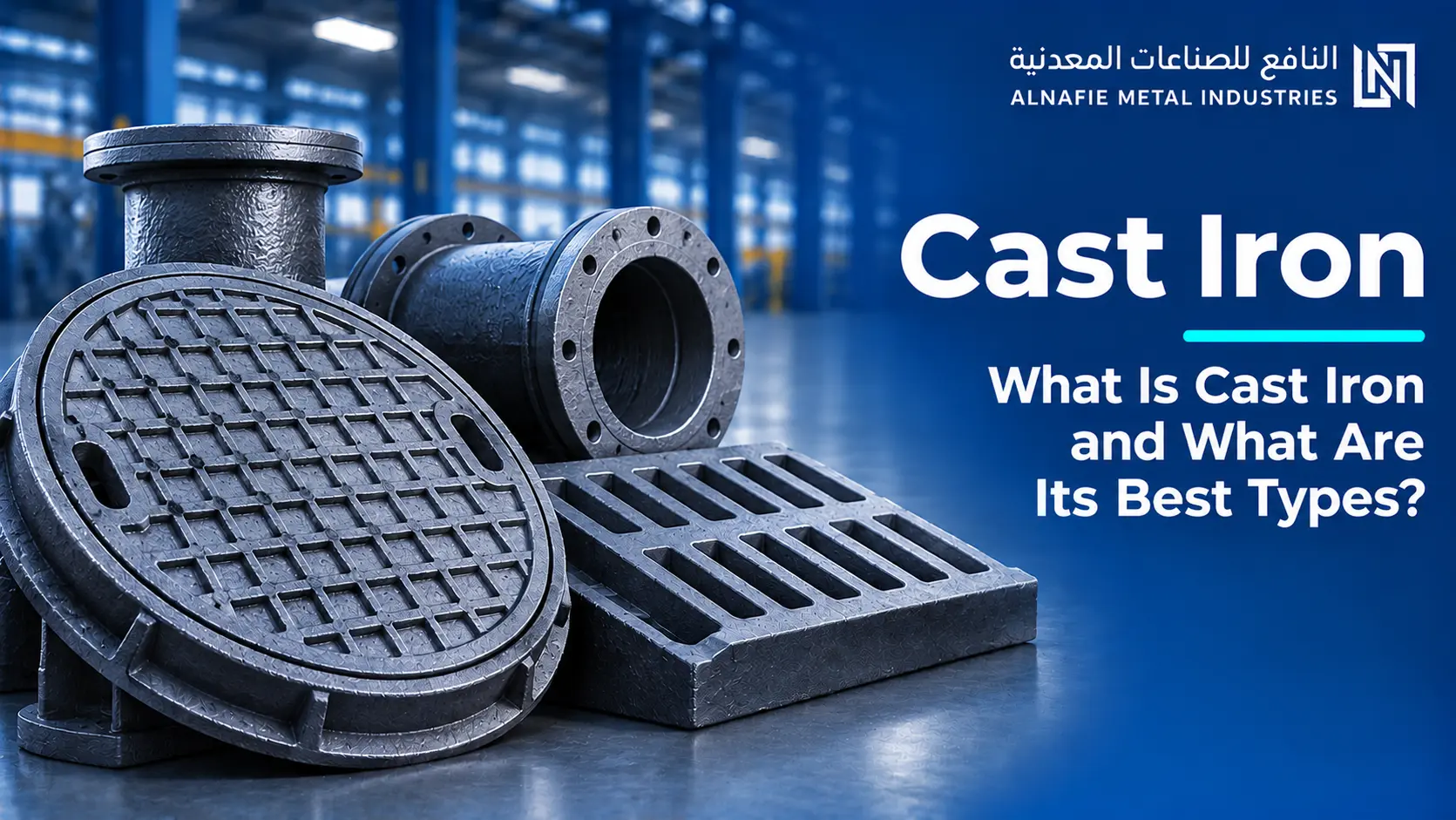
Cast iron is one of the oldest engineered metals and it is still all around us in Saudi Arabia: manhole covers on city streets, pump and valve bodies in water stations, machine bases in factories, and the heavy skillets and pots that have become a favourite in home kitchens. Yet many people are unsure how it differs from ordinary steel, why it is so hard yet can crack, and whether cooking in it is healthy.
This guide explains what the material is, how its chemistry shapes its behaviour, the main types, its strengths and weaknesses, where it is used in industry and at home, and how to protect and care for it. It draws on our experience at Alnafie Metal Industries working with ferrous metals across industrial fabrication, piping and equipment projects.
What Is Cast Iron?
Cast iron is an iron alloy with a high carbon content, typically 2% to 4%, plus around 1% to 3% silicon. The name comes from how it is shaped: the metal is melted, poured into a mould of the required shape and left to solidify. It melts at a lower temperature than steel and flows easily, which makes it ideal for complex shapes.
Is Cast Iron 100% Iron?
No. It is mostly iron, but the 2% to 4% carbon and the silicon are essential to what it is. Much of that carbon exists as graphite inside the metal, and the shape of the graphite decides how the material behaves.
How Carbon and Graphite Shape Its Properties
Steel contains less than about 2% carbon, and most structural steel has less than 0.3%. In this iron the carbon level is much higher, and a large part of it separates out as graphite during solidification:
- Graphite flakes: excellent vibration damping and machinability, but the flakes act as internal notches, so the metal is brittle.
- Graphite spheres (nodules): far tougher, able to bend and absorb impact.
- No free graphite: very hard and abrasion resistant, but extremely brittle.
Silicon promotes graphite formation, and cooling rate in the mould also matters, so the same melt can produce different properties depending on casting practice. For the wider picture of iron and steel families, read our guide to types of steel.
What Are the Five Types of Cast Iron?
1. Grey Iron ( Grey Cast iron)
The most common and lowest cost type. Graphite forms as flakes, giving a grey fracture surface. Grey iron damps vibration very well, machines easily and resists sliding wear, but it is weak in tension and brittle under impact. Uses include machine bases, pump housings, manhole covers, brake discs and much traditional cookware.
2. White Iron ( White Cast iron)
Almost no free graphite; carbon is locked in very hard carbides, giving a bright white fracture. White iron is extremely hard and abrasion resistant but very brittle and difficult to machine. It is used for wear liners, grinding balls and slurry pump parts.
3. Ductile Iron (Nodular or Spheroidal Graphite Iron)
Magnesium is added before pouring so graphite forms spheres. The result combines easy casting with toughness approaching that of steel, with much better impact and bending resistance than grey iron. Ductile iron is used for most modern large-diameter water pipes, valves, fittings and many automotive parts.
4. Malleable Iron
Starts as white iron, then undergoes long heat treatment so carbon forms compact clusters. The metal becomes less brittle and can tolerate some deformation. Used for small fittings, brackets and hand tools.
5. Compacted Graphite Iron
A middle ground between grey and ductile iron, with short, worm-like graphite. It offers higher strength than grey iron and better thermal conductivity than ductile iron, and is used in some modern engine blocks.
Alloyed irons with chromium, nickel or molybdenum are sometimes treated as a sixth group, used for heat-resistant furnace parts and severe-duty pump components.
Comparison Table
| Type | Graphite form | Key strength | Key weakness | Typical uses |
|---|---|---|---|---|
| Grey Cast iron | Flakes | Damping, machinability | Brittle | Machine bases, covers, cookware |
| White Cast iron | Almost none | Extreme hardness | Very brittle | Wear liners |
| Ductile Cast iron | Spheres | Toughness, impact resistance | Costs more than grey | Water pipes, valves |
| Malleable Cast iron | Clusters | Less brittle | Long heat treatment | Small fittings |
| Compacted graphite Cast iron | Short worms | Strength plus conductivity | Tighter process control | Engine blocks |
| Alloyed Cast iron | Varies | Heat or wear resistance | Higher cost | Furnace and pump parts |
Which Type of Cast Iron Is Best?
It depends on the job. Grey iron is best for damping and low cost, ductile iron for toughness and pressure, white iron for abrasion, and alloyed iron for heat. For cookware, well-cast and well-finished grey iron is the most common choice.
Properties and Advantages
- Excellent castability: lower melting point and high fluidity allow complex shapes, internal passages and thin details.
- Vibration damping: especially grey iron, ideal for precision machine bases.
- High compressive strength: it carries large compressive loads.
- Good machinability: graphite acts as a natural lubricant.
- Wear resistance: particularly white and alloyed grades.
- Heat retention: heats slowly and holds heat, the secret of its popularity in cooking.
- Cost-effective for complex parts: compared with machining or welding the same shape from steel.
Disadvantages
- Brittleness: grey and white iron fracture rather than bend under heavy impact.
- Low tensile strength: compared with steel.
- Difficult welding: special procedures are needed to avoid cracking.
- Weight: parts are heavy.
- Rust: it corrodes without protection.
- No hot forming: it cannot be rolled or forged; shaping is by casting.
In cookware specifically, the common drawbacks are weight, the need for seasoning and drying to prevent rust, and slow heating.
Cast Iron vs Steel
| Factor | Cast iron | Steel |
|---|---|---|
| Carbon content | 2%–4% | Below about 2% |
| Shaping | Casting in moulds | Rolling, forging, drawing, casting |
| Tensile strength | Low to medium | High |
| Compressive strength | Very high | High |
| Ductility | Low | High |
| Vibration damping | Excellent (grey) | Lower |
| Weldability | Difficult | Good to excellent |
| Typical uses | Castings, bases, pipes, cookware | Structures, rebar, pipe, plate |
Which is stronger? Steel is stronger in tension and impact; the iron wins in compression and damping. Each is stronger at different things. Our guides to steel pipe and stainless steel cover the steel side in detail.
Cast Iron vs Wrought Iron
| Factor | Cast iron | Wrought iron |
|---|---|---|
| Carbon | High | Very low |
| Shaping | Casting | Hammering while hot |
| Behaviour | Hard and brittle | Soft and ductile |
| Welding | Difficult | Possible |
| Use today | Widespread | Rare; most “wrought” work today is mild steel |
How Is It Made?
Most parts are produced by sand casting:
- Pattern making: a replica of the final part in wood, metal or plastic.
- Mould making: sand is packed around the pattern, which is then removed to leave a cavity.
- Melting: raw materials and scrap are melted and the carbon, silicon and alloy content adjusted.
- Treatment: for ductile iron, magnesium is added just before pouring.
- Pouring: molten metal fills the mould.
- Cooling: at a controlled rate for the target structure.
- Shake-out and cleaning: the sand mould is broken away and excess metal removed.
- Machining and finishing: critical faces and holes are machined, then painted or coated.
Foundries routinely remelt old castings, so the metal recycles very efficiently. For grading and selling it, see our scrap metal guide.
Cast Iron Uses
Water and Infrastructure
- Water and sewer pipes: especially large-diameter ductile iron with internal cement lining and external coating.
- Valves and fittings: in networks and pumping stations.
- Manhole covers and drainage gratings: strong enough for traffic loads.
See how pipe materials compare in our steel pipe guide, and how these materials are used in large projects in our guide to desalination plants in Saudi Arabia.
Cast Iron Pipe in Detail
Modern ductile iron pipe handles operating pressure, soil loads and traffic, and survives handling and installation far better than old grey iron pipe. It usually has a cement mortar lining to protect the metal and keep the bore smooth, and an external zinc and bitumen coating or polyethylene sleeve in aggressive soils. Push-on joints with rubber gaskets speed installation and allow slight movement as soil settles. Material selection for any water project still depends on pressure, diameter, soil, water chemistry and whole-life cost.
Factories and Machinery
- Machine bases: grey iron damps vibration and keeps machining accurate.
- Pump and compressor housings: complex shapes that are easy to cast.
- Wear liners: in cement and mining plants, as noted in our cement plant guide.
- Gears, pulleys and covers.
In power and petrochemical plants, ductile and alloyed iron valve and pump bodies appear on some lines depending on temperature and pressure; see our guide to petrochemicals in Saudi Arabia.
Automotive
Engine blocks in many vehicles and heavy machines, brake discs and drums, exhaust manifolds and some suspension parts.
Cookware
Skillets, pots, griddles and grills, the use most people in Saudi Arabia search for.
Architecture and Decoration
Decorative gates, columns, old railings, garden furniture and heritage lamp posts.
Grades and Standards
Grey iron is graded mainly by tensile strength, for example classes 200, 250 and 300 in European designations, roughly matching tensile strength in MPa, or ASTM A48 classes in ksi. Ductile iron uses two numbers, such as 400-15, meaning tensile strength in MPa and elongation percentage; in ASTM A536 a common grade is 65-45-12. On projects, the grade should be stated in the specification and backed by a foundry certificate with test results, whether to American, European or Saudi (SASO) requirements.
Does Cast Iron Rust?
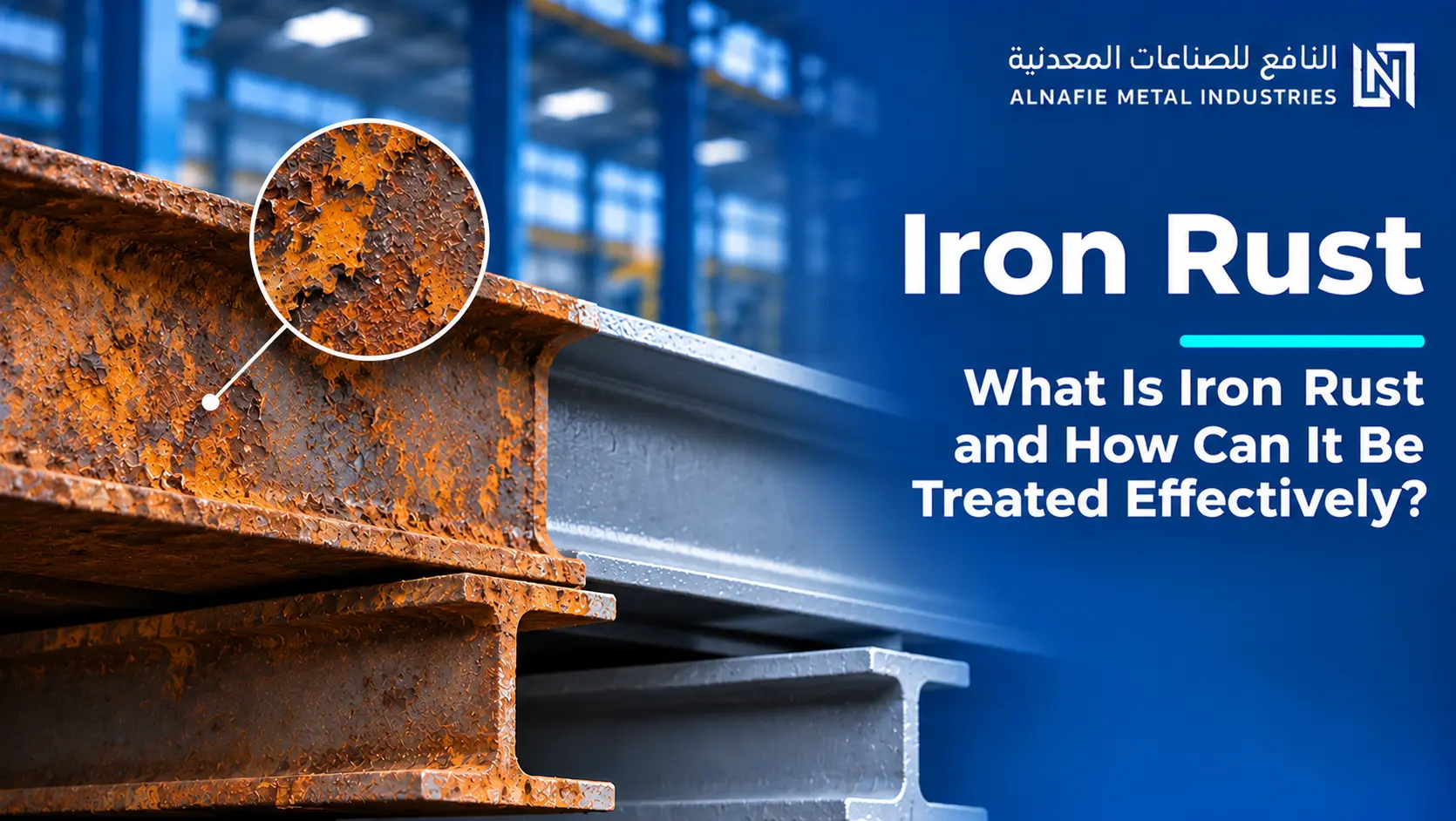
Yes. It has no chromium, so it rusts when exposed to moisture and air without protection, though rust on thick sections is usually superficial and slow. Protection methods include:
- Industrial paint systems after proper surface preparation, as in our metal finishing services.
- Epoxy and bituminous coatings for pipes and covers.
- Internal linings for water pipes.
- Oil seasoning for cookware.
- Enamel coating for some cookware and decorative pieces.
Welding and Repair
Welding is possible but much harder than welding steel, because the high carbon content and low ductility cause cracking during heating and cooling. Successful repairs usually need:
- Thorough cleaning of oil and contaminants.
- Preheating of the part or the repair zone.
- Special electrodes, typically nickel-based.
- Short weld runs with light peening.
- Very slow cooling afterwards.
For critical or pressure-bearing parts, many engineers prefer replacement or mechanical repair over welding.
Machining
Grey iron is one of the easiest metals to machine, because graphite flakes break chips into small pieces and lubricate the cut. Many precision parts are cast close to shape and then machined on critical faces and bores. White iron is so hard it is usually ground rather than turned, and ductile iron machines reasonably well with different tooling and speeds.
Quality Inspection of Castings
Castings can hide internal defects:
- Porosity: trapped gas bubbles.
- Shrinkage: voids in thick sections as metal contracts.
- Cracks: from uneven cooling or stress.
- Inclusions: trapped sand or slag.
Inspection may include visual and dimensional checks, hardness testing, ultrasonic testing and hydrostatic pressure testing for pump, valve and pipe bodies. Always request a foundry certificate with chemical analysis and mechanical test results.
When to Choose Iron Castings and When to Choose Steel
Choose a casting when:
- The part has complex shapes and internal passages that are hard to weld or machine.
- Loads are mainly compression and vibration.
- High abrasion resistance is needed.
- Volumes are high enough to spread pattern cost.
Choose steel when:
- The part faces heavy impact, tension or repeated bending.
- Site welding or future modification is needed.
- The shape is simple and can be built from plate and sections.
- Weight matters and thinner sections are required.
Many machines combine both: a cast pump body, a steel shaft and a welded steel base.
Cookware: Is It Healthy to Cook in Cast Iron?
Cast iron cookware has been used for centuries and is considered safe for everyday cooking for most people. It can add small amounts of iron to food, especially with acidic dishes and long cooking times. This is generally not a problem, but people with medical conditions involving iron overload should seek medical advice. Enamelled pans keep food from contacting the bare iron.
Why Avoid Cooking Certain Foods in It?
Highly acidic foods such as tomato sauces simmered for a long time can strip seasoning and pick up a metallic taste in bare pans. Enamelled versions handle acidic dishes well.
Is It 100% Non-Toxic?
Bare iron with a simple oil seasoning contains no synthetic non-stick coating. Quality matters, so buy from reputable makers, especially for enamelled pieces.
Bare vs Enamelled
| Factor | Bare | Enamelled |
|---|---|---|
| Seasoning needed | Yes | No |
| Rust | Rusts if neglected | Protected by enamel |
| Acidic foods | Best limited | Suitable |
| Durability | Extremely tough | Enamel can chip if knocked |
| Price | Usually lower | Usually higher |
How to Care for Cast Iron Pans
- Wash with warm water and a non-abrasive sponge; avoid long soaking.
- Dry immediately, ideally on the stove until completely dry.
- Wipe a very thin layer of oil over the surface after each use.
- If light rust appears, scrub it off and re-season in the oven.
- Store in a dry place.
Cookware Compared
| Factor | Cast iron | Stainless steel | Aluminium |
|---|---|---|---|
| Heat retention | Excellent | Moderate | Poor |
| Heating speed | Slow | Moderate | Fast |
| Weight | Very heavy | Moderate | Light |
| Care | Seasoning and drying | Easy | Easy |
| Rust | Rusts if neglected | Resistant | Does not rust |
Cast Iron Price in Saudi Arabia
Cast Iron Price Range in Saudi Arabia (November 2026)
Prices depend entirely on what you are buying: cookware, industrial castings or scrap. These indicative ranges come from Saudi retailers and scrap yards:
| Product | Approximate range |
|---|---|
| Small cast iron pots and pans (10–12 cm) | SAR 25–100 |
| Mid-size pots and skillets, bare or enamelled | SAR 145–400 |
| Premium international brands | SAR 1,000–3,000 approximately |
| Small household drain covers | From about SAR 50 |
| Heavy-duty manhole covers for roads and car parks | From several hundred to over SAR 1,000, by load class and size |
| Cast iron scrap | SAR 0.80–1.75 per kg |
Custom industrial castings, such as pump bodies, valve bodies and machine bases, have no fixed price per kilogram. They are quoted on iron type, grade, part weight, pattern complexity, quantity and machining, so send drawings and specifications to a foundry for a quote.
Retail prices change with promotions, seasons and metal markets, so confirm the price at the time of purchase.
Why Did We Stop Using Cast Iron for Some Things?
As steelmaking improved, many structural uses moved to steel because it is stronger in tension and far less brittle. Bridges, beams and columns that were once cast are now rolled or fabricated steel. The metal kept its place in castings, machinery, pipes and cookware, and the invention of ductile iron in the twentieth century gave it a second life by combining easy casting with near-steel toughness.
Cast Iron in the Saudi Climate
Heat does not affect cast iron in normal service, but humidity and salt in coastal cities such as Jeddah, Yanbu and Dammam speed up rusting on exposed parts like manhole covers, decorative gates and lamp posts. The answer is a coating suited to the environment, regular paint maintenance and details that stop water collecting around the part. For buried water pipes, the external coating and internal lining decide service life more than the metal itself.
How to Identify It
- Colour: dark grey, rusting reddish brown.
- Surface: unmachined castings show a sandy texture from the mould.
- Fracture: grey iron breaks with a grey, grainy surface.
- Sound: grey castings give a relatively dull ring when struck, thanks to damping.
- Magnet: strongly attracted, like other ferrous metals.
Common Mistakes
- Using grey iron where impact loads occur: sudden fracture without warning.
- Welding without a proper procedure: cracks appear later.
- Over-tightening flange bolts: grey iron can crack under excessive stress.
- Neglecting protection in humid areas: rust attacks thin sections.
- Quenching a hot pan in cold water: thermal shock can crack it.
- Buying pressure parts without grade certificates: the wrong grade can fail under pressure.
Our Experience With Ferrous Metals
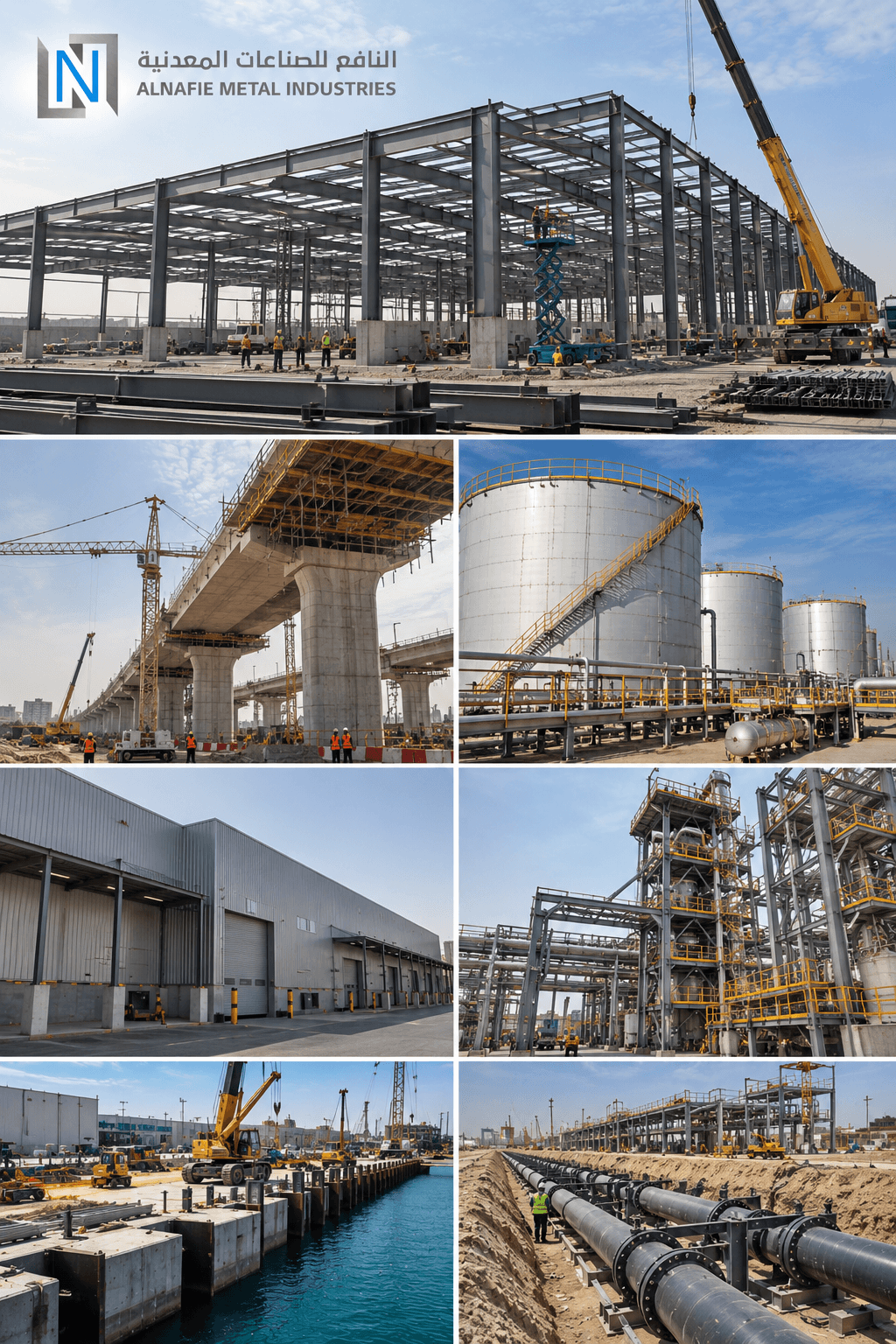
Alnafie Metal Industries works with ferrous metals across fabrication and assembly, handling iron castings, steel and stainless components within equipment, piping and industrial installations. Through our piping works and static industrial equipment, we see where castings make sense and where steel or stainless is the better choice. Read more in our steel fabrication buyer guide, or contact our team about your project.
Planning an Industrial Project? Alnafie Can Fabricate and Erect It
Steel structures, storage tanks, piping and static equipment for power, petrochemical and industrial plants.
Alnafie Metal Industries
Metal fabrication in Jeddah · 500+ employees · 144,000 m² of facilities
ISO 9001 • ISO 14001 • ISO 45001 • ASMEFrequently Asked Questions
What is cast iron?
An iron alloy with 2% to 4% carbon and some silicon, shaped by pouring molten metal into moulds. It is hard and strong in compression but more brittle than steel.
Is it healthy to cook in cast iron?
Yes, for most people. It can add small amounts of iron to food. People with iron overload conditions should seek medical advice.
Why did we stop using cast iron?
For structural uses, steel replaced it because steel is stronger in tension and less brittle. It remains widely used for castings, machinery, pipes and cookware.
Is cast iron 100% iron?
No. It contains 2% to 4% carbon and around 1% to 3% silicon, and those elements define its properties.
What are the five types of cast iron?
Grey, white, ductile (nodular), malleable and compacted graphite iron.
Which type of cast iron is best?
Grey for damping and low cost, ductile for toughness and pressure, white for abrasion, and alloyed iron for heat resistance.
Does cast iron rust?
Yes, without protection. Paint, coatings, linings, enamel or oil seasoning prevent rust.
Can cast iron be welded?
Yes, with special procedures including preheating, nickel electrodes and slow cooling. Critical parts are often replaced or repaired mechanically instead.
about
Alnafie Metal Industries
AlNafie Metal Industries is a leading private company with 33 years of experience in Saudi Arabia’s development. Specializing in steel construction and tank rehabilitation, NMI provides full steel fabrication and erection services for major EPC projects, including power, gas, petrochemical, industrial, and commercial sectors.