Iron rust is one of the most expensive problems in construction and industry, and one of the most underestimated. It starts as a small brown spot on a gate or railing and ends as exposed ceiling rebar, a leaking tank or a steel frame that needs full rehabilitation. In Saudi Arabia the stakes are higher: coastal humidity and salty soils in many regions make steel corrode far faster than it does in dry, clean air.
This guide covers iron rust from two angles. The science: what rust is, the rusting of iron equation, and whether rusting is a chemical change. And the practice: what causes rust, the main types of corrosion, how to prevent rust on metal, and how to treat rusted doors, ceilings and industrial equipment. It draws on our work at AlNafie Metal Industries preparing and protecting steel surfaces for projects across the Kingdom.
What Is Iron Rust?
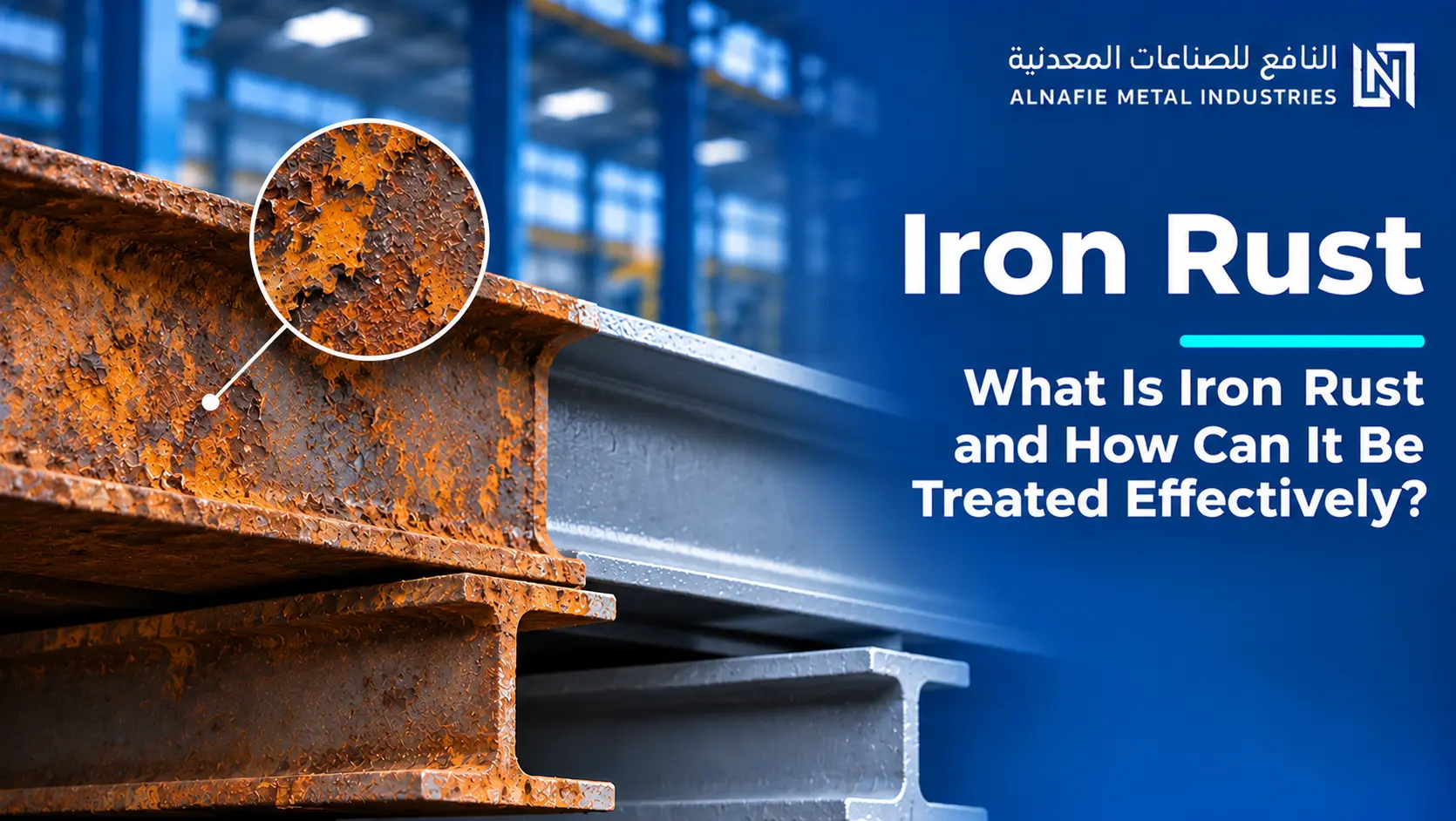
Iron rust is the reddish-brown layer that forms on iron and steel when they are exposed to oxygen and water together. Chemically, it is hydrated iron(III) oxide: iron oxide bound with water molecules, usually written as Fe₂O₃·nH₂O.
What sets rust apart from the oxides of metals like aluminium or chromium is that it does not protect the metal beneath it. Rust is porous and flaky. It holds moisture against the surface and lets corrosion continue until the steel is consumed. That is exactly why stainless steel resists corrosion: its chromium forms an extremely thin, tight oxide film that seals the surface. We explain this in detail in our stainless steel guide.
The Rusting of Iron: How Rust Forms
Iron does not rust with oxygen alone, or with water alone. It needs both. The reaction is electrochemical, meaning a tiny electric current flows across the metal surface:
- At the anode: iron atoms lose electrons and dissolve as iron ions (Fe → Fe²⁺ + 2e⁻).
- At the cathode: oxygen dissolved in water accepts those electrons and forms hydroxide ions (O₂ + 2H₂O + 4e⁻ → 4OH⁻).
- Combination: iron ions react with hydroxide to form iron hydroxide, which oxidises further in air.
- Result: the product becomes hydrated iron(III) oxide, the brown rust we see.
Rusting of Iron Equation and Rust Formula
The simplified overall equation is:
4Fe + 3O₂ + 2nH₂O → 2Fe₂O₃·nH₂O
In words: iron + oxygen + water → hydrated iron(III) oxide (rust).
Dissolved salts speed this up dramatically because they make water a better conductor. That is why iron rust appears much faster in Jeddah or Dammam than in dry inland areas.
Is Iron Rust Fe₂O₃ or Fe₃O₄?
Common red-brown iron rust is hydrated Fe₂O₃. Fe₃O₄, or magnetite, is a black iron oxide that forms when oxygen is limited, for example inside pipes or under water. It is denser and more adherent, and is sometimes called black rust.
What Are the Three Types of Rust?
People usually mean three colours of iron oxide:
- Red rust: hydrated iron(III) oxide, the most common type in open air.
- Black rust: magnetite (Fe₃O₄), formed with little oxygen.
- Yellow or brown rust: iron oxide-hydroxide, often seen in very wet conditions or as flash rust after washing or blasting.
Is Rusting of Iron a Chemical Change?
Yes. The rusting of iron is a chemical change because it produces a new substance with completely different properties: a different colour, a brittle and flaky texture, and weaker magnetism. It cannot be turned back into iron by simple physical means. A physical change, by contrast, only alters shape or state, such as cutting or melting steel.
What Causes Iron Rust?
Moisture and Water
Any water on steel starts the reaction: rain, overnight condensation, high humidity, or water trapped in a joint. The longer it stays, the more iron rust forms.
Salts and Chlorides
Salt accelerates iron rust sharply. Coastal air carries salt spray, and many inland Saudi sites have saline sabkha soils that attack foundations, buried pipes and reinforcement.
Industrial Pollution
Sulphur gases in industrial atmospheres and chemicals in plants and treatment facilities make surface moisture acidic and speed corrosion.
Contact Between Different Metals
When steel touches a more noble metal such as copper or stainless steel in the presence of moisture, the steel corrodes faster. This is galvanic corrosion.
Poor Design
Pockets that trap water, intermittent welds with gaps between them, and steel touching soil without protection are where iron rust starts first.
Damaged or Missing Protection
A scratch in the paint, damaged galvanizing or thin concrete cover over rebar all open the door to corrosion.
Is Iron Rust Harmful?
For structures, yes:
- Loss of strength: rust consumes the steel cross-section and reduces load capacity.
- Cracked concrete: rust occupies several times the volume of the original steel, so when it forms inside concrete it pushes the cover off.
- Leaks and failures: in tanks and pipes it causes pitting, holes and contaminated contents.
- High maintenance costs: rehabilitation costs far more than protection done right at the start.
- Safety risks: advanced corrosion in frames, stairs and railings can lead to partial collapse.
For people, touching ordinary iron rust is not considered toxic, though rusty sharp edges can cause wounds that need proper care.
Can Iron Be Recovered from Rust?
Not on site, but steel covered in iron rust keeps its value as scrap. Steel mills melt it down and reduce the oxide back to new steel. Heavy rust lowers the effective weight slightly, so some buyers adjust prices. Our scrap metal guide explains sorting and pricing.
Rust vs Corrosion: Is Rusting a Type of Corrosion?
Corrosion is the general term for any metal degrading through reaction with its environment: iron, aluminium, copper and others. Rust is one type of corrosion that applies only to iron and its alloys. So all rust is corrosion, but not all corrosion is rust. Copper corrodes to a green patina and aluminium to a white oxide, but neither is called rust.
Types of Corrosion in Metals
Uniform Corrosion
Spreads across the whole surface at roughly the same rate. It is the easiest to predict and design for.
Pitting Corrosion
Small, deep pits in specific spots. It is dangerous because it can perforate a wall while the surface looks almost intact, and it is common where chlorides are present.
Crevice Corrosion
Occurs in narrow gaps between parts, under gaskets and bolt heads, where water is trapped.
Galvanic Corrosion
Occurs when two different metals touch in a moist environment, and the less noble one corrodes faster.
Corrosion Under Insulation (CUI)
Occurs beneath thermal insulation on pipes and tanks, where water seeps in and stays hidden. It is a well-known issue in oil, gas and power facilities.
Stress Corrosion Cracking
Cracks that form when mechanical stress combines with a corrosive environment. It is dangerous because failure can be sudden.
Rebar Corrosion in Concrete
Steel inside concrete is initially protected, because concrete is alkaline and forms a passive layer on the bar. Two things break that protection:
- Chloride ingress: from seawater, saline soil or contaminated mix materials.
- Carbonation: carbon dioxide from the air slowly reduces the alkalinity of concrete until it reaches the steel.
Once corrosion starts, it expands, cracks the cover and exposes the bars. Prevention starts with adequate cover and low-permeability concrete, as explained in our rebar guide.
How to Prevent Iron Rust on Metal
What Is the Best Way to Prevent Rust?
There is no single best method for every case. The right approach depends on the environment, the required life and the budget. In practice, the most reliable protection for structural steel combines proper surface preparation with either hot-dip galvanizing or a multi-coat paint system, plus design that keeps water away.
Protective Coatings and Anti-Rust Paint
The most widely used defence against iron rust isolates steel from water and oxygen with paint. Industrial projects typically use a three-coat system:
- Primer: such as zinc-rich epoxy, which bonds to the steel and protects it even where the coating is scratched.
- Intermediate coat: a thick epoxy barrier against moisture.
- Topcoat: usually polyurethane, which resists UV and holds its colour.
The system is chosen by environment. ISO 12944 classifies atmospheres from low to very high corrosivity and sets suitable systems and thicknesses for each.
Galvanization
Galvanization coats steel with zinc, most effectively by hot-dip galvanizing, where the whole part is dipped in molten zinc. Zinc protects in two ways: as a barrier, and sacrificially, corroding in place of the steel if the surface is scratched. Our galvanized steel guide covers types and costs.
Thermal Spray (Metallizing)
Molten zinc or aluminium is sprayed onto the surface, which suits large parts that do not fit galvanizing baths.
Cathodic Protection
Used for buried pipelines, tank bottoms and marine structures, cathodic protection makes the whole steel structure a cathode so it does not corrode:
- Sacrificial anodes: blocks of zinc, magnesium or aluminium connected to the steel corrode instead of it.
- Impressed current: an external power source drives a small, controlled current that stops the steel from corroding.
Corrosion-Resistant Materials
Stainless steel is used in tanks, food and chemical systems, and some alloys resist atmospheric corrosion better than carbon steel. They cost more up front but cut maintenance over the long run.
Smart Design
- Avoid pockets that trap water and add drainage holes.
- Use continuous welds instead of intermittent welds in exposed areas.
- Isolate dissimilar metals.
- Keep steel off the ground.
- Leave access for future inspection and painting.
Temporary Protection in Storage
Protective oils, corrosion-inhibiting packaging, or tarpaulins with ventilation protect parts stored before installation.
Surface Preparation: The Foundation of Any Protection
Most coating failures come from poor surface preparation, not from the paint itself. The right sequence:
- Degrease with suitable solvents.
- Abrasive blast to remove rust and mill scale and create a profile the coating can grip. The usual industrial standard is Sa 2½ to ISO 8501-1, a near-white metal finish.
- Remove dust after blasting.
- Coat promptly, before the surface flash-rusts, especially in humid weather.
At Alnafie we provide blasting and metal finishing in-house, so parts leave the factory prepared and protected.
How to Remove Iron Rust from Metal
What Is the Quickest Way to Remove Rust from Metal?
For large areas, abrasive blasting is by far the fastest and gives a clean surface ready for coating. For small items, wire brushing, sanding or grinding work quickly on light to moderate rust.
Chemical Rust Remover
Products based on acids such as phosphoric acid dissolve iron rust, and some convert it into a stable black layer known as a rust converter. Follow the safety and rinsing instructions.
Can Vinegar Remove Rust?
Yes. White vinegar contains acetic acid, which slowly dissolves light iron rust on small items. Soak for several hours, scrub, rinse and dry thoroughly. Very long soaking can attack the metal, and the cleaned surface must be oiled or painted straight away because it will rust again quickly.
What Kills Rust Naturally?
Mild household acids such as vinegar and lemon juice, often combined with salt or baking soda as a gentle abrasive, can remove light surface iron rust from small items. They are not suitable for structural steel or heavy corrosion.
Modern Methods
Laser cleaning suits delicate parts and restoration work, and electrolysis is used for small parts in workshops.
Treating Iron Rust by Situation
Rusted Doors, Gates and Fences
Clean back to bare metal with a brush or sandpaper, remove dust, apply an anti-rust primer, then two topcoats.
Rusted Ceiling Rebar
When ceiling plaster falls and bars are exposed, it is a structural issue that needs an engineer. The general steps:
- Break out damaged concrete around the bars until you reach sound concrete, including behind the bar.
- Clean the steel back to bare metal.
- Assess section loss and add or replace bars that have lost significant diameter, as the engineer specifies.
- Coat the steel with a suitable corrosion-inhibiting primer.
- Apply a bonding agent, then structural repair mortar.
- Fix the root cause, such as water leaking from the roof or bathrooms.
Rebar Rust Before Concreting
Light surface rust is normal and harmless. Flaking rust or pitting must be removed by wire brushing or blasting, and bars with clearly reduced diameter should be rejected.
Rusted Tanks and Pipes
These need ultrasonic thickness testing to measure metal loss, followed by local repair or replacement and then restoration of the internal and external protection systems.
Iron Rust in Saudi Conditions
Saudi Arabia has very different corrosion environments:
- Coastal cities (Jeddah, Yanbu, Rabigh, Dammam, Jubail): high humidity and airborne salts, usually classed as high-corrosivity environments.
- Industrial zones: gases and chemicals that accelerate corrosion.
- Inland areas: relatively dry air, but saline soils at some sites and large day–night temperature swings that cause condensation.
So the protection system for the same part changes with where it is installed. Water and process facilities such as desalination plants and petrochemical plants need the highest protection levels.
How Long Does It Take for Iron Rust to Form?
There is no fixed time. Bare steel on a humid coast can show iron rust within days, or even hours after a damp night, while the same part in a dry enclosed space may stay unchanged for weeks. Freshly blasted steel is especially sensitive, which is why it should be coated the same day. Steel protected by a good paint system or hot-dip galvanizing can last many years before maintenance, depending on environment and workmanship.
Iron Rust on Different Steel Products
- Sheet and plate: cut edges and bends are most vulnerable because coatings are thinner there. See our guide to sheet metal.
- Wire mesh: junctions and welds hold water; galvanized or PVC-coated mesh lasts longer. Our wire mesh guide compares options.
- Pipes: internal corrosion from the conveyed fluid and external corrosion from soil or humidity, worst when buried without wrapping. See our steel pipe guide.
- Cast iron: it rusts too if left unprotected, as covered in our cast iron guide.
Inspection and Maintenance
Every protection system needs follow-up, and early maintenance is far cheaper than late repair:
- Regular visual checks, especially at joints, welds, column bases and water traps.
- Dry film thickness readings to confirm the coating is still within specification.
- Ultrasonic thickness testing on tanks and pipes to measure metal loss.
- Cathodic protection surveys to confirm the system is working.
- Prompt touch-up of scratches and peeling before they spread.
Common Mistakes in Rust Prevention
- Painting directly over rust.
- Skipping proper surface preparation.
- Applying less coating thickness than specified.
- Using an indoor system in a coastal environment.
- Joining dissimilar metals without isolation.
- Ignoring periodic inspection.
How AlNafie Protects Steel Against Iron Rust
At Alnafie Metal Industries, corrosion protection starts at design and ends at inspection, with the system chosen for the environment where each part will be installed:
- Steel structures: blasting and multi-coat paint systems or galvanizing, depending on location.
- Storage tanks: internal linings for the stored product, external coatings, and cathodic protection for tank bottoms where needed.
- Piping works: wrapping or coating to suit the service.
- Epoxy coated rebar for coastal structures and tanks.
All of this is part of the wider metal forming and fabrication chain inside our plant, from cutting and bending through to finishing. If your project needs a suitable protection system, contact our team through the contact page.
Planning an Industrial Project? Alnafie Can Fabricate and Erect It
Steel structures, storage tanks, piping and static equipment for power, petrochemical and industrial plants.
Alnafie Metal Industries
Metal fabrication in Jeddah · 500+ employees · 144,000 m² of facilities
ISO 9001 • ISO 14001 • ISO 45001 • ASMEIron Rust FAQ
What causes iron rust?
Iron rust forms when iron reacts with oxygen in the presence of water or moisture. Salts, industrial pollution, contact with other metals and designs that trap water all speed it up.
What is the chemical formula of rust?
The common formula is Fe₂O₃·nH₂O, hydrated iron(III) oxide. The overall equation is 4Fe + 3O₂ + 2nH₂O → 2Fe₂O₃·nH₂O.
Is rusting of iron a chemical change?
Yes. It creates a new substance with different properties from iron, and it cannot be reversed by simple physical means.
What is the best way to prevent rust?
Prepare the surface properly, then protect the steel with hot-dip galvanizing or a multi-coat paint system suited to the environment, and design out water traps. Buried and marine steel also uses cathodic protection.
How can rusting be prevented?
By keeping water and oxygen away from the steel: painting, galvanizing, oiling, using stainless steel, applying cathodic protection, and storing steel dry and off the ground.
Is corrosion and rust the same thing?
No. Corrosion is the general degradation of any metal by its environment, while rust is the specific corrosion of iron and steel.
Is rusting a type of corrosion?
Yes. Rusting is the corrosion of iron and its alloys.
What is the quickest way to remove rust from metal?
Abrasive blasting for large areas; wire brushing, sanding or grinding for small items.
Can vinegar remove rust?
Yes, on small items with light rust. Soak for several hours, scrub, rinse, dry, and protect the surface immediately.
Is rust Fe₂O₃ or Fe₃O₄?
Ordinary red rust is hydrated Fe₂O₃. Fe₃O₄ is magnetite, a black oxide that forms where oxygen is limited.
Can electricity be used to protect iron from rust?
Yes. Impressed current cathodic protection passes a small controlled current that makes the steel a cathode so it does not corrode. It is used for buried pipelines, tanks and marine structures.
about
Alnafie Metal Industries
AlNafie Metal Industries is a leading private company with 33 years of experience in Saudi Arabia’s development. Specializing in steel construction and tank rehabilitation, NMI provides full steel fabrication and erection services for major EPC projects, including power, gas, petrochemical, industrial, and commercial sectors.