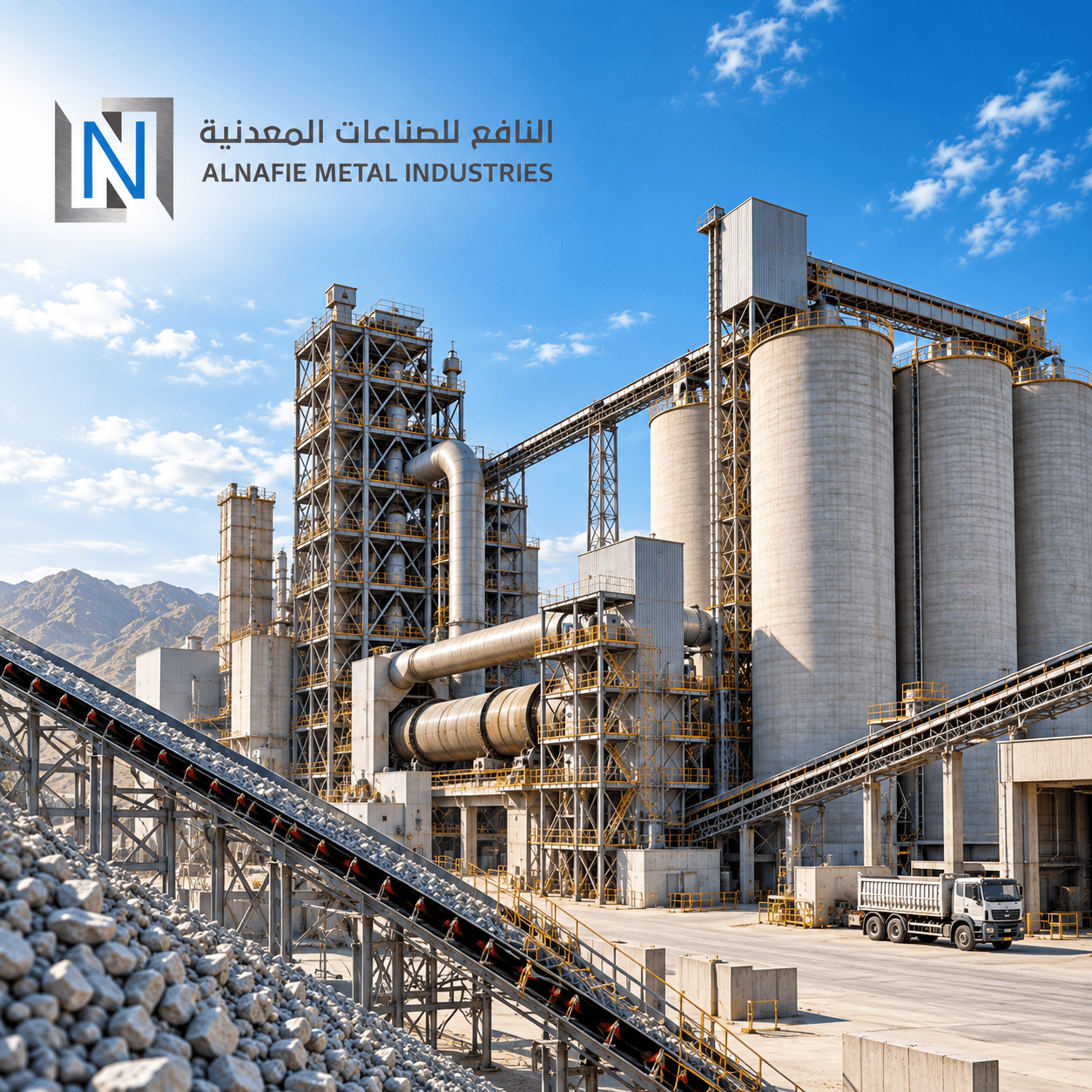
A cement plant is one of the heaviest industrial builds in the construction supply chain. Production runs through a continuous chain that starts at the quarry, moves through crushing, grinding and pyroprocessing, and ends with cement stored in silos and loaded for dispatch. Every stage depends on the one before it.
What catches most project teams out is that the equipment package is only half the scope. A cement plant also needs a complete structural and metalwork package built around that equipment, engineered to carry heavy dynamic loads, resist abrasion and high temperature, and survive years of continuous dust and vibration.
This guide covers the 12 core components of a cement plant, the equipment on each stage of the line, the structural steel and fabricated items required, and the factors that actually drive the schedule when you build in Saudi Arabia. It is written for project owners, EPC contractors and procurement teams scoping the work, with input from Alnafie Metal Industries on the fabrication side.
What is a cement plant?
A cement plant is an integrated industrial facility that converts raw minerals, mainly limestone and clay plus corrective materials, into finished cement. The plant crushes and grinds those materials, processes them thermally to produce clinker, then grinds the clinker with gypsum and additives into the final product.
The distinction between clinker and cement matters for scoping. Clinker is the intermediate product that leaves the rotary kiln as hard nodules. Cement is the finished product obtained by grinding clinker with gypsum and other additives in controlled proportions. That is why a cement plant runs two sequential processing lines, each with its own equipment, supporting structures and storage.
Modern plants operate in one of the harshest environments in heavy industry: sustained high temperatures, highly abrasive material, constant dust loading and continuous vibration. That environment is exactly why the fabrication and engineering side of a cement plant carries as much project risk as the process equipment itself. The steelwork is what carries the equipment, connects the stages and keeps the line running.
How a cement plant works: the production line step by step
The cement production line runs through nine linked stages. A failure at any one of them takes output from the whole cement plant down with it.
1. Raw material extraction
The cycle starts at nearby quarries with limestone, clay and corrective materials such as sand and iron ore. Raw materials are selected against a defined chemical composition, because clinker quality downstream is decided here.
2. Crushing
Material passes through limestone crushers that reduce block size for transport and grinding. Crushers sit on heavy steel structures designed to absorb repeated impact and shock loading.
3. Material handling and storage
Crushed material moves on conveyor systems into storage halls and blending beds, where it is homogenised to stabilise the feed before grinding. Conveyor galleries and storage structures are the most extensive steelwork on any cement plant site.
4. Raw grinding
The raw mill reduces the blend to a fine powder known as raw meal, which is stored in blending silos ahead of the thermal stage.
5. Pyroprocessing in the rotary kiln
Raw meal enters the preheater tower and then the rotary kiln, where temperatures reach roughly 1,450°C and the chemical reactions that form clinker take place. This is the core of the cement plant and by far its largest energy consumer.
6. Clinker cooling and storage
Clinker leaves the kiln at high temperature and is rapidly cooled to lock in its properties, then conveyed to clinker storage or dedicated silos. The cooler also recovers heat back into the process.
7. Cement grinding
The cement mill grinds clinker with gypsum and additives in set proportions to produce the different cement types the market requires.
8. Cement storage
Finished product is stored in cement silos that protect it from moisture and allow controlled extraction against the daily packing and dispatch schedule.
9. Packing and dispatch
The cycle ends at packing and bulk loading systems. This is the point where the cement plant meets the supply chain and the customer.
What are the main components of a cement plant?
Components fall into three groups: process equipment, supporting structures, and handling and storage systems. Getting this list right is the first step in scoping a cement plant properly.
Raw material crushers
Receive quarried rock and reduce its size. They need foundations and structures built for continuous impact loading.
Material conveyors
Link every stage of the plant and move raw material, clinker and cement. They are carried on galleries, bridges and transfer towers.
Raw material storage halls
Covered structures for storing and blending material ahead of grinding, typically long span steel buildings.
Raw mills
Grind the blend into raw meal, and need support platforms and structures rated for heavy static and vibratory loads.
Rotary kiln
The single most critical asset in the plant, operating at extreme temperature within a system of supports, ducting and stacks.
Clinker cooler
Drops clinker temperature rapidly and recovers thermal energy back into the process.
Cement mills
Grind clinker with additives, and rank among the highest energy consumers in the cement plant.
Clinker and cement silos
Large vertical storage units that demand precise fabrication and dedicated structural load calculations.
Packing and loading systems
Bagging machines, bulk loading equipment and dispatch platforms.
Ducting and stacks
Carry process gases and air between equipment and treatment systems, fabricated from heat and abrasion resistant sections.
Structural steelwork
The backbone of the cement plant. It carries equipment, links the stages and provides operating and maintenance access.
Tanks and static equipment
Fuel, water and utility tanks plus the pressure equipment tied into the production line.
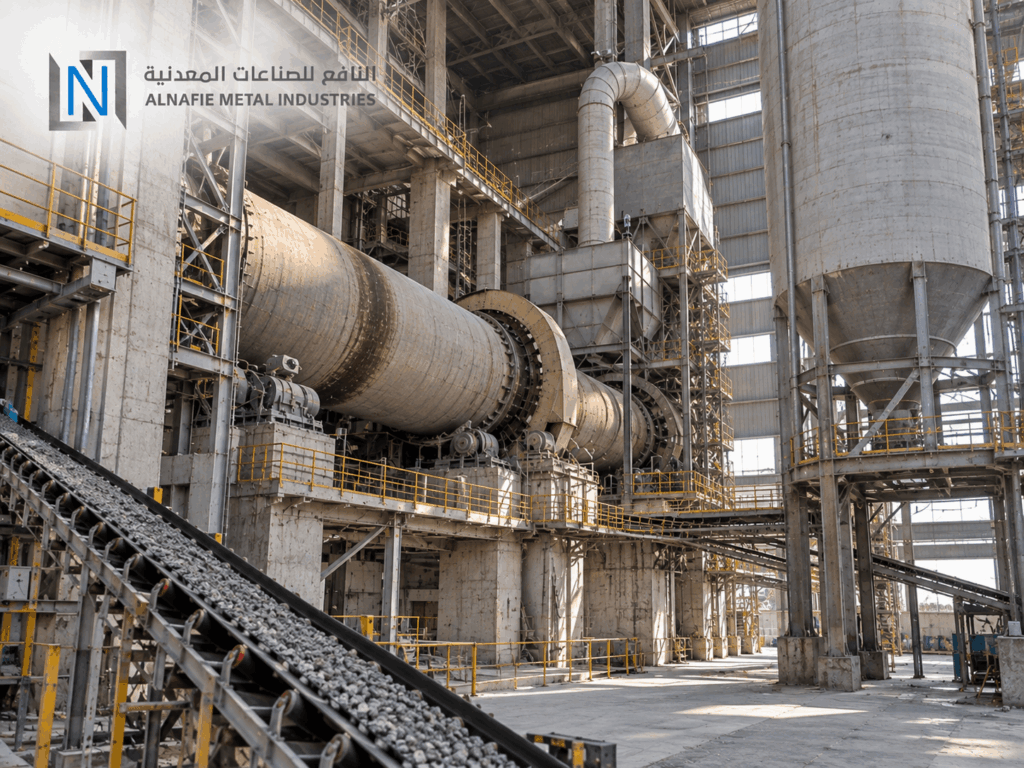
Key cement plant equipment
| Equipment | Function |
|---|---|
| Crushers | Size reduction of quarried raw material |
| Raw mills | Grinding and preparation of raw meal |
| Rotary kiln | Clinker production at high temperature |
| Clinker cooler | Rapid cooling and heat recovery |
| Cement mill | Grinding clinker with gypsum and additives |
| Silos | Storage of raw material, clinker and cement |
| Conveyors | Material transfer between production stages |
| Packing systems | Bagging and bulk loading |
| Ducting | Transfer of process gas and air |
| Stacks | Gas discharge under plant emissions systems |
Every item on that list shares one requirement: it depends on fabricated steel components built specifically for its dimensions and loads. That is why the fabrication partner is a core appointment on a cement plant project, not a late procurement line item.
Structural steel requirements in a cement plant
Structural steel in a cement plant does far more than hold equipment in place. It forms the network that ties the process together and makes safe operation and maintenance possible. Typical scope includes:
- Support structures for heavy equipment such as mills and crushers.
- Operating platforms around kilns, mills and control points.
- Steel stairways and access routes between levels.
- Industrial walkways and access bridges between plant units.
- Conveyor galleries and transfer towers.
- Structures for storage areas and material halls.
- Support frames for silos and tanks.
- Frames and bases for process and electrical systems.
Material grade and design are not secondary details here. Static and live loads, vibration from the mills, dust ingress and radiant heat all shorten service life when the design is wrong. Successful cement plant design starts with a rigorous load study before anything reaches the shop floor, and follows the Saudi Building Code on the civil and structural interfaces.
Metal products a cement plant needs
Most of the fabricated scope on a cement plant maps to a defined product list, which you can review under our product range:
Steel structures
The structural base that carries equipment and connects production stages.
Steel silos
Storage units for clinker, cement and raw materials, sized to the plant’s rated capacity.
Industrial tanks
Including storage tanks for fuel, water and utility service across the site.
Pressure vessels and static equipment
Covered under static equipment, fabricated to recognised engineering codes.
Piping systems
Delivered through piping works for liquids, gases and compressed air between process units.
Industrial ducting
Large fabricated sections moving hot gas between the kiln, preheater and treatment systems.
Industrial stacks
Vertical structures built to withstand heat and corrosion while discharging gas under the plant’s emissions systems.
Plate work and metal components
Produced through plate works, covering plates and formed sections built to drawing, alongside rebar for concrete foundations and galvanized steel for weather exposed elements.
Supporting systems
Including electrical panels and perimeter fencing securing the site and operating areas.
Why fabrication quality decides cement plant uptime
Heavy load capacity
Cement equipment is large and heavy. Any shortfall in the design or execution of a support structure shows up in equipment stability and operator safety.
Resistance to operating conditions
Heat, vibration, abrasion and dust act together inside a cement plant, which drives both material selection and surface treatment, particularly in the Saudi climate.
Dimensional accuracy
Components tied directly to process equipment do not tolerate dimensional drift. Small deviations translate into alignment and performance problems.
Fewer site problems
Accurate fabrication to drawing cuts fit-up issues in the field and shortens erection time. On a cement plant programme, that is schedule recovered directly.
How Alnafie supports cement plant projects
Building a cement plant is not just an equipment erection exercise. It requires an industrial partner able to fabricate and deliver the metal components that support every operating stage, to specification and to programme.
From an integrated metal fabrication facility in Jeddah, Alnafie delivers metal solutions for cement plants covering:
- Structural steel, platforms and industrial walkways.
- Silos and storage units.
- Industrial tanks and pressure vessels.
- Piping, ducting and stacks.
- Equipment and metal components built to engineering drawings.
Work is executed through our fabrication services, which include iron cutting, laser metal cutting, metal bending, metal rolling, metal perforation, slitting, blasting and metal finishing, through to delivery to site anywhere in the Kingdom.
Experience spans multiple heavy industry sectors, from steel fabrication to petrochemicals, which carries directly into the load cases and tolerances a cement plant demands.
Why cement plants need custom fabrication, not catalogue parts
There is no single metalwork solution that fits every cement plant. The differences between projects are fundamental:
- Plant layout and the arrangement of units across the site.
- Target production capacity.
- Equipment dimensions and the OEM supplying them.
- Static, live and vibratory load cases.
- Site conditions, ground characteristics and climate.
- Operating temperatures and dust loading.
- Erection requirements and site work sequencing.
- Approved engineering drawings and technical specifications.
This is why fabrication to specification, rather than off the shelf supply, is the correct route on a cement plant build. You can verify any industrial partner’s compliance record by reviewing their certifications before award.
Fabrication stages for cement plant components
Fabricated components follow a defined route from drawing to site:
Drawing review → material selection → cutting → forming → welding → finishing and surface treatment → inspection and testing → assembly → delivery and erection
Quality is set at the first stage. Reviewing drawings with an engineering team that understands cement plant conditions surfaces clashes early and saves time and cost in the field. Inspection is what confirms dimensions and welds meet specification before anything ships.
How to choose a fabrication partner for a cement plant project
When evaluating suppliers for a cement plant, work through this checklist:
- Track record on heavy industrial projects.
- Production capacity and schedule reliability.
- Shop area and facilities available for fabrication and assembly.
- Range of equipment available in house.
- Engineering capability to work from detailed drawings.
- Compliance with specifications and applicable codes.
- Quality control system and inspection documentation.
- Capability to fabricate large and heavy sections.
- Readiness for EPC project requirements.
- Ability to supply and erect on site.
You can review company background and fabrication capability through our company profile before shortlisting.
Building a cement plant in Saudi Arabia
A cement plant in Saudi Arabia succeeds or fails on decisions made before the site is fixed:
- Plant location: proximity to quarries and to target markets.
- Raw material availability: limestone in stable quantity and quality above all.
- Infrastructure: road access and connection to industrial networks.
- Transport and logistics: for distributing both bagged and bulk cement.
- Power and water: the two largest operating cost lines.
- Market proximity: to reduce freight cost and protect margin.
The Saudi market offers a mature industrial base for this class of project, backed by sustained construction activity across infrastructure, housing and giga projects. Just as important, using in-Kingdom fabrication rather than imported steelwork cuts lead times, reduces freight exposure and puts your engineering counterpart in the same time zone. On a cement plant programme, that is a decisive scheduling advantage. Working with an established industrial manufacturer in Saudi Arabia keeps that scope close to site.
How long does cement plant construction take?
There is no fixed duration that applies across projects. The schedule for a cement plant is set by interlocking factors:
- Target production capacity and overall project size.
- Production line type and process technology.
- Extent of civil and foundation works.
- Lead times on major equipment packages.
- Design and detailed engineering duration.
- Fabrication and supply duration for metalwork.
- Site erection activities.
- Testing and commissioning.
The reliable approach is to build a project specific schedule once the design and equipment list are frozen, rather than working to generic figures that misrepresent the critical path and distort planning from day one.
From fabrication to installation
Plant performance does not rest on process equipment alone. It rests on every component integrating correctly, from structures and steelwork through to the systems supporting the production lines. A cement plant is a single system, and a weak link anywhere in it surfaces later as lost output and rising maintenance cost.
Appointing one industrial partner covering fabrication, treatment and supply reduces the number of interfaces and shortens the decision cycle. That is the scope Alnafie Metal Industries carries on industrial projects in the Kingdom, from drawing review through to handover on site.
Frequently asked questions
What is a cement plant?
A cement plant is an integrated industrial facility that converts limestone, clay and corrective materials into cement through nine stages, the most critical being pyroprocessing in a rotary kiln at roughly 1,450°C to produce clinker. It runs as two sequential lines: raw material preparation and clinker production, then cement grinding, storage and packing. Each line requires heavy process equipment, supporting steel structures and dedicated storage.
What are the main components of a cement plant?
The core components are crushers, material conveyors, raw material storage and blending halls, raw mills, the preheater tower, the rotary kiln, the clinker cooler, cement mills, clinker and cement silos, packing and loading systems, plus ducting and stacks. Added to those is the structural steelwork that carries the equipment, links the stages and provides operating and maintenance access. In practice that steelwork determines how well the plant is executed.
How is cement produced inside the plant?
Production follows nine stages in sequence: raw material extraction, crushing, handling and storage, raw grinding, pyroprocessing in the kiln, clinker cooling, cement grinding, cement storage, then packing and dispatch. Each stage feeds the next, so a stoppage on any single unit in a cement plant halts the entire line rather than one section of it.
What is the most important equipment in a cement plant?
The rotary kiln is the most critical asset and the largest energy consumer, followed by the raw mills and cement mills, crushers, clinker cooler, silos, conveyors, packing systems and ducting. Each of these requires a steel structure engineered to its specific dimensions and load cases, which is what separates a plant that runs steadily from one that suffers repeated stoppages.
What is the difference between clinker and cement?
Clinker is the intermediate product discharged from the rotary kiln as hard, dark nodules, formed by burning raw meal at roughly 1,450°C. Cement is the finished product created by grinding clinker with gypsum and other additives in controlled proportions. Clinker cannot be used directly in construction; it must go through the grinding stage to become usable cement.
Why does structural steel matter so much in a cement plant?
Structural steel is the backbone of the facility. It carries heavy equipment such as mills and kilns, links production stages through conveyor galleries and transfer towers, and provides platforms, stairways and walkways for safe operation and maintenance. Design must account for static and live loads, vibration, heat and dust, because weakness there translates directly into equipment instability and higher maintenance cost across the asset life.
What metal products does a cement plant need?
A cement plant requires structural steel, silos, industrial tanks, pressure vessels, piping systems, industrial ducting, stacks, plate work, rebar for foundations, galvanized steel for exposed elements, electrical panels and perimeter fencing. Most of these are fabricated to the project’s engineering drawings rather than supplied from a catalogue, because dimensions and load cases differ from one plant to the next.
Can cement plant components be fabricated to engineering drawings?
Yes, and fabrication to drawing is the standard route on this class of project. Equipment dimensions vary between OEMs, load cases vary with rated capacity, and site, ground and climate conditions vary by region. Off the shelf solutions rarely fit, while fabrication to specification reduces site fit-up problems and protects the erection programme.
How long does cement plant construction take?
No fixed duration applies to every project. The schedule depends on target capacity, production line technology, the extent of civil and foundation works, equipment lead times, detailed engineering duration, fabrication and supply time, site erection, then testing and commissioning. The accurate approach is a project specific schedule built once the design and equipment list are frozen.
Does Alnafie supply metal solutions for cement plants?
Yes. Alnafie Metal Industries fabricates structural steel, platforms and walkways, silos and storage units, industrial tanks and pressure vessels, piping, ducting and stacks, and metal components built to engineering drawings. Services also cover cutting, laser cutting, bending, rolling, perforation, slitting, blasting and finishing, through to supply and erection on site.
Does Alnafie handle fabrication and installation for industrial projects?
Yes. The scope runs as a complete cycle: engineering drawing review, material selection, fabrication, surface treatment, inspection and testing, then supply and erection at the project site. Consolidating that scope with one partner reduces interfaces and shortens the decision cycle on a cement plant build. To discuss your project, contact the Alnafie team directly.
about
Alnafie Metal Industries
AlNafie Metal Industries is a leading private company with 33 years of experience in Saudi Arabia’s development. Specializing in steel construction and tank rehabilitation, NMI provides full steel fabrication and erection services for major EPC projects, including power, gas, petrochemical, industrial, and commercial sectors.