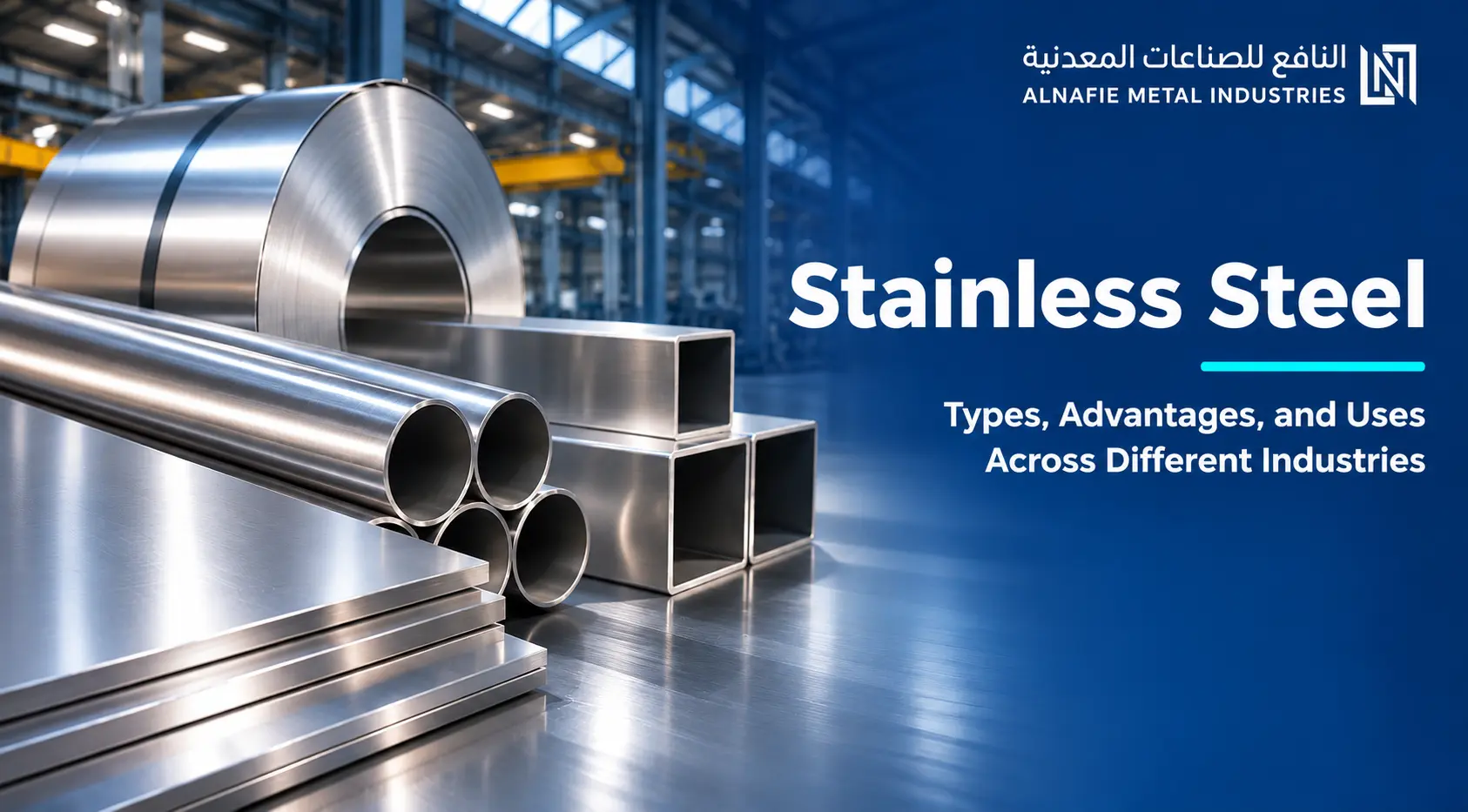
Stainless steel is the material Saudi engineers reach for when corrosion, hygiene or appearance really matter. It lines dairy tanks in Al-Kharj, carries treated water in desalination plants on the Red Sea coast, and forms handrails and cladding across Riyadh. But “stainless” covers dozens of grades with very different performance and price, and choosing the wrong one is a common, expensive mistake.
This guide explains what the alloy is made of, the main families and grades, the real difference between 304 and 316, why stainless can still rust, how to verify what you are buying, and how to select the right grade for a project in the Kingdom.
What Is Stainless Steel?
Stainless steel is an iron-based alloy that contains at least 10.5% chromium. That chromium reacts with oxygen to form an extremely thin, invisible oxide film on the surface, known as the passive layer. The film blocks further corrosion and, crucially, repairs itself when scratched as long as oxygen is present.
Ordinary carbon steel has no such protection, which is why it needs paint or galvanizing. The passive layer is what lets stainless go without coatings in most environments.
What Is It Made Of? Composition Explained
Every grade is mostly iron, with a recipe of alloying elements on top:
- Chromium (10.5% and above): the core of corrosion resistance.
- Nickel: found in the 300 series. Improves ductility, toughness, weldability and resistance to many acids.
- Molybdenum: found in 316 and duplex grades. Greatly improves resistance to pitting from chlorides such as salt.
- Carbon: usually kept low. “L” grades such as 304L and 316L limit carbon to 0.03% for better weld performance.
- Manganese and nitrogen: used in the 200 series as partial nickel substitutes, and in duplex grades for strength.
Is stainless steel 100% steel? It is a type of steel, but not pure iron. A typical 304 sheet is roughly 70% iron, with the rest mostly chromium and nickel.
Stainless Steel Grades and Families
Grades are grouped into families based on their internal crystal structure. Knowing the family tells you a lot about how a grade will behave.
Austenitic (200 and 300 Series)
The largest family, including 304 and 316. Excellent corrosion resistance, easy to form and weld, and generally non-magnetic in the annealed condition. This family covers most tanks, piping, food equipment and architectural work.
Ferritic (400 Series, Such as 430)
Chromium with little or no nickel. Magnetic, cheaper and with moderate corrosion resistance. Common in appliance panels, trim and some automotive parts.
Martensitic (Such as 410 and 420)
Can be hardened by heat treatment. Used for knives, surgical tools, valve trim and pump shafts where hardness matters more than maximum corrosion resistance.
Duplex (Such as 2205)
A balanced mix of austenitic and ferritic structures. Roughly twice the yield strength of 304 and much better resistance to chloride stress corrosion cracking. Widely used in seawater, desalination, and oil and gas service.
Precipitation Hardening (Such as 17-4 PH)
Combines high strength with good corrosion resistance, used for shafts, aerospace parts and high load components.
Stainless Steel Grades Chart
| Grade | Family | Chromium | Nickel | Molybdenum | Typical uses |
|---|---|---|---|---|---|
| 201 | Austenitic | 16–18% | 3.5–5.5% | No | Low-cost household items, indoor decor |
| 304 | Austenitic | 18–20% | 8–10.5% | No | Food, water, tanks, general use |
| 304L | Austenitic | 18–20% | 8–12% | No | Welded equipment |
| 316 | Austenitic | 16–18% | 10–14% | 2–3% | Coastal, marine, chemical |
| 316L | Austenitic | 16–18% | 10–14% | 2–3% | Welded tanks and piping |
| 430 | Ferritic | 16–18% | Negligible | No | Appliance panels, trim |
| 410 | Martensitic | 11.5–13.5% | Low | No | Valves, cutlery, pump parts |
| 2205 | Duplex | ~22% | ~5% | ~3% | Seawater, desalination, oil and gas |
What are the five grades? People usually mean the five families: austenitic, ferritic, martensitic, duplex and precipitation hardening.
Grade 304 Explained
Grade 304 is the most widely used stainless in the world. It is often called 18/8 because it contains about 18% chromium and 8% nickel. It offers excellent resistance in most indoor and mild outdoor environments, forms and welds easily, and is the standard choice for food processing, commercial kitchens, potable water tanks and sinks.
Its low carbon sister, 304L, limits carbon to 0.03%. That reduces carbide precipitation in the heat affected zone of welds, so 304L is preferred for heavily welded fabrications.
Is 18-10 grade 304 or 316? 18/10 indicates 18% chromium and 10% nickel, which falls within the 304 family. It is common in cookware and cutlery, where the extra nickel gives slightly better lustre and corrosion resistance.
316 Stainless Steel Explained
316 adds 2–3% molybdenum and more nickel. Molybdenum is the key: it significantly raises resistance to pitting and crevice corrosion caused by chlorides, which come from seawater, salty air, de-icing salts and many cleaning chemicals.
316L is the low carbon version and is the usual specification for welded tanks, process piping and pharmaceutical equipment. In Saudi Arabia, 316 or 316L is the sensible minimum for exposed work in Jeddah, Yanbu, Dammam, Jubail or anywhere near the coast.
304 vs 316 Stainless Steel: Which Is Better?
| Factor | Grade 304 | Grade 316 |
|---|---|---|
| Molybdenum | None | 2–3% |
| Nickel | 8–10.5% | 10–14% |
| Chloride and salt resistance | Good | Much better |
| Best environment | Indoor, inland, mild | Coastal, marine, chemical |
| Weldability and formability | Excellent | Excellent |
| Strength | Similar | Similar |
| Cost | Lower | Higher |
Which is better quality, 304 or 316? Neither is “better quality” in general. 316 is better in chloride-rich environments, while 304 is the smarter, cheaper choice indoors and inland. Paying for 316 where 304 is enough adds cost without benefit; using 304 on a Red Sea seafront invites staining and pitting.
Is 316 more expensive than 304? Yes. The extra nickel and the molybdenum make 316 noticeably more expensive, and the gap moves with global nickel and molybdenum prices.
What are the disadvantages of 316? Higher cost, and it is still vulnerable to pitting in very aggressive conditions such as warm seawater, where duplex or super austenitic grades may be needed.
What are the disadvantages of 304? Limited resistance to chlorides. In salty or chlorinated environments it can pit, stain or suffer stress corrosion cracking.
How Can I Tell 304 From 316?
They look identical, and a magnet cannot separate them. Reliable methods are:
- Mill test certificate: check the chemical analysis and match the heat number to the markings on the material.
- Molybdenum spot test: a chemical test kit that reacts to molybdenum, confirming 316.
- Portable XRF analyser (PMI): gives the alloy composition on site in seconds and is the most reliable field method.
Does Stainless Steel Rust?
Yes, it can. “Stainless” means it resists corrosion, not that it is immune. The passive layer can break down when:
- Chlorides attack it: salt air, seawater and bleach-based cleaners cause pitting, especially on 304.
- Crevices trap moisture: tight joints, gaskets and overlapping plates starve the surface of oxygen.
- Iron contaminates the surface: using carbon steel brushes, grinding discs or tools on stainless leaves iron particles that rust and look like the stainless is corroding.
- Welds are not cleaned: heat tint around welds reduces corrosion resistance unless removed and passivated.
- The wrong grade is used: 201 or 430 in a humid coastal setting will not last.
Can grade 304 rust? Yes, particularly near the sea or where chlorine-based cleaners are used. Brown “tea staining” on coastal installations is common and usually superficial.
How long until stainless steel rusts? There is no fixed time. In the right grade and environment it can last decades with minimal maintenance; in the wrong grade near the sea, staining can appear within months.
What is the enemy of stainless steel? Chlorides, trapped moisture and iron contamination are the three main enemies.
How do I keep it from rusting? Choose the right grade for the environment, specify a smooth surface finish, design out crevices, keep fabrication tools separate from carbon steel, passivate after fabrication and wash exposed surfaces regularly with fresh water.
Is Stainless Steel Magnetic?
It depends on the family. Austenitic grades such as 304 and 316 are generally non-magnetic when annealed, but cold working (bending, rolling, deep drawing) can make them slightly magnetic. Ferritic and martensitic grades such as 430 and 410 are clearly magnetic. A magnet can hint at the family but cannot confirm the grade.
Is Stainless Steel Safe for Food and Water?
Austenitic grades, especially 304 and 316, are the most widely accepted food grade stainless steel options for contact with food, beverages, drinking water and pharmaceuticals. They are non-reactive with most foods, smooth, and easy to clean and sanitize. Problems usually come from low-cost products of unknown composition, not from genuine 304 or 316. For new food plants, our guide to the manufacturing industries in Saudi Arabia covers how material choices fit into wider plant planning.
Stainless Steel vs Carbon Steel
| Factor | Carbon steel | Stainless |
|---|---|---|
| Corrosion resistance | Poor without protection | High |
| Coating required | Usually | Usually not |
| Initial cost | Lower | Higher |
| Maintenance | Regular repainting | Minimal |
| Typical uses | Structures, foundations, general piping | Food, water, chemicals, facades |
Galvanized steel sits between the two for many outdoor structures. See our guide to galvanized steel types, uses and cost for that comparison.
Common Product Forms
Stainless Steel Sheet and Plate
Sheet and plate are the most requested forms, used for tanks, equipment shells, cladding, worktops and enclosures. Read our overview of sheet metal works, including stainless sheet.
Stainless Steel Pipe and Tube
Available welded or seamless, in 304/304L for general service and 316L for chemical and marine lines. For fabrication and installation, see our piping works and metal pipes.
Bars, Angles and Sections
Round, flat and square bar plus angles and channels for light structures, handrails and equipment frames.
Surface Finishes
The same grade can be supplied in different finishes, and the finish affects both appearance and corrosion behaviour:
- 2B: smooth, matte mill finish. The standard for industrial sheet and tanks.
- BA (bright annealed): reflective, used in decorative and appliance work.
- No. 4 / hairline: brushed lines, common in lifts, kitchens and facades.
- Mirror (No. 8): full polish for decorative features.
Smoother finishes hold less salt and dirt, so they resist staining better in coastal air.
Industrial Uses in Saudi Arabia
- Storage tanks: 304 and 316L tanks for water, chemicals and food products. See our industrial steel storage tanks, the stainless steel tank project and our water tank and floating roof solutions.
- Desalination: high chloride levels call for 316L, duplex and super duplex grades. Read about desalination plants in Saudi Arabia.
- Petrochemicals: corrosion-resistant equipment and piping in Jubail and Yanbu. Our guide to petrochemicals in Saudi Arabia covers the sector.
- Demineralized water: systems that must not contaminate the water, like our demineralized water storage project.
- Static equipment: vessels, separators and process skids. See our static industrial equipment.
- Food, beverage and pharmaceuticals: processing lines, mixers, hoppers and worktops.
- Architecture: handrails, cladding and decorative features.
Fabricating Stainless: What Good Shops Do Differently
- Dedicated tools: separate grinding discs, brushes and clamps prevent iron contamination.
- Precision cutting: laser metal cutting gives clean edges with a small heat affected zone.
- Allowance for springback: stainless springs back more than mild steel during metal bending and metal rolling.
- Matched filler and shielding gas: welds use filler metal matched to the grade.
- Pickling and passivation: after welding, heat tint is removed and the passive layer restored, followed by appropriate metal finishing.
Stainless Steel Price Factors in Saudi Arabia
Prices change with global nickel, chromium and molybdenum markets, so any fixed number dates quickly. The main factors are:
- Grade: 316 costs more than 304, which costs more than 201 or 430.
- Form: sheet, pipe and sections are priced differently.
- Thickness and size: heavier sections cost more per piece.
- Finish: bright and mirror finishes cost more than 2B.
- Quantity and source: volume and certified mills affect the rate.
- Fabrication: cutting, forming, welding and finishing add cost based on complexity.
Stainless vs Aluminium vs Galvanized Steel
Buyers often compare these three because all resist corrosion in some way, but each has its place:
| Factor | Stainless | Aluminium | Galvanized steel |
|---|---|---|---|
| Weight | Heavy | Very light | Heavy |
| Strength | High | Lower | High |
| Corrosion resistance | High, grade dependent | Good in most atmospheres | Good, depends on zinc thickness |
| Food contact | Excellent | Limited in some uses | Not suitable |
| Heat resistance | High | Lower | Moderate |
| Typical cost | Highest | Medium | Lowest |
Choose stainless for food, drinking water, chemicals or long-life appearance. Choose aluminium when weight is the priority. Choose galvanized steel for large outdoor structures, fences and towers where cost matters and there is no food contact. Many plants combine them: a galvanized frame carrying stainless process parts, with insulating washers between the two metals.
Performance in the Saudi Climate: Coast vs Inland
Conditions across the Kingdom vary enough to change the right grade:
- Coastal cities (Jeddah, Yanbu, Dammam, Jubail): high humidity and salt-laden air are the toughest test. 316 is the practical minimum for exposed work, ideally with a smooth finish and routine fresh water washing.
- Inland cities (Riyadh, Qassim): dry air means far less corrosion, so 304 handles most indoor and outdoor uses. Dust should still be cleaned off, because it can hold moisture against the surface.
- Industrial zones: chemical fumes and aggressive cleaners can demand higher grades even far from the sea.
- Highlands (Abha, Taif): temperature swings, rain and condensation make good drainage and crevice-free design important.
The simple rule: the closer to the sea or the more chemicals involved, the higher the grade and the smoother the finish.
Cleaning and Maintenance
Looking after the alloy is simple if done regularly:
- Wash routinely with warm water and mild detergent, rinse with fresh water and dry with a soft cloth.
- Wipe with the grain on brushed and hairline finishes.
- Avoid chlorine bleach and chloride cleaners, or rinse immediately if they are used.
- Never use steel wool, which leaves iron particles that rust. Use non-metallic pads.
- Remove light brown staining with a dedicated cleaner; heavier attack may need re-passivation.
Common Buying Mistakes
- Accepting a grade without a certificate: 201 is sometimes sold as 304, and the difference only shows after months in humidity.
- Relying on a magnet: it cannot confirm the grade.
- Cutting thickness to save money: in tanks and pressure equipment, thickness is tied to design loads.
- Ignoring the finish: rough surfaces stain faster on the coast.
- Fixing directly to carbon steel: in wet conditions this corrodes the carbon steel unless the metals are isolated.
How to Choose the Right Grade
- Indoor or inland general use, food contact: 304.
- Heavily welded parts: 304L or 316L.
- Coastal, salt or chemical exposure: 316 or 316L.
- Seawater and high pressure: duplex 2205 or higher.
- Indoor decorative and appliance panels on a budget: 430.
- Low-cost household items: 201, accepting a shorter life in humidity.
Work With Alnafie Metal Industries
Looking for a trusted industrial company in Saudi Arabia? Choose Alnafie Industrial for reliable industrial solutions, exceptional quality, and expertise you can count on.
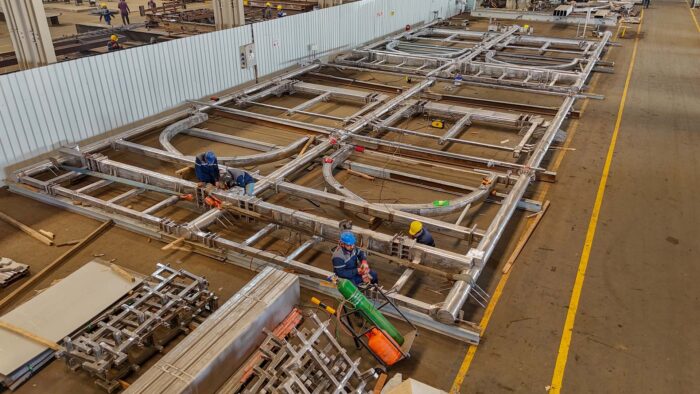
Alnafie Metal Industries fabricates stainless tanks, equipment and components to drawing, from cutting and forming to welding, pickling and finishing, with separate tooling to protect surface quality. Learn more about our approach in the steel fabrication buyer guide for Saudi Arabia, or contact our team for grade advice and a fabrication quote.
Planning an Industrial Project? Alnafie Can Fabricate and Erect It
Steel structures, storage tanks, piping and static equipment for power, petrochemical and industrial plants.
Alnafie Metal Industries
Metal fabrication in Jeddah · 500+ employees · 144,000 m² of facilities
ISO 9001 • ISO 14001 • ISO 45001 • ASMEFrequently Asked Questions
What is stainless steel made of?
Mostly iron, with at least 10.5% chromium. Many grades also contain nickel, molybdenum, manganese or nitrogen, depending on the required corrosion resistance and strength.
Is stainless steel good quality?
Genuine grades from certified mills are excellent for corrosion resistance, hygiene and long life. Quality problems usually come from low-cost products with unknown or downgraded composition.
Which is better quality, stainless steel 304 or 316?
316 performs better in salty, coastal or chemical environments because of its molybdenum content. 304 is the better value for indoor and inland use.
Is 316 more expensive than 304?
Yes. Its higher nickel and added molybdenum make it more expensive, and the price gap moves with global metal markets.
How can I tell if my stainless steel is 304 or 316?
Check the mill certificate and markings, use a molybdenum spot test, or use a portable XRF analyser. A magnet cannot tell them apart.
Can 304 stainless steel rust?
Yes. Chlorides from sea air or bleach cleaners, trapped moisture and iron contamination can all cause rust spots or pitting on 304.
Is 18-10 stainless steel 304 or 316?
18/10 belongs to the 304 family. It means about 18% chromium and 10% nickel, with no molybdenum.
What are the five grades of stainless steel?
The five families are austenitic, ferritic, martensitic, duplex and precipitation hardening.
How do I keep stainless steel from rusting?
Choose the right grade, use a smooth finish, avoid crevices, keep tools separate from carbon steel, passivate after fabrication and rinse exposed surfaces with fresh water regularly.
about
Alnafie Metal Industries
AlNafie Metal Industries is a leading private company with 33 years of experience in Saudi Arabia’s development. Specializing in steel construction and tank rehabilitation, NMI provides full steel fabrication and erection services for major EPC projects, including power, gas, petrochemical, industrial, and commercial sectors.