Major engineering projects in Saudi Arabia run on a tight supply chain, and metal sits at the front of it. The structure that carries the building, the tank that stores the fuel and the rebar inside the concrete all decide how long the facility lasts, how safe it is and when it gets handed over.
This guide explains what engineering projects need in metal products and services at every stage, and how to pick the right supplier. It also shows what Alnafie Metal Industries offers. The company has served the industrial and construction sectors in the Kingdom for 33 years from its factory in Jeddah, so the owner of any engineering project can source every metal requirement from one place.
What Are Engineering Projects and What Types Exist in Saudi Arabia?
Engineering projects are organized efforts that turn an engineering design into a working facility or system, within a set budget, schedule and technical specification. Every project moves through consecutive stages, from study and design through to commissioning and handover.
Engineering projects in the Kingdom vary by the sector they serve. The main types are:
- Construction projects: towers, residential and commercial complexes, hospitals and airports.
- Industrial projects: factories, warehouses, production lines and refineries.
- Infrastructure projects: bridges, roads, water and sewage networks and marine jetties.
- Energy and water projects: power plants, desalination plants and fuel tanks.
What these types share is that metal goes into their structure, their services and their protection systems. That makes the metal supplier a core partner in the success of all engineering projects, whatever their size.
As Saudi projects expand under Vision 2030, demand has grown for local suppliers who can fabricate large quantities to precise specifications. The principle is the same for a small contracting job and for giga projects: every engineering project needs metal that meets the specification and arrives on time.
Stages of Engineering Projects and the Metal Supplier’s Role in Each
Many engineering projects fall behind because of supply problems, not design problems. So a project manager should know what to ask the metal factory for at every stage:
- Design and shop drawings: The factory reviews the shop drawings, sets the sections, thicknesses and connection methods, and flags early any detail that is hard to fabricate or transport.
- Raw material supply: Plates, sections and rebar are ordered with mill certificates that prove the grade and chemical composition.
- Fabrication and forming: Parts are cut, bent, rolled and welded inside the factory. This stage decides how accurately everything fits on site later.
- Surface treatment: Sandblasting, then painting or galvanizing, to protect the metal from corrosion, especially in coastal cities.
- Transport and delivery: Parts are loaded and numbered in erection sequence, and reach you through the delivery service to the project site on the agreed date.
- Site erection: From hangar installation and warehouses to lifting heavy structures and tanks, with trained crews and suitable lifting equipment.
- Inspection and handover: Non-destructive testing of welds, pressure testing of pipes and vessels, then a complete quality file handed to the owner.
The more of these stages sit with one supplier, the fewer the gaps between parties. That is what engineering projects on tight schedules need, and what the manager of any engineering project wants: clear responsibility for quality.
This is where good engineering project management shows its value: settle the supply source before execution starts, not after.
Metal Products That Engineering Projects of Every Size Need
Quantities change from one project to the next, but the product list is nearly the same. These are the main items Alnafie supplies to engineering projects:
Steel Structures and Hangars
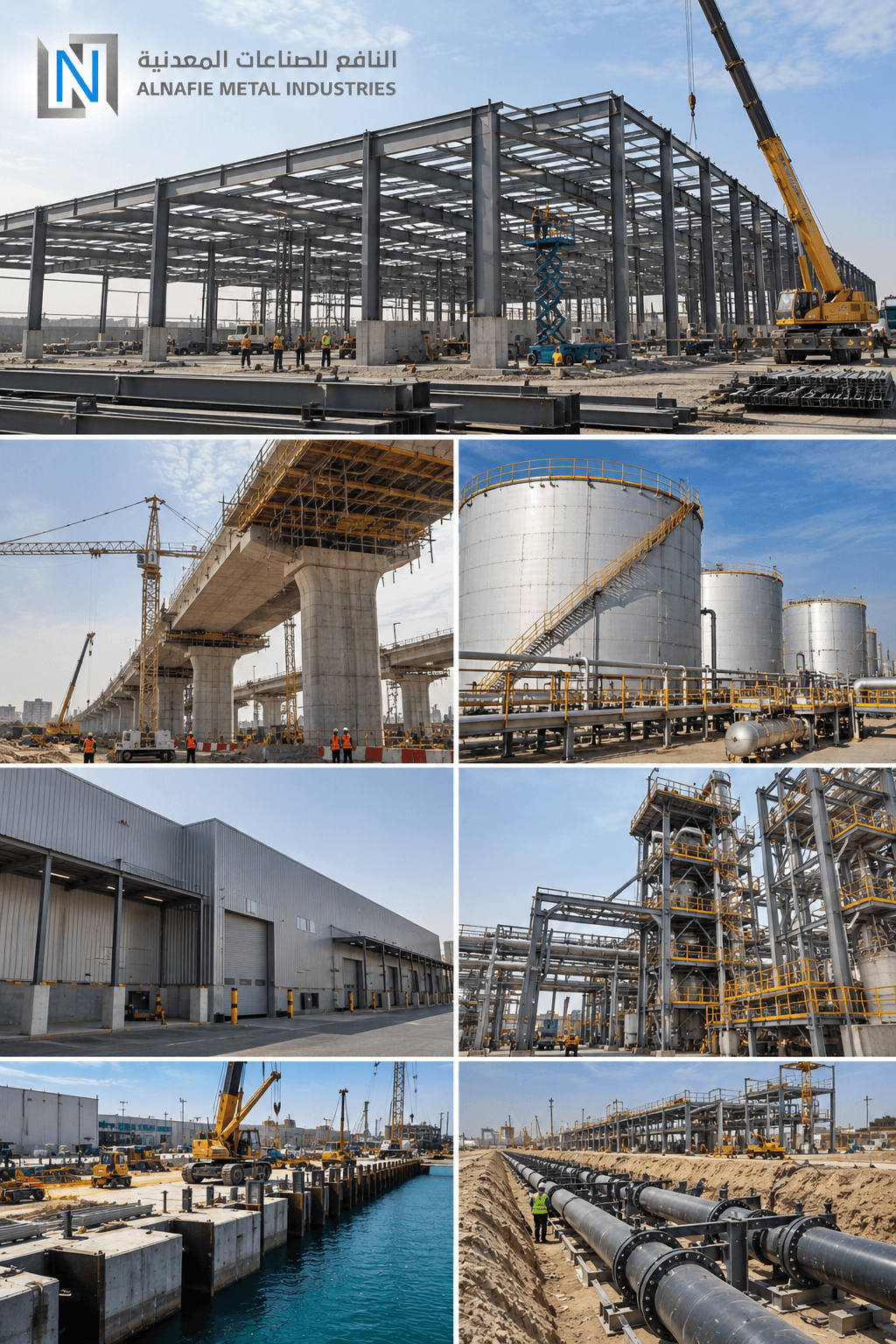
Steel structures are the backbone of factories, warehouses and airport halls. They are made of beams and columns joined by bolts or welding, and you will also hear them called metal structures. The range includes the steel hangar built on a truss system, with Z and C purlins for roofs and sides. In any engineering project, the advantage of a steel structure is fast erection and low weight compared with concrete.
Storage Tanks and Water Tanks
Factories, water plants and power plants need storage tanks in many sizes and shapes. Alnafie’s engineering team has experience building storage tanks and steel tanks for liquids, gases and petrochemicals, and rehabilitating existing ones. Its work includes water tanks and stainless steel tanks.
Static Equipment and Pressure Vessels
Static equipment covers pressure vessels, silos, stacks, air ducts and boiler ducts. It is the heart of an industrial facility, and it is fabricated to strict codes because any defect affects safety directly. That is why engineering projects in the energy and petrochemical sectors require a supplier with international approvals such as ASME.
Piping Works
In any industrial engineering project, pipes carry water, steam, gas and chemicals between the units of the facility. Piping works cover fabricating steel pipes, pre-assembling them in the factory, then installing and testing them. Pre-assembled pipe spools cut welding on site and shorten the schedule.
Rebar
No concrete stands without rebar, the material that construction engineering projects consume most. Alnafie distributes steel rebar and offers epoxy coating, an important protection for structures exposed to moisture and salts.
Plate Works and Galvanized Steel
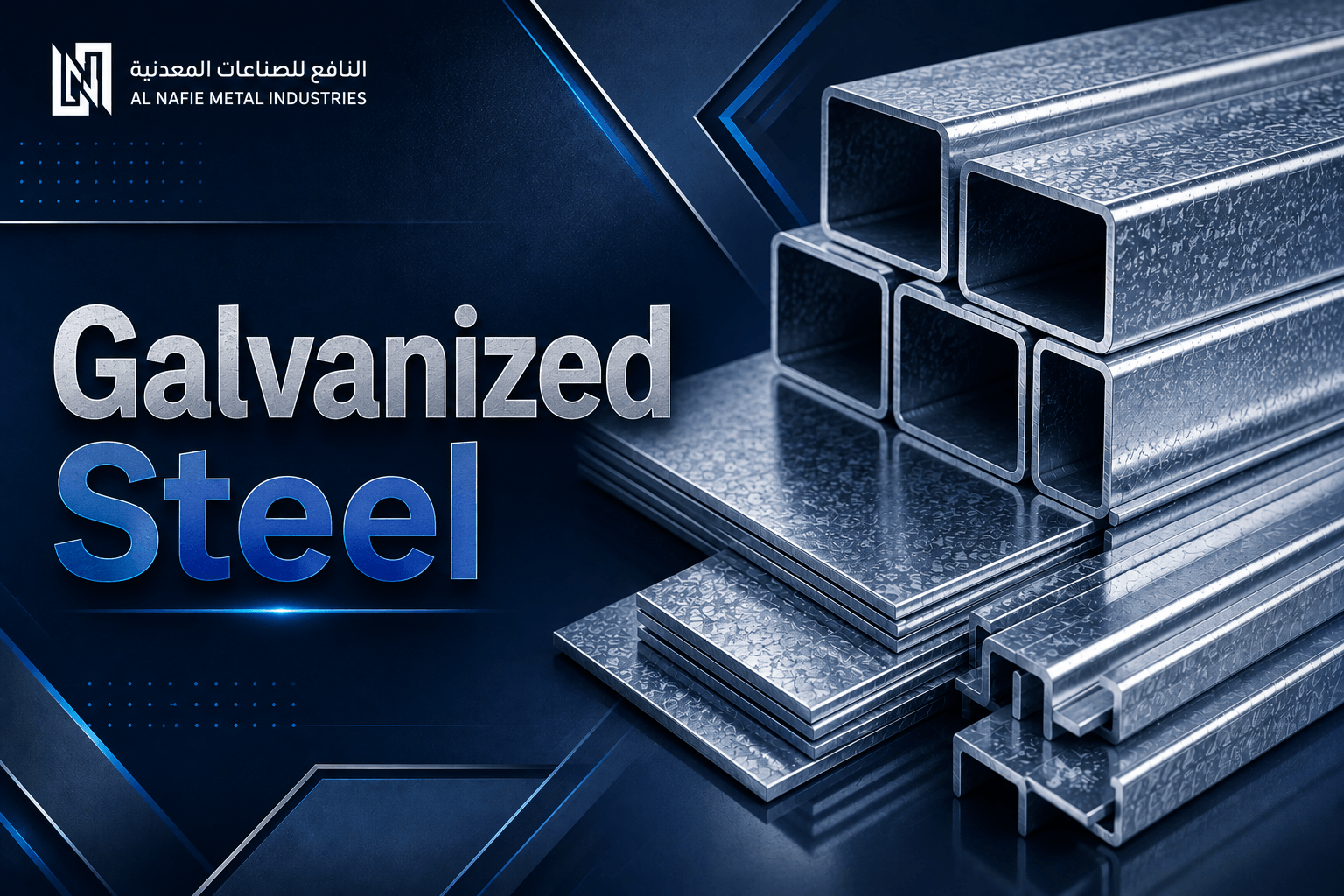
Plate works go into roofs, facades, floors and tank shells. Steel plate comes in several thicknesses, with corrugated steel sheet for cladding and galvanized sheet for exposed areas. Galvanized steel remains the best choice for coastal engineering projects, because the zinc layer protects the metal from rust.
Security Fencing and Electrical Panels
Work sites on engineering projects and critical facilities need security fencing from day one. Options range from a welded steel fence to wire mesh and galvanized chain link fence in different heights. The system is completed by metal enclosures for electrical panels that protect distribution and control equipment.
With this list, engineering projects cover most of their metal needs from one source instead of splitting orders across several suppliers.
What to Specify When Ordering Each Product
| Product | What the purchase order should specify |
|---|---|
| Steel structures | Design drawings, steel grade, paint or galvanizing system, and whether erection is in scope |
| Storage tanks | Capacity, stored material, operating pressure and temperature, design code |
| Piping works | Diameters and thicknesses, material grade, test pressure, weld inspection percentage |
| Rebar | Diameters, grade, quantity per diameter, and whether epoxy coating is required |
| Steel plate and sheet | Thickness, size, surface type, galvanized or black |
| Fencing | Height, mesh type, fixing method, perimeter length |
The more precise the purchase order, the faster the quotation arrives and the closer it is to the real cost.
Metal Fabrication Services Prepared to Your Project Drawings
Alnafie does not stop at supplying raw material. It prepares the material to the required size and shape before it leaves the factory. These are the main metal fabrication services and when engineering projects need them:
| Service | When the project needs it |
|---|---|
| Steel cutting to length | Preparing plates and coils in set lengths before fabrication |
| Laser cutting service | Precise parts, complex shapes and decorative facades |
| Slitting | Dividing wide coils into strips of a set width |
| Metal bending | Forming angles, sections and purlins |
| Metal rolling | Forming cylinders for tank shells and pipes |
| Metal perforation | Fixing holes in plates and sections |
| Sandblasting | Cleaning the surface before painting or coating |
| Metal finishing | Beveling edges and preparing them for welding |
| Delivery | Moving the order to the project site |
When these services sit under one roof, the part reaches site ready to erect. That shortens engineering projects and cuts material waste.
The practical rule: cut to length for large quantities and standard sizes, and laser when precision or shape complexity matters more than production speed.
You can order any single service through the quotation form on the website, whether you need laser cutting for a few parts, or steel bending and plate rolling for a whole large engineering project.
Sectors Alnafie Serves in Engineering Projects Across the Kingdom
Over three decades, Alnafie has taken part in engineering projects spread across many sectors:
- Energy and power: power plants and their structures, including the electricity towers project in Abha.
- Gas and petrochemicals: tanks, pressure vessels and pipelines needed by the petrochemical sector and refineries.
- Water: desalination plants, including the SWCC steel structure project.
- Infrastructure projects and airports: the NEOM piled jetty and the steel works revamp at King Khalid Airport.
- Industry and storage: cement, fertilizer and food processing plants, and steel warehouses.
This spread shows that engineering projects, whatever their activity, meet at the same need: metal from a reliable source.
Vision 2030 projects open the door to more demand for local manufacturing, from NEOM projects and the Red Sea to Riyadh projects and Jeddah projects. All of them are giant engineering projects that need Saudi factories able to produce at the required scale and quality. Every engineering project in these sectors has its own specifications and approvals.
Quality Standards and Approvals Required in Engineering Projects
Major engineering projects do not accept a supplier without documented approvals. These are the main ones consultants and owners ask for:
- ASME: authorization from the American Society of Mechanical Engineers for fabricating and assembling piping.
- NBIC R and NB: approval for repair and alteration work, and certification for inspecting and repairing pressure vessels.
- ISO certificates: ISO 9001 for quality management, ISO 14001 for environmental management and ISO 45001 for occupational health and safety.
- Saudi Building Code: the regulatory reference for designing and building structures in the Kingdom.
- Local content: government procurement gives preference to products manufactured inside the Kingdom.
On engineering projects, ask for a quality file with every delivery: mill certificates for the material, weld inspection reports, pressure test results where applicable, and paint or galvanizing thickness reports. This file is what the consultant relies on at receipt. Without it, approval of the work is delayed even when the execution is sound.
Alnafie holds ASME and NBIC approvals and all three ISO certificates, and you can view Alnafie’s certificates and approvals in full. Asking about ISO certification and pressure approvals should come before any contract in engineering projects.
How to Choose a Metal Products Supplier for Your Project
Whether you are a main contractor, work in general contracting, or are comparing suppliers used by construction companies in Saudi Arabia, review these points before you sign a supply contract for your engineering project:
- Production capacity: Are the factory’s area, equipment and crews enough for your project’s quantities and schedule?
- Approvals: Valid certificates you can verify, not just logos on a website.
- Track record: Completed projects of the same type as yours, documented with photos and owner names.
- Integrated services: Fabrication, forming, surface treatment and delivery from one party.
- Inspection system: Clear procedures for quality control in engineering projects, and an inspection file with every shipment.
- Commitment to dates: A supply plan tied to the erection schedule on site.
A supplier that passes all six points protects the budget and schedule of any engineering project.
Common Metal Supply Mistakes That Delay Execution
Some supply mistakes repeat across engineering projects, and an early decision avoids them:
- Ordering long-lead materials late: Some grades and thicknesses are not available in the local market immediately, and a late order stops fabrication entirely.
- Starting with drawings that are not final: Any change after cutting starts means wasted material and rework.
- Neglecting surface treatment: Paint over a poorly cleaned surface peels quickly, especially near the sea.
- Splitting the order across many suppliers: Responsibilities multiply and sizes differ at assembly on site.
- Receiving shipments without inspection: Checking material certificates and dimensions at receipt is far easier than finding the defect after erection.
- Unplanned transport: Long and heavy parts need a route, permits and lifting equipment arranged before the shipping date.
Avoiding these mistakes does not need extra budget. It needs early coordination between the designer, the contractor and the factory.
Why Is Alnafie a Partner for Major Engineering Projects?
Alnafie Metal Industries is a Saudi steel factory based in Jeddah, and one of the steel companies in Saudi Arabia that combine fabrication, forming and erection to serve varied engineering projects. Its key numbers:
- 33 years of experience in metal industries.
- More than 500 employees.
- 144,000 square meters of total facility area.
- ASME and NBIC approvals and three ISO certificates.
Its work includes the Mataf project at Al-Haram Al-Makki, along with the NEOM jetty and the electricity towers in Abha. Details and photos are on the completed projects page.
Alnafie’s scope covers steel structures, tanks, pressure tanks, pipelines, air ducts, silos and stacks, plus distribution of rebar, security fencing, corrugated sheets and Z and C purlins. That breadth lets you source most metal items for an engineering project from one factory, with one party responsible for quality.
This experience makes Alnafie a practical choice for anyone looking for a steel factory in Jeddah that serves engineering projects across the Kingdom’s regions.
Request a Quotation for Your Project Now
Send your drawings or bill of quantities to the Alnafie team and get a quotation for the metal products and services your engineering project needs. Call 920006420, email info@alnafie-indust.com or use the contact us page.
Frequently Asked Questions
What are the main metal products engineering projects in Saudi Arabia need?
The main ones are steel structures, rebar, storage tanks, piping works, steel plate, security fencing and electrical panels. Quantities vary by project type: industrial facilities need more tanks and pressure vessels, while buildings rely on rebar and structures.
What are the stages of engineering projects from design to handover?
They start with design and shop drawings, then material supply, then fabrication and forming, then surface treatment, transport and erection, and end with inspection and handover. The metal supplier has a role in every stage, from reviewing drawings to handing over the quality file.
What certificates should a metal supplier hold for any engineering project?
The main ones are ISO 9001 for quality management, and ASME and NBIC approvals where piping and pressure vessels are fabricated or repaired, along with ISO 14001 and ISO 45001 for environment and safety. Products must also comply with the Saudi Building Code and the owner’s specifications.
Does Alnafie provide fabrication and erection together for major engineering projects?
Yes. Alnafie provides steel fabrication, forming and erection services for power plants, gas and petrochemical plants, desalination plants and industrial and commercial facilities, plus delivery of orders to site.
about
Alnafie Metal Industries
AlNafie Metal Industries is a leading private company with 33 years of experience in Saudi Arabia’s development. Specializing in steel construction and tank rehabilitation, NMI provides full steel fabrication and erection services for major EPC projects, including power, gas, petrochemical, industrial, and commercial sectors.