Petrochemicals touch almost every hour of your day without ever announcing themselves.
The clothes you are wearing, the water bottle on your desk, your car’s dashboard, the fertilizer that grew your food, even the blister pack your medicine comes in — all of them trace back to petrochemical materials that feed a near-endless list of everyday industries.
But what exactly are petrochemicals? How are they classified? What are their most important products? How does a petrochemical plant actually run? And why is this sector one of the pillars of Saudi Arabia’s industrial economy?
This guide walks through petrochemicals from the fundamentals to the production stages and key applications — then looks at the engineering side most guides skip: what these plants are built from, what breaks them, and what a fabrication partner has to get right.
What Are Petrochemicals?
Petrochemicals are chemical compounds derived from crude oil and natural gas, used as the raw materials behind thousands of industrial and consumer products.
Petrochemicals vs. Petroleum Products
This is where most people get confused.
Petroleum products are what comes out of oil refining for energy and fuel purposes: gasoline, diesel, jet fuel, lubricating oils.
Petrochemicals are not burned for energy. They are re-engineered at the molecular level to become raw material for other industries.
Put simply: gasoline is consumed inside an engine, while ethylene becomes bags, pipes, containers, and fibers.
The Main Feedstocks
The industry runs on two primary sources.
Natural gas — specifically ethane and propane, which produce olefins at high efficiency and low cost.
Naphtha — a liquid produced by refining crude oil. It yields a wider range of compounds, but at a higher cost.
Feedstock selection is not a minor technical detail. It determines production cost and how competitive a plant is globally. This is exactly where Saudi Arabia holds a structural advantage, with large volumes of ethane available at a competitive cost — which is also why steam cracking dominates production in the Kingdom.
Why Petrochemicals Are a Foundational Industry Worldwide
Because they sit in the middle of the industrial value chain.
Above them are energy and resources. Below them are hundreds of downstream industries that cannot exist without them: packaging, automotive, construction, agriculture, textiles, electronics, and pharmaceuticals.
When a single petrochemical plant goes down, the effect is not limited to one product. An entire chain behind it feels it.
What Are the Types of Petrochemicals?
Petrochemicals fall into three sequential categories, each produced from the one before it.
Basic Petrochemicals
These are the starting point, produced directly by cracking raw feedstock.
The main ones are ethylene, propylene, butadiene, benzene, toluene, xylene, and methanol.
These compounds rarely reach the consumer in their raw form. Their value lies in being the first building block for everything that follows.
Intermediate Petrochemicals
These are produced by chemically processing basic petrochemicals to bring them one step closer to a finished product.
Practical examples: ethylene glycol, vinyl chloride, styrene, terephthalic acid, and ammonia.
This is where specialization begins. Ethylene glycol, for instance, later becomes polyester fiber and beverage bottles, while ammonia becomes fertilizer.
End Products
These are ready for direct industrial use.
Examples: polyethylene, polypropylene, polyester, synthetic rubber, resins, and solvents.
An easy way to tell them apart: basic petrochemicals are produced inside the plant, intermediates are processed inside it, and end products leave it for converting factories.
What Are the Most Important Petrochemical Products?
Plastics and polymers — by far the largest category. They go into packaging, water pipes, automotive parts, home appliances, and insulating building materials.
Fertilizers — urea, ammonia, and phosphate fertilizers. Directly tied to food security and agricultural yield.
Synthetic rubber — tires, conveyor belts, gaskets, and seals in industrial equipment.
Synthetic fibers — polyester, nylon, and acrylic, the backbone of textiles, clothing, and furnishings.
Solvents — used in paints, inks, detergents, and pharmaceutical preparations.
Intermediate chemicals — materials the consumer never sees, but which go into adhesives, insulation, and industrial additives.
What they have in common is that most of them are never sold under their own name. They disappear inside another product carrying a completely different brand.
What Is a Petrochemical Plant?
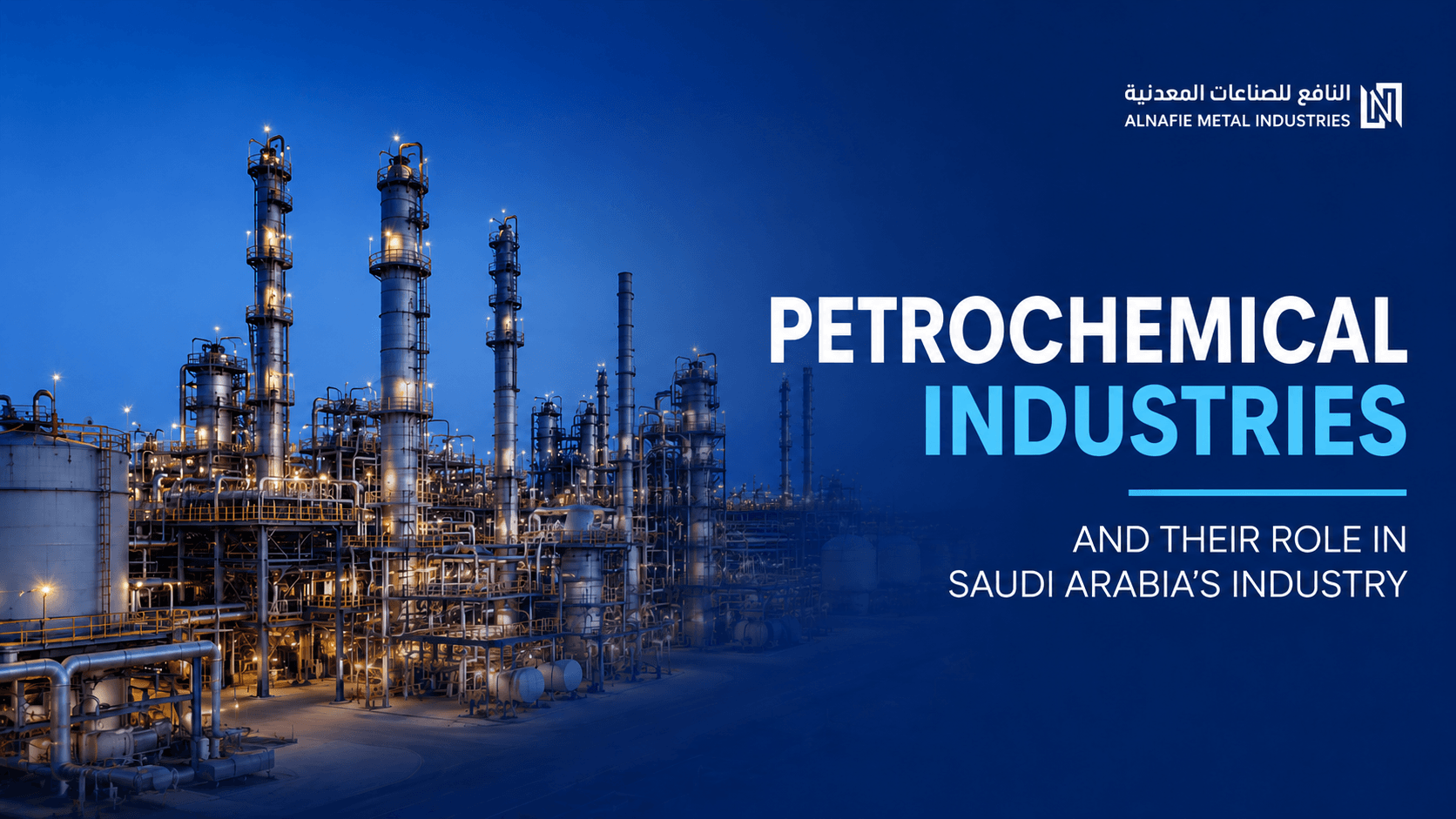
Petrochemical plants are integrated industrial facilities that convert oil and gas into chemicals other industries can use.
A plant is not a single building. It is a complex of multiple production units, transfer networks, storage facilities, safety and monitoring systems, and supporting utility stations.
Petrochemical Plant vs. Oil Refinery
A refinery separates crude oil into fuel products of different weights. Its work is essentially physical: separation and distillation.
A petrochemical plant chemically rebuilds molecules to form new compounds that did not exist in the raw feedstock at all.
The modern industry trend is to combine the two in integrated complexes, so that refinery output moves straight into the chemical units without external transport. Saudi Aramco has set a target of converting up to four million barrels of crude per day into chemicals by 2030, which is the clearest statement of where this integration is heading.
How Does a Petrochemical Plant Work?
The production cycle runs through five connected stages.
1. Feedstock receiving. Ethane or naphtha arrives by pipeline or tanker and is held in dedicated storage tanks before entering production.
2. Pre-treatment. Impurities, moisture, and unwanted compounds are removed — the ones that would otherwise damage catalysts further down the line.
3. Chemical reaction. This is the heart of the process. Large molecules are cracked or rearranged under precisely calculated heat and pressure, usually in the presence of catalysts.
4. Separation and purification. The reaction produces a mixture of compounds, separated through distillation and separation columns until the product reaches the required purity.
5. Storage and distribution. The product moves to tanks or silos, then ships as a liquid, a gas, or solid pellets.
The critical point about this cycle is that it is continuous, not batch. A plant is designed to run without stopping for long stretches, and any unplanned shutdown carries a very high operating cost.
Key Facilities and Components Inside a Petrochemical Plant
Production and processing units — reactors, distillation columns, heat exchangers, and furnaces.
Storage tanks — for raw, intermediate, and final materials, with specifications that change according to the nature of the liquid or gas and its hazard classification.
Piping networks — the arteries connecting every unit to the next, moving liquids and gases at widely varying pressures and temperatures.
Rotating and industrial equipment — pumps, compressors, valves, and control systems.
Steel structures — access platforms, stairs, walkways, pipe racks, and equipment support structures.
Supporting utilities — steam generation, cooling water, compressed air, firefighting systems, and electrical distribution boards.
Why Are Petrochemicals Important to Saudi Arabia?
The sector is one of the pillars of the Kingdom’s non-oil economy, and one of the most successful examples anywhere of converting natural resources into advanced downstream manufacturing.
According to the Saudi Export Development Authority, petrochemical merchandise exports reached SAR 149 billion (about USD 40 billion) in 2024 — 68% of the Kingdom’s total merchandise exports, out of a record SAR 515 billion in overall non-oil exports.
On the production side, Saudi petrochemical capacity now stands at roughly 118 million tonnes per year, with analysts at Arthur D. Little expecting it to approach 140 million tonnes within five years. Gulf Petrochemicals and Chemicals Association figures put Saudi Arabia at 74% of total GCC chemical production capacity, including 19.8 million tonnes of polymers in 2024 — the largest share in the region by a wide margin.
Jubail and Yanbu: Where the Capacity Sits
Almost all of that capacity is concentrated in two purpose-built industrial cities.
Jubail Industrial City, on the Arabian Gulf coast in the Eastern Province, is the larger of the two and the center of gravity for Saudi petrochemicals. It hosts the integrated complexes that sit closest to the Kingdom’s gas processing infrastructure, along with dedicated export terminals — which is why the heaviest ethane-based cracking capacity is there.
Yanbu Industrial City, on the Red Sea, is fed by the East–West pipeline network and gives producers direct access to European and Mediterranean shipping lanes without transiting the Gulf. It combines refining with chemical production in the same integrated pattern.
For contractors, the practical difference is environmental as much as logistical. Both sites are coastal, which means salt-laden air, high humidity, and an accelerated corrosion profile that changes how components are specified, coated, and inspected.
The Link to Downstream Manufacturing
The sector’s importance is not measured by export value alone, but by what it makes possible for everyone else.
Having petrochemical materials available domestically means that packaging, plastics, piping, paint, and textile factories find their raw material inside the Kingdom, without import costs or supply chain risk.
That is what makes the sector an enabler of local manufacturing, not just an exporter.
The Link to Saudi Vision 2030
The sector intersects with Vision 2030 in three clear directions.
Economic diversification — reducing reliance on crude oil exports in favor of higher value-added products.
Deepening the value chain — expanding into specialty products and advanced polymers instead of stopping at basic chemicals.
Building a local industrial base — which creates continuous demand for metal industries and for the fabrication, supply, and erection services that new and existing industrial facilities require.
Working on a petrochemical package? Our factory profile sets out our fabrication capacity, equipment list, and code approvals in one document. Download it, or send drawings to info@alnafie-indust.com for a quotation.
What Are the Main Challenges Facing the Petrochemical Industry?
This industry operates in some of the harshest conditions in the industrial world, and its challenges are as much engineering problems as economic ones.
Corrosion
The number one challenge, without competition.
Facilities handle reactive chemicals, high temperatures, and high pressures — and at coastal sites like Jubail and Yanbu, salt-laden air on top of all that.
That turns material selection and surface protection into a decision affecting the operating life of the entire facility, not just a line item in a specification. Surface preparation grade, coating system, and — where the application allows it — hot-dip galvanizing are what separate a component that lasts twenty years from one that needs replacing in five.
Process Safety
Flammable and explosive materials impose strict standards on both design and execution.
Weld quality, the integrity of pipe connections, tank compliance with specification, and precision in support structures are all classified as part of the safety system, not as finishing quality. This is why welding procedure qualification, welder certification, and non-destructive examination records matter as much as the finished component.
Uptime and the Turnaround Window
An unplanned shutdown costs twice over: lost production, an expensive restart, and delayed supply commitments.
That is why facility performance is measured by continuous run rate, and why repair and replacement work is deliberately batched into a planned turnaround — a scheduled shutdown, usually every two to five years, when the unit comes offline and everything that could not be touched during operation happens at once.
Turnaround schedules are fixed months in advance and priced by the day. A contractor who cannot pre-fabricate off site, deliver to the gate on schedule, and erect inside the window is not a viable option regardless of price.
Equipment Maintenance and Material Storage
As operating years accumulate, tanks, piping, and platforms need inspection, repair, and part replacement.
Storage tanks are the clearest example: floor plate corrosion, shell repairs, and roof replacement are recurring work on any tank farm past its first decade. Tank rehabilitation is a specialist discipline with its own inspection codes and repair procedures, and repairing pressure equipment in service is governed separately from building it new.
Quality and Documentation Requirements
Facilities in this sector work to precise engineering specifications and mandatory material certification.
A component that does not match the drawing, or does not carry complete documentation — mill test certificates, welding records, coating reports, dimensional inspection — is rejected regardless of how good it looks. On Aramco, SABIC, and SEC packages, the documentation file is a deliverable in its own right.
Sustainability and Environmental Impact
Pressure keeps building to cut emissions, reduce energy and water consumption, manage waste, and expand chemical recycling.
That shows up in the design of new facilities and in the upgrading of existing ones — and in practice, much of that upgrading work arrives as fabrication scope.
What Equipment Do Petrochemical Plants Need?
What all of the challenges above have in common is that addressing them starts with the quality of the metal component itself.
Storage Tanks
Used for raw materials, intermediate liquids, final products, and sometimes liquefied gases.
Specifications differ sharply according to the material, its pressure, its temperature, and its hazard level — which is what makes storage tank fabrication an engineering discipline rather than simple metal forming.
Roof configuration follows the stored product. Volatile hydrocarbons need a floating roof — internal or external — to eliminate the vapour space above the liquid and cut both emission losses and fire risk. Stable products can use a fixed cone or dome roof. Self-supporting and aluminium dome roofs cover the cases in between. That single decision changes the tank’s cost, its inspection regime, and its environmental compliance profile.
Piping and Industrial Components
Piping moves liquids and gases between plant units under varying pressures and temperatures.
Fabrication accuracy in piping works — from cutting and bending through welding, NDT, and hydrostatic testing — feeds directly into operational safety. Spool traceability from mill certificate to final weld map is standard scope, not an extra.
Steel Structures
Structures carry equipment and provide operating and maintenance platforms, stairs, walkways, and pipe racks.
Steel structures are designed to handle static and dynamic loads in a corrosive environment, which sets a higher bar than conventional buildings — heavier sections, tighter connection detailing, and coating systems specified for coastal exposure.
Static Equipment
This covers vessels, reactors, heat exchangers, and columns.
They sit at the core of processing and production, and static equipment fabrication is governed by precise requirements in material selection, welding execution, and inspection — the tightest tolerances anywhere in the plant, because these components hold a pressure boundary.
Supporting Metalwork
Not every item in a plant is a pressure boundary, but the supporting scope is substantial: plate and sheet metal work for enclosures, ducting, and cladding; electrical panel boards for distribution and control rooms; security fencing for perimeter and unit segregation; and rebar for foundations, tank pads, and containment bunds.
The Codes That Govern This Work
Nothing in a petrochemical facility is fabricated to a general standard. Each category of component falls under a specific code, and knowing which code applies to which scope is most of what separates a competent fabricator from a risky one.
API 650 covers welded atmospheric storage tanks — the large vertical tanks that dominate a tank farm. API 620 takes over where pressure or low temperature exceeds what API 650 allows, which is why it governs refrigerated and liquefied gas service. AWWA D100 applies to water storage rather than hydrocarbons.
ASME Section VIII is the reference for pressure vessels: reactors, exchangers, columns, and any vessel with a pressure boundary. ASME B31.3 governs process piping, setting out material selection, wall thickness calculation, examination, and testing for the piping that connects units.
NBIC NB-23 matters less at construction and more later. It governs the inspection, repair, and re-rating of pressure-retaining equipment already in service — which is the code a plant operator relies on during a turnaround when a vessel needs to be repaired rather than replaced.
AWS D1.1 covers structural welding and welder qualification. AISC governs structural steel design and fabrication. SASO is the Saudi materials baseline, and on Aramco projects SAES (Saudi Aramco Engineering Standards) sits above all of it. Major operators — Aramco, SEC, SABIC — publish their own specifications on top of the international codes, and those specifications, not the codes alone, are usually what a component is accepted against.
Two management-system certifications also come up on nearly every prequalification: ISO 9001 for quality management and ISO 45001 for occupational health and safety. On a site handling flammable and pressurised material, the second is close to a prerequisite rather than a differentiator.
Alnafie Metal Industries in Petrochemical Projects
Everything above leads to one conclusion: projects in this sector need an industrial partner capable of fabricating and forming steel to precise engineering specifications, and of supplying and erecting it when required.
Alnafie Metal Industries is an independent, privately run Saudi company that has spent more than three decades in steel construction and metal fabrication, with a specific specialization in building and rehabilitating steel storage tanks for liquids, gases, and petrochemicals. We supply full fabrication and erection packages to EPC contractors across power, gas, petrochemical, desalination, refining, chemical, fertilizer, cement, and food processing projects.
Codes and Certifications
We work to the codes set out above: API 650, API 620 and AWWA D100 for tanks, ASME for pressure equipment and pipe fabrication, NBIC NB-23 for repair of pressure-retaining equipment, AWS D1.1 for structural welding, and AISC and SASO for structural work — alongside Saudi Aramco, SEC and SABIC specifications and SAES where the project calls for it. We hold ASME authorization for pipe fabrication and assembly, and ISO 9001 and ISO 45001 certification. Everything is documented on our certificates page, with delivered work on our projects page.
Our scope is turnkey rather than fabrication alone: engineering, detailing, procurement, fabrication, painting, inspection and testing, delivery, installation, cladding and insulation, and equipment assembly.
In-House Fabrication Capability
Petrochemical scope moves through our own shop rather than a chain of subcontractors, which is what makes turnaround schedules achievable:
- Cutting and profiling — iron cutting, CNC laser cutting, and coil slitting
- Forming — metal bending, rolling, and perforation
- Surface preparation — blasting and metal finishing, the stage that determines how well a component resists corrosion later on
- Supply and erection — Kingdom-wide delivery to Jeddah, Riyadh, Dammam, and remote sites
For the wider picture of how fabrication scope is priced, scheduled, and specified in the Saudi market, see our complete buyer’s guide to steel fabrication in Saudi Arabia.
How to Choose a Fabrication Partner for Petrochemical Work
In this sector, choosing a contractor affects safety and schedule together — not just cost.
Code approvals matched to your scope. Every scope has its governing code, and a fabricator qualified for one is not automatically qualified for another. Establish which code applies to your package, then ask to see the certificate rather than accept a general claim of experience.
Evidence of work in live plants. Industrial projects differ from conventional construction in coordination complexity and permit-to-work discipline. Ask about packages delivered inside operating facilities, not just about company size.
Turnaround readiness. Ask directly how much of your scope can be pre-fabricated off site, what the shop load looks like in your window, and what the contingency is if inspection rejects a weld on day three of a fourteen-day shutdown.
In-house capability breadth. Cutting, forming, welding, and coating under one roof means tighter control over quality and dates, and fewer handover points between parties — and handover points are where most delays and disputes originate.
Material traceability and documentation. Ask for mill test certificates, NDT reports, welding procedure specifications, and coating inspection records. Confirm the documentation package before award, not after.
Coastal coating specification. For Jubail and Yanbu, confirm the surface preparation grade and coating system are specified for coastal exposure. This is the single most common cause of premature failure in the region.
If you have a project in the petrochemical sector and need fabrication, supply, or erection services, our engineering team can review your requirements and help you identify the right approach.
Send us your drawings for a quotation — or call 920006420.
Frequently Asked Questions
What are petrochemicals used for in daily life?
They go into plastic containers and water pipes, polyester clothing, car tires and dashboards, paints and detergents, medicine packaging and medical supplies, and the fertilizers used to grow crops. Most of these materials never appear under their own name — they disappear inside a finished product carrying a different brand.
What raw materials are used to make petrochemicals?
The two primary sources are natural gas and crude oil. Gas yields ethane and propane, the most efficient low-cost route to olefins. Refining crude oil produces naphtha, which yields a wider range of compounds at a higher cost. Feedstock choice is what determines a plant’s global competitiveness.
How are petrochemicals made?
Feedstock is first cleaned of impurities and moisture, then fed into a cracking furnace where heat and pressure — usually with a catalyst — break large hydrocarbon molecules into smaller, more reactive ones such as ethylene and propylene. Those products are separated by distillation into individual streams of the required purity. From there, they are either shipped as basic chemicals or polymerized and processed further into intermediates and end products. In Saudi Arabia the dominant route is steam cracking of ethane, because of the Kingdom’s abundant low-cost gas supply.
Are petrochemicals fossil fuels?
No, though they come from the same source. Fossil fuels are burned to release energy. Petrochemicals are made from the same crude oil and natural gas, but instead of being combusted they are chemically restructured into materials — plastics, fibers, fertilizers, and solvents. Roughly the same barrel, an entirely different destination.
Are petrochemicals environmentally friendly?
The industry is energy intensive, and its plastic products create a waste management challenge. That said, the sector is actively moving toward lower emissions, better energy and water efficiency, and wider use of chemical recycling, which returns plastic to primary raw materials. Environmental impact depends heavily on the production technology and the waste management system around it.
What is the difference between petrochemicals and chemicals?
“Chemicals” is the broader term, covering every chemical compound whatever its source — minerals, plants, salts, or hydrocarbons. Petrochemicals are a subset, limited to compounds derived specifically from oil and natural gas. In other words: every petrochemical is a chemical, but not every chemical is a petrochemical.
What is the future of the petrochemical industry in Saudi Arabia?
The direction is clearly toward deepening the value chain: expanding into specialty products and advanced polymers instead of stopping at basic chemicals, and integrating refining with chemical production in combined complexes. Capacity is expected to move from roughly 118 million tonnes per year toward 140 million within five years. That direction aligns with Vision 2030 targets for economic diversification, and it means continued demand for industrial projects and the fabrication and supply services attached to them
about
Alnafie Metal Industries
AlNafie Metal Industries is a leading private company with 33 years of experience in Saudi Arabia’s development. Specializing in steel construction and tank rehabilitation, NMI provides full steel fabrication and erection services for major EPC projects, including power, gas, petrochemical, industrial, and commercial sectors.