
Rebar

Every concrete building in Saudi Arabia, from a villa foundation in Riyadh to a desalination tank on the Red Sea coast, depends on rebar. The steel bars tied together before the pour decide whether the structure carries its loads, resists cracking and lasts for decades. Yet the same questions come up on almost every project: which bar sizes go where, what grade to order, how many bars are in a ton, and how much steel a floor really needs.
This guide answers those questions in practical terms. It covers what rebar is and why concrete needs it, the main types of rebar, a full size and weight chart in millimetres, Saudi specifications, how to estimate quantities, and what drives the rebar price in Saudi Arabia today. It draws on our experience at AlNafie Metal Industries supplying, cutting and bending reinforcement steel for projects across the Kingdom.
What Is Rebar?
Rebar, short for reinforcing bar, is a carbon steel bar placed inside concrete to strengthen it. Concrete is excellent in compression but weak in tension: when it bends or is pulled, it cracks. Steel is the opposite, strong in tension and ductile. Put the two together and you get reinforced concrete, a material that handles compression, tension and bending at the same time.
Two things make the partnership work. Steel and concrete expand with heat at almost the same rate, so they stay bonded through Saudi summers and cool winter nights. And the alkaline concrete protects the bar from corrosion as long as the concrete cover is thick enough.
If you want to see where reinforcement steel sits among other steel products, read our guide to types of steel.
Rebar Meaning and Common Names
On drawings, mill certificates and supplier quotes you will see several names for the same product:
- Rebar / reinforcing bar / reinforcement bar: the general terms.
- Reinforcement steel / reinforcing steel: used for the material as a whole.
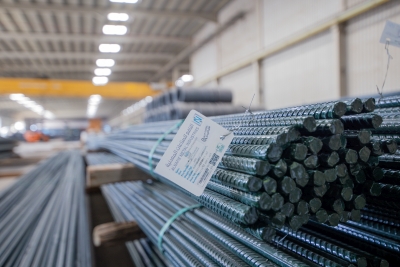
- Deformed bar: a bar with raised ribs on the surface, the standard type today.
- Plain bar / round bar: a smooth bar with no ribs.
- Steel rebar: used to separate steel bars from fibre-reinforced polymer bars.
What Is Rebar in RCC and How Is It Used?
RCC stands for reinforced cement concrete. When a slab or beam carries load, its top is squeezed and its bottom is stretched. Concrete takes the compression on top, while the rebar at the bottom takes the tension and holds cracks closed. In columns, longitudinal bars share the compressive load and prevent buckling, and the ties (stirrups) hold those bars in place and resist shear.
For load to transfer, the bar must grip the concrete. That is why modern reinforcement is deformed: the ribs lock into the concrete and give far better bond than a smooth bar.
Types of Rebar
By Surface: Deformed vs Plain
- Deformed bars: ribbed along its length. It is the default for structural work because of its superior bond.
- Plain bars: smooth, with weak bond. Today it is limited to minor or non-structural uses.
By Grade (Yield Strength)
Rebar grades describe the minimum stress the bar can carry before it deforms permanently. Under ASTM A615/A615M, which is widely referenced in Saudi Arabia, the common grades are:
| Metric grade | Imperial grade | Minimum yield strength | Typical use |
|---|---|---|---|
| 280 | Grade 40 | 280 MPa | Small diameters, light work |
| 420 | Grade 60 | 420 MPa | The most common grade in Saudi buildings |
| 520 | Grade 75 | 520 MPa | Large projects and heavily loaded columns |
What Is Grade 60 Rebar?
Grade 60 rebar has a minimum yield strength of 60,000 psi, or about 420 MPa. It is the workhorse grade for residential and commercial concrete in the Kingdom, and it is what most structural drawings specify unless the engineer calls for a higher grade.
By Coating and Protection
- Black (uncoated) bars: the standard, most economical option.
- Epoxy coated rebar: coated with fusion-bonded epoxy that isolates the steel from moisture and chlorides. It is widely used near the coast, in water tanks and in marine structures.
- Galvanized rebar: coated with zinc by hot-dip galvanizing, and more tolerant of handling damage than epoxy. Read more in our galvanized steel guide.
- Stainless steel bars: for structures where corrosion must be avoided at almost any cost. See our stainless steel guide for grade details.
GFRP Rebar
GFRP (glass fibre reinforced polymer) and BFRP (basalt) bars never rust and weigh a fraction of steel. They are less ductile, cannot be bent on site, and must be used only where the structural design is based on them. They suit some marine and infrastructure applications.
Welded Rebar Mesh
Bars welded into a ready grid speed up slab-on-grade, paving and precast work by removing manual tying. We cover sizes and uses in our wire mesh guide.
What Is the Strongest Type of Rebar?
In terms of strength alone, higher grades such as Grade 75 (520 MPa) and above carry the most stress. But “strongest” is not always “best”. A high grade that is hard to bend, or an uncoated bar in a coastal tank, can perform worse over the life of the structure than a Grade 60 bar with the right protection.
Rebar Sizes
Rebar Sizes in mm Used in Saudi Arabia
The Saudi market works in millimetres. Standard diameters are 8, 10, 12, 14, 16, 18, 20, 22, 25, 28 and 32 mm, with larger sizes for special projects. The standard bar length is 12 metres.
Metric and Imperial Rebar Sizes
US drawings and some imported specifications use bar numbers, where each number is roughly one-eighth of an inch. A quick comparison:
| US bar size | Nominal diameter | Closest metric size |
|---|---|---|
| #3 | 9.5 mm (3/8 in) | 10 mm |
| #4 | 12.7 mm (1/2 in) | 12 mm |
| #5 | 15.9 mm (5/8 in) | 16 mm |
| #6 | 19.1 mm (3/4 in) | 18 or 20 mm |
| #8 | 25.4 mm (1 in) | 25 mm |
Is #4 or #5 Rebar Bigger?
#5 is bigger. The number counts eighths of an inch, so #4 is half an inch and #5 is five-eighths of an inch.
When to Use 3/8 vs 1/2 Rebar?
The engineer decides, but as a rule of thumb, 3/8 inch (10 mm) is common for stirrups, light slabs and secondary reinforcement, while 1/2 inch (12 mm) is a typical main bar for slabs, small footings and lightly loaded elements.
Rebar Weight Chart
Rebar weight per metre follows a simple formula: weight (kg/m) = diameter² (mm) ÷ 162. Using it for a 12 m bar:
| Diameter (mm) | Rebar weight per meter (kg) | Weight of 12 m bar (kg) | Bars per ton (approx.) |
|---|---|---|---|
| 8 | 0.395 | 4.74 | 211 |
| 10 | 0.617 | 7.41 | 135 |
| 12 | 0.889 | 10.67 | 94 |
| 14 | 1.210 | 14.52 | 69 |
| 16 | 1.580 | 18.96 | 53 |
| 18 | 2.000 | 24.00 | 42 |
| 20 | 2.469 | 29.63 | 34 |
| 22 | 2.988 | 35.85 | 28 |
| 25 | 3.858 | 46.30 | 22 |
| 28 | 4.840 | 58.07 | 17 |
| 32 | 6.321 | 75.85 | 13 |
These are theoretical values. Actual weight varies within the tolerance allowed by the standard, which is one reason reinforcement is sold by the ton in Saudi Arabia.
What Is 12 mm Rebar?
12 mm rebar is a bar with a nominal diameter of 12 millimetres. It weighs about 0.889 kg per metre, or roughly 10.7 kg for a standard 12 m bar, and a ton contains about 94 bars. It is one of the most used sizes for slabs and small footings.
Rebar Weight Calculator: Doing It Yourself
- Add up the total length of each diameter from the drawing, including laps and bends.
- Multiply each total by the weight per metre from the chart.
- Add the results for all diameters.
- Allow for wastage. Shop-cut and bent bars reduce it significantly.
Need Reber for your project? Get a quote from Alnafie today.
Alnafie Metal Industries
Metal fabrication in Jeddah · 500+ employees · 144,000 m² of facilities
ISO 9001 • ISO 14001 • ISO 45001 • ASMESaudi Rebar Specifications and Standards
Reinforcement steel used in the Kingdom must meet the requirements of the Saudi Standards, Metrology and Quality Organization (SASO). The most widely referenced specification is based on ASTM A615/A615M. The main checks are:
- Chemical composition: carbon, manganese, phosphorus and sulphur within limits.
- Mechanical properties: yield strength, tensile strength and elongation for the grade.
- Bend test: the bar must bend around a specified pin without cracking.
- Mass per metre: within the permitted tolerance.
- Rolled-in markings: mill symbol, size and grade on every bar.
- Mill certificate: linked to the heat and batch number.
Where enhanced weldability is needed, engineers may specify ASTM A706.
Receiving Rebar on Site: Tests and Checks
- Match markings to the certificate: mill symbol, size and grade.
- Weigh random samples: compare them with the weight chart.
- Check the surface: light surface rust is normal; flaking, scaling or pitting is not.
- Send samples to a lab on larger projects for tensile and bend tests.
- Reject bent or kinked bars that were damaged in handling.
Rebar in Construction: Where It Goes
Foundations and Footings
Footings usually use 12 to 20 mm bars depending on load and soil, with a larger concrete cover because they are cast against earth.
Columns and Beams
Columns typically use 14 to 25 mm longitudinal bars with 8 or 10 mm ties. Beams combine bottom tension bars, top bars and stirrups as designed.
Slabs and Roofs
Slabs commonly use 10 to 14 mm bars in two directions. Ribbed (hourdi) slabs concentrate larger bars in the ribs.
Water Tanks and Hydraulic Structures
Ground tanks and treatment basins need tight crack control, and many use epoxy coated bars, as seen in desalination plants.
Steel-framed warehouses and hangars rely on structural steel rather than reinforcement bars, but their concrete foundations still need rebar. For that kind of project, see our steel structures page and our steel structure warehouse project.
Rebar vs Structural Steel
Rebar works inside concrete and never carries load on its own. Structural steel, such as beams, channels and hollow sections, forms a complete frame connected by bolts or welds. A concrete building needs reinforcement bars; a steel warehouse needs structural sections; both need reinforced concrete foundations. Knowing the difference helps you order the right material and understand why prices per ton differ.
Reading Rebar Drawings
Structural drawings use shorthand you should recognise before work starts:
- Number before the symbol: the count of bars, so 6T16 means six 16 mm bars.
- T, Y or Φ: high-yield deformed bar, depending on the design office’s convention.
- @ followed by a number: spacing, so T12@150 means a 12 mm bar every 150 mm.
- B and T in slabs: bottom and top layers.
- Stirrups: usually shown as size and spacing, such as R8@200 or T10@150.
Make sure drawings are approved and final before cutting. Any change after cutting and bending means scrap and delay.
Concrete Cover, Laps and Tying
- Concrete cover: the distance between the bar and the concrete surface. The Saudi Building Code SBC 304, based on ACI 318, sets minimum values by element, larger for elements cast against earth and smaller for interior slabs. Insufficient cover is the leading cause of corroded bars and spalled concrete.
- Lap splices: where a bar ends, the next one overlaps it by a length the engineer sets as a multiple of the bar diameter.
- Rebar couplers: in large columns and bars of 25 mm and above, mechanical couplers save steel and reduce congestion compared with long laps.
- Tying: bars are tied with soft tie wire and set on chairs and concrete spacers to hold the cover during the pour.
Post-Installed Rebar (Doweling)
Doweling anchors new bars into existing concrete, for example to add a column or extend a slab:
- Scan to locate existing bars before drilling.
- Drill to the diameter and depth set by the adhesive manufacturer and the engineer.
- Clean the hole thoroughly with a brush and compressed air, more than once.
- Fill with epoxy adhesive from the bottom up to avoid trapped air.
- Insert the bar with a slight twist and leave it undisturbed until cured.
Bar Bending Schedule (BBS)
A bar bending schedule turns the structural drawing into numbers: for each element it lists diameter, shape code, segment lengths, number of pieces and total weight. Fabricators cut and bend from it.
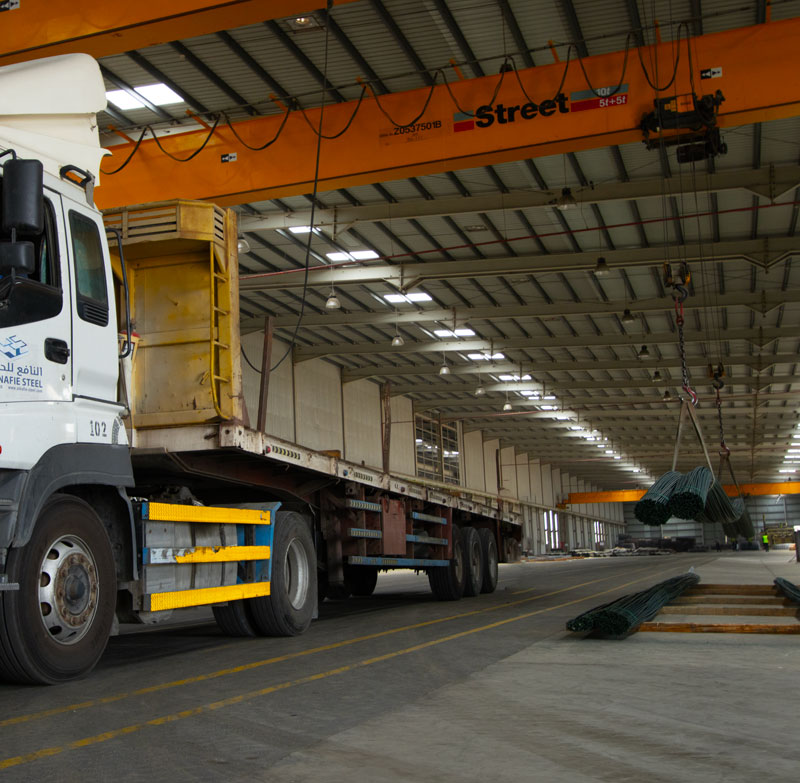
At Alnafie, we receive schedules from contractors and deliver bars cut, bent and tagged by element using our iron cutting and metal bending capabilities. This cuts site wastage and speeds up fixing.
How Much Rebar per Square Metre?
There is no fixed figure, because quantity depends on the structural design, slab type, spans, number of floors and soil. As a common preliminary estimate for concrete residential buildings, consumption is roughly 40 to 60 kg of steel per square metre per floor, or about 4 to 6 tons for a 100 m² floor. The exact figure only comes from the drawings and the bar bending schedule.
Rebar Corrosion: When Rust Becomes a Problem
Light surface rust that wipes off does not harm bond. The problem is flaking rust that reduces the bar’s cross-section, or corrosion that starts inside the concrete after casting. That rust expands and cracks the cover, which is what you see in old ceilings.
Protection starts with storage on supports away from soil and rain, continues with adequate cover and low-permeability concrete, and in harsh environments includes coated bars. We explain causes, treatment and prevention in our guide to iron rust.
Storing Rebar on Site
- Keep bars on timber or concrete supports at least about 15 cm off the ground.
- Separate and label each diameter to avoid mix-ups during fixing.
- Cover long-stored bars with a tarpaulin, leaving ventilation so moisture does not collect.
- Keep epoxy coated bars out of prolonged direct sun and lift it with soft slings to protect the coating.
- Schedule deliveries close to when the steel is needed instead of storing it for months.
How Saudi Conditions Affect Rebar
Coastal cities such as Jeddah, Dammam and Jubail combine humidity with airborne and soil salts, which accelerate corrosion when cover is thin or concrete is permeable. Inland sites see large day–night temperature swings, and some soils contain sulphates. Engineers respond with thicker cover, sulphate-resistant cement, and coated bars for sensitive elements such as foundations and tanks.
Which Steel Is Used for Reinforcement?
For concrete buildings, it is deformed carbon steel bars, most often Grade 60 (420 MPa). Steel-framed buildings use structural sections instead, and special environments may call for epoxy coated, galvanized, stainless or GFRP bars.
Rebar Price in Saudi Arabia
Based on prices listed by Saudi building materials platforms on 22 November 2026, standard bars sold for roughly SAR 3,200 to 3,400 per ton including VAT, and epoxy coated rebar for roughly SAR 3,900 to 4,050 per ton. Prices move with raw material and scrap costs and with demand, so treat these figures as a guide.
What drives the price:
- Global iron ore prices and the cost of scrap that feeds electric arc furnaces. Our scrap metal guide explains its role.
- Diameter, since very small sizes can cost more per ton.
- Coating: black, epoxy or galvanized.
- Quantity: project pricing differs from single-ton pricing.
- Cutting, bending and delivery services.
How Rebar Is Made
Rebar is made from direct-reduced iron or scrap, melted mostly in electric arc furnaces and cast into billets. The billets are reheated and passed through successive rolling stands that reduce them to the target diameter, and the final stand rolls on the ribs and markings. Controlled cooling then gives the bar its mechanical properties before it is cut to 12 m lengths. Our steel fabrication guide covers the wider process.
From Supply to Fabrication
On well-run projects, reinforcement passes through preparation before it reaches site: cutting to length, bending into stirrups and hooks, assembling cages for columns and piles, and surface preparation for coated bars through blasting and metal finishing. These steps are part of the wider field of metal forming, which covers every method of turning raw steel into finished parts.
Common Rebar Mistakes
- Storing bars directly on soil.
- Insufficient concrete cover.
- Swapping diameters without the engineer’s approval.
- Short laps, or laps in the wrong location.
- Cold bending around too small a radius, which causes micro-cracks.
- Buying the cheapest steel with no mill certificate.
Recycling Rebar
Steel is one of the most recyclable materials, and much of the region’s reinforcing steel is made from scrap melted in electric arc furnaces. Offcuts from site and shop are collected and sold back to mills. The more bars are cut and bent in the shop to a proper schedule, the less scrap leaves the site and the lower the project cost.
Rebar from Alnafie Metal Industries
AlNafie Metal Industries supplies black and epoxy coated bars for projects, with cutting and bending to your bar bending schedule, bundles tagged by element, and delivery to site. We request mill certificates for every batch, and we can supply the rest of your project’s metalwork, from storage tanks to piping works and steel pipe.
Send your drawings or bar bending schedule through our contact page and our team will return a detailed quotation.
Planning an Industrial Project? Alnafie Can Fabricate and Erect It
Steel structures, storage tanks, piping and static equipment for power, petrochemical and industrial plants.
Alnafie Metal Industries
Metal fabrication in Jeddah · 500+ employees · 144,000 m² of facilities
ISO 9001 • ISO 14001 • ISO 45001 • ASMERebar FAQ
What is a rebar?
Rebar is a steel bar, usually deformed carbon steel, placed inside concrete to carry tension and control cracking. The name is short for reinforcing bar.
What is rebar in RCC?
In reinforced cement concrete, rebar is the steel that takes the tensile and bending stresses the concrete cannot carry on its own.
What are the standard sizes of rebar?
In Saudi Arabia, standard rebar sizes are 8, 10, 12, 14, 16, 18, 20, 22, 25, 28 and 32 mm, supplied in 12 m lengths.
What is 12 mm rebar?
It is a bar with a 12 mm nominal diameter, weighing about 0.889 kg per metre or 10.7 kg per 12 m bar, with about 94 bars per ton.
Is #4 or #5 rebar bigger?
#5 is bigger: it is five-eighths of an inch (about 16 mm), while #4 is half an inch (about 12 mm).
What is grade 60 rebar?
Grade 60 rebar has a minimum yield strength of 60,000 psi (about 420 MPa). It is the most commonly specified grade in Saudi buildings.
What is the strongest type of rebar?
Higher grades such as Grade 75 (520 MPa) carry the most stress, but the best choice also depends on bendability, corrosion exposure and the design.
What is the price of steel rebar in Saudi Arabia?
Based on Saudi building materials platforms on 22 November 2026, standard bars were about SAR 3,200 to 3,400 per ton including VAT, and epoxy coated rebar about SAR 3,900 to 4,050.
How many rebar bars are in a ton?
It depends on diameter: about 211 bars of 8 mm, 94 bars of 12 mm, 69 bars of 14 mm and 53 bars of 16 mm, all 12 m long.
Which steel is used for reinforcement?
Deformed carbon steel bars, typically Grade 60. Epoxy coated, galvanized, stainless or GFRP bars are used where corrosion risk is high.
How much rebar does a 100 m² floor need?
As a rough preliminary estimate, about 4 to 6 tons, based on 40 to 60 kg per square metre. The exact quantity comes from the structural drawings.
