Search for steel mesh in Saudi Arabia and you will find very different products sold under almost the same name: reinforcement mesh for concrete slabs, square welded mesh for fences and cages, chain link for farms and sports grounds, hexagonal netting for poultry, expanded metal for walkways, and steel grating for industrial floors. Ordering the wrong one, or comparing quotes for products that are not equivalent, is one of the most common purchasing mistakes on construction sites.
This guide sorts out the main types of wire mesh, explains how sizes are specified, shows where each type is used, and lists the factors that drive price in the Kingdom. It draws on our experience in steel fabrication, security fencing and reinforcement at Alnafie Metal Industries.
What Is Wire Mesh?
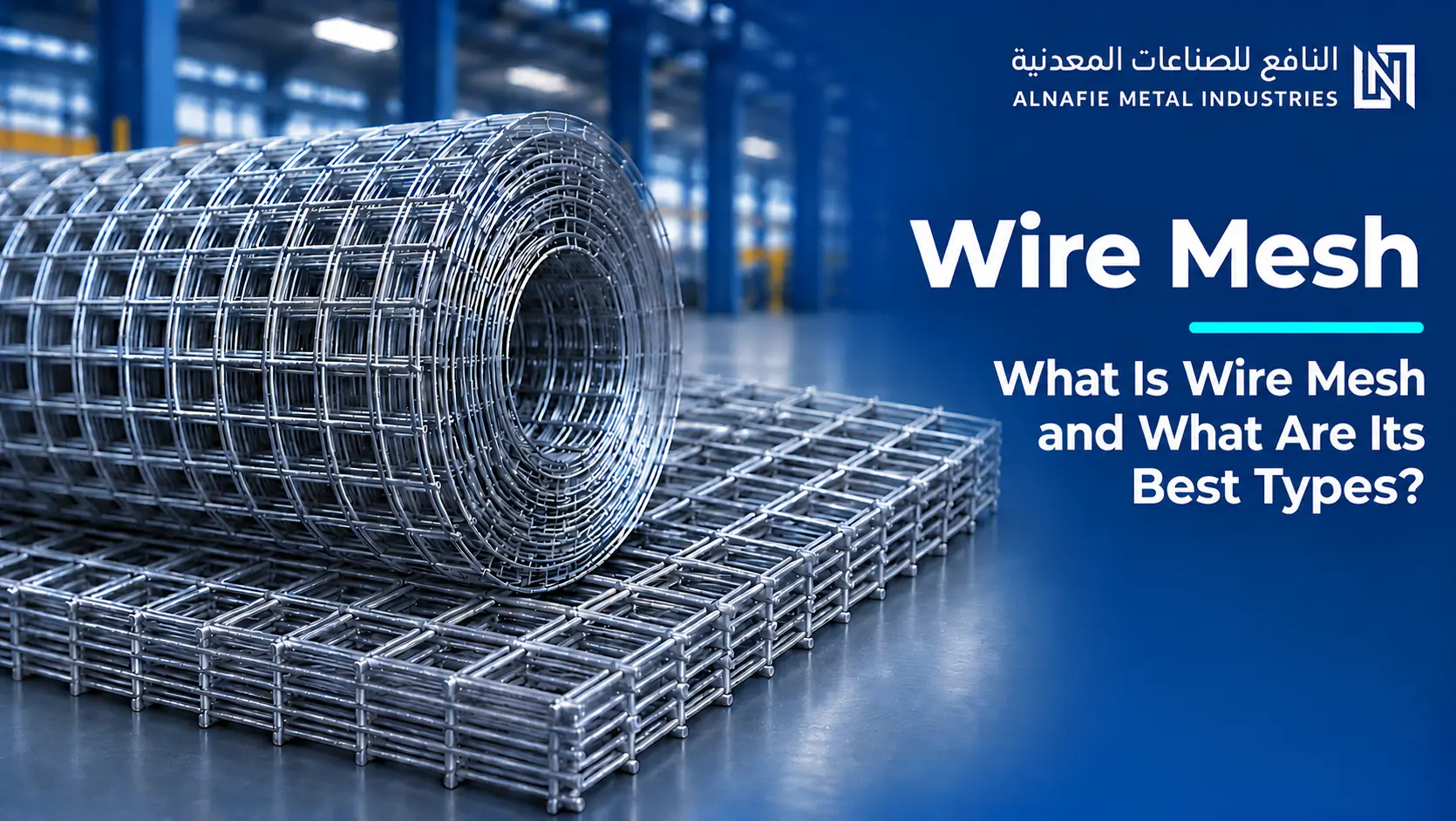
Wire mesh is a grid of steel wires or bars that cross each other to form regular openings. The wires may be welded at each intersection, woven or twisted together, or the “mesh” may be formed from a single slit and stretched sheet. Types differ in manufacturing method, wire diameter, opening shape and size, and corrosion protection.
What Is Wire Mesh Called?
Depending on the product you will hear welded wire mesh, welded wire fabric, reinforcement mesh, BRC mesh (a common trade name in the Gulf), steel mesh, wire netting, chain link fencing, hexagonal mesh, chicken wire, expanded metal and grating. In Arabic the general term is شبك حديد.
When you request a quote, always specify four things: type, wire diameter, opening size and finish (black, galvanized or PVC coated). Without them, two offers cannot be compared fairly.
Main Types of Wire Mesh
| Type | How it is made | Opening shape | Typical use |
|---|---|---|---|
| Welded reinforcement mesh | Bars welded at intersections | Square or rectangular | Ground slabs, pavements, precast |
| Welded wire mesh (light) | Thinner wires welded | Small or medium squares | Fences, cages, partitions |
| Chain link mesh | Wires twisted together | Diamond | Sports grounds, farms, sites |
| Hexagonal mesh | Wires twisted in hexagons | Hexagonal | Poultry, plant protection |
| Expanded metal | Slit and stretched sheet | Diamond | Walkways, machine guards, facades |
| Anti-climb mesh | Welded with very narrow openings | Narrow rectangle | High-security perimeters |
| Steel grating | Flat bars welded or pressed | Rectangular | Industrial floors, platforms, stairs |
| Gabion mesh | Heavy galvanized woven or welded | Hexagonal or square | Retaining walls, slope protection |
Welded Reinforcement Mesh
Steel bars laid in two directions at right angles and resistance welded at every intersection in a factory. Because spacing is fixed and accurate, it saves hours of tying rebar on site. It is used in ground-bearing slabs, pavements, swimming pools, light concrete walls and precast elements.
Light Welded Mesh
Thinner wires welded into small or medium squares, supplied in rolls or panels. Used for light fencing, animal cages, warehouse partitions and opening protection.
Chain Link Mesh
Woven by twisting wires into a diamond pattern without welding, so it is flexible and follows uneven ground. Common for sports courts, farms, construction sites and warehouse yards, available galvanized or PVC coated in green.
Hexagonal Mesh
Light netting with hexagonal openings, often called chicken wire. Used for poultry houses, protecting seedlings and reinforcing some plaster work.
Expanded Metal
Made from a single steel sheet that is slit and stretched to form diamond openings, with no welds. It is strong for its weight and used for industrial walkways, machine guards and architectural facades. A related product is perforated sheet, where holes are punched; see our metal perforation services.
Anti-Climb Mesh
Welded mesh with openings too narrow for fingers or standard cutting tools, making it hard to climb or cut. Used around airports, substations and sensitive facilities, as covered in our security fencing guide.
Steel Grating
Flat bars set on edge and joined by cross bars by pressing or welding. It carries heavy loads at far less weight than solid plate and lets water and air pass. Used for plant floors, platforms, stair treads and trench covers.
Gabion Mesh
Heavy galvanized mesh baskets filled with stone, used for retaining walls, road slope and wadi protection, and landscaping.
Reinforcement Mesh for Concrete
Why Use Mesh Instead of Tied Bars?
- Faster installation: a ready panel is placed directly instead of tying hundreds of intersections.
- Accurate spacing: factory-fixed spacing removes distribution errors.
- Lower labour: especially across large warehouse floors and car parks.
- Stability during pouring: welded panels do not shift as easily as tied bars.
Mesh does not replace main reinforcement in columns, beams and foundations unless the engineer designs it that way. For bar reinforcement details, see our rebar and epoxy-coated rebar page.
How Does Mesh Control Cracking?
Concrete is strong in compression but weak in tension. As it shrinks while curing and expands and contracts with Saudi temperature swings, small tensile stresses form and open surface cracks. Mesh spread across the whole slab holds the concrete together and distributes those stresses instead of letting them concentrate. It works best alongside proper joints, curing and mix design, and only when it sits at the right depth in the slab.
Reinforcement Mesh Sizes (BS 4483)
A widely used reference is the British standard for welded fabric, which names each sheet by its steel area in mm² per metre:
| Designation | Bar diameter (mm) | Spacing (mm) | Steel area (mm²/m) | Approx. weight (kg/m²) |
|---|---|---|---|---|
| A142 | 6 | 200 × 200 | 142 | 2.22 |
| A193 | 7 | 200 × 200 | 193 | 3.02 |
| A252 | 8 | 200 × 200 | 252 | 3.95 |
| A393 | 10 | 200 × 200 | 393 | 6.16 |
Rectangular “B” and “C” series exist for one-way slabs, and many mills also supply 100 or 150 mm spacings. In the Saudi market, mesh is often described simply by bar size and opening, such as 8 mm at 150 × 150 mm.
The standard sheet size under that system is 4.8 m × 2.4 m, about 11.52 m² before laps. In the Saudi retail market, however, the most common sheets are 2 m × 5 m (10 m²) and 1.5 m × 4 m (6 m²), so confirm the sheet size before comparing prices.
Wire Mesh 6mm, 8mm and 10mm: Where Each Fits
- 6 mm: light ground slabs, pavements, walkways and anti-crack reinforcement.
- 8 mm: medium slabs such as private car parks, light warehouse floors and pools.
- 10 mm: heavier floors with forklift traffic or commercial parking, subject to design.
The final choice always follows the structural drawings, because slab thickness, loads and soil conditions all matter.
Laps, Cover and Spacers
- Laps: adjacent sheets overlap by the distance shown on the drawings, commonly at least two cross wires.
- Cover: mesh must sit on chairs or spacers so it ends up inside the concrete at the required cover, not on the ground.
- Tying: sheets are tied together so they do not move during the pour.
Welded Wire Mesh vs Wire Mesh: What Is the Difference?
“Wire mesh” is the broad family. Welded wire mesh is one type, where wires are fused at each crossing, giving a rigid panel with fixed openings. Woven types such as chain link and hexagonal netting are flexible because the wires are twisted, not welded. Welded mesh is stiffer and keeps its shape; woven mesh adapts to terrain and absorbs impact.
What Is Wire Mesh Used For?
- Concrete reinforcement: slabs, pavements, pools and precast.
- Fencing: homes, farms, sports grounds, warehouses and industrial perimeters.
- Animal enclosures: poultry, sheep, camels and cages.
- Machine guarding: protecting workers from moving parts.
- Partitions and storage cages: separating high-value stock in warehouses. This is common inside warehouses clad with sandwich panels.
- Floors and platforms: steel grating around tanks and equipment, as seen with industrial storage tanks.
- Window and door protection: custom fabricated grilles.
- Civil works: gabions for slopes and retaining walls.
What Are the Uses of Welded Mesh Specifically?
Welded mesh is chosen wherever a rigid, uniform grid is needed: concrete reinforcement, rigid fence panels, security partitions, cages and machine guards.
Wire Mesh Fence: Options for Homes and Farms
- Small-opening welded mesh: keeps out small animals and birds, suitable for gardens and aviaries.
- Medium welded mesh for yards: heavier wire on steel posts set in concrete.
- Rigid welded panels: framed or with longitudinal folds for stiffness and a cleaner look.
- Chain link: economical and flexible for long farm boundaries.
- PVC coated mesh: extra protection against humidity and a coloured finish.
A fence is more than mesh: posts, rails, clips, bracing and gates complete it. Posts are usually galvanized steel tube; see our steel pipe guide for sizes and schedules.
Installing a Mesh Fence Step by Step
- Set out the line with corner stakes and string.
- Dig footings sized for fence height and wind.
- Set galvanized posts in concrete and plumb them.
- Add bracing at corners, gates and long runs.
- Unroll and tension the mesh evenly, especially chain link.
- Fix with clips to posts and line wires at regular spacing.
- Hang gates on stronger frames and suitable hinges.
- Treat any cuts or welds with zinc-rich paint.
Choosing the Right Mesh by Application
| Application | Recommended type | Finish |
|---|---|---|
| Ground slab or pavement | Welded reinforcement mesh | Black |
| Home yard or garden fence | Welded squares or rigid panels | Galvanized or PVC coated |
| Long farm boundary | Chain link | Galvanized |
| Poultry house | Hexagonal netting | Galvanized |
| Sensitive facility | Anti-climb welded | Galvanized and painted |
| Plant floor or platform | Steel grating | Hot-dip galvanized |
| Window protection | Custom fabricated grille | Painted or galvanized |
| Slope or retaining wall | Gabion baskets | Heavy galvanized |
What to Write in a Reinforcement Mesh Order
- Bar diameter in both directions.
- Bar spacing in both directions.
- Sheet or roll size.
- Steel grade and required yield strength.
- Reference standard.
- Number of sheets or total weight.
- Mill certificate with tensile and weld shear test results.
On delivery, spot-check bar diameters and spacings across several sheets and make sure welds hold firmly.
Window Protection Options
- Solid bar grilles: square or round bars welded into a frame. Very strong, suited to ground floors and stores.
- Square tube grilles: lighter and cheaper with a modern look, provided wall thickness is adequate.
- Welded mesh in a frame: small openings stop hands and tools, good for stores and electrical rooms.
- Decorative wrought work: combines security with appearance, fabricated to design.
For bedrooms, include an openable section from the inside for emergency exit. Whatever the type, good surface preparation and paint decide how long it lasts outdoors.
Galvanized Wire Mesh: When Do You Need It?
Galvanizing coats steel with zinc to protect it from rust. Options include:
- Hot-dip galvanized after fabrication: thicker coating that covers welds; best for outdoor and coastal use.
- Made from pre-galvanized wire: cheaper, but welds are less protected.
- Galvanized plus PVC coating: double protection and colour.
Mesh embedded in concrete is usually black, because the concrete protects it. Mesh exposed to weather, such as fences and cages, lasts far longer galvanized, particularly in Jeddah, Dammam and humid areas. Our guide to galvanized steel types, uses and cost explains coating methods in detail.
Grating vs Wire Mesh vs Reinforcement Mesh
| Factor | Steel grating | Fencing mesh | Reinforcement mesh |
|---|---|---|---|
| Material | Flat bars | Thin to medium wire | Round or ribbed bars |
| Function | Walkable load-bearing floor | Fence, barrier, guard | Reinforcement inside concrete |
| Load capacity | Very high | Low to medium | Works with concrete |
| Common finish | Hot-dip galvanized | Galvanized or PVC coated | Black |
| Where used | Plants, platforms, stairs | Fences, farms, warehouses | Slabs, pavements, pools |
How Is Wire Mesh Size Measured?
- Opening size: usually measured centre to centre of wires, written as width by length, for example 50 × 50 mm.
- Wire diameter: measured with calipers in millimetres. Some suppliers use gauge numbers, so convert before comparing.
- Roll size: width and length, for example 1.5 m × 25 m.
- Panel size: length and width for sheet products.
How to Calculate Mesh Quantities
- Calculate net area: slab length times width, or fence length times height.
- Allow for laps, which reduce each sheet’s effective coverage.
- Divide total area by effective sheet area to get the number of sheets.
- Add a cutting allowance around columns and openings.
- Calculate weight: area times kg/m² for the chosen type, since mesh is usually priced by weight.
Example: a 10 × 12 m slab is 120 m². With A252 at 3.95 kg/m², you need about 474 kg before laps and waste.
Wire Mesh Price in Saudi Arabia: What Drives It?
Prices move with steel and zinc markets, so fixed numbers date quickly. The main drivers are:
- Wire or bar diameter: heavier wire means more weight and cost.
- Opening size: smaller openings mean more steel per square metre.
- Type: reinforcement mesh, fencing mesh and grating are priced differently.
- Finish: galvanized costs more than black, and PVC coated more than both.
- Form: rigid panels versus rolls.
- Quantity: larger orders get better rates.
- Accessories: posts, clips and gates for fences are priced separately.
The fair way to compare is to ask every supplier for weight per square metre, because two offers at the same price per metre can differ greatly in steel content.
Wire Mesh Price Range in Saudi Arabia (November 2026)
These indicative prices come from Saudi building material stores and suppliers. Prices vary by mill, quantity and delivery location:
| Type and size | Approximate range |
|---|---|
| 6 mm reinforcement mesh, 2 × 5 m sheet, 200 × 200 mm | SAR 85–95 per sheet |
| 6 mm reinforcement mesh, 1.5 × 4 m sheet | SAR 50–55 per sheet |
| 7 mm reinforcement mesh, 2 × 5 m sheet | SAR 115–125 per sheet |
| 8 mm reinforcement mesh, 2 × 5 m sheet | SAR 130–155 per sheet |
| 8 mm reinforcement mesh, 1.5 × 4 m sheet | SAR 80–100 per sheet |
| 10 mm reinforcement mesh, 2 × 5 m sheet | SAR 230–240 per sheet |
| Galvanized welded square mesh roll, 1.2 m wide, 10–15 m long | SAR 140–190 per roll |
| Expanded metal sheet, 1 × 2 m | SAR 18–60 per sheet, by thickness |
| Galvanized chain link roll | SAR 150–400 per roll |
| PVC-coated chain link roll | SAR 300–450 per roll |
| Sports court fencing roll | SAR 300–600 per roll |
| Farm fencing, supply and install | SAR 30–70 per linear metre |
Price per square metre: dividing the 2 × 5 m sheet price by its 10 m² area gives roughly SAR 9 per m² for 6 mm, SAR 13–15 for 8 mm and SAR 23–24 for 10 mm mesh, before laps, cutting and delivery.
Sheet size makes a big difference: a 1.5 × 4 m sheet covers only 6 m². Always compare per square metre or by weight, and ask whether prices include VAT and delivery.
Mesh in Industrial Facilities
Industrial sites use mesh in many forms: anti-climb or heavy welded perimeter fencing, machine guards, platforms and stair treads in grating, and storage cages. Power plants and petrochemical facilities apply stricter specifications for barriers and guarding, as discussed in our guides to petrochemicals in Saudi Arabia and engineering projects in Saudi Arabia. In these environments corrosion protection and safety compliance matter more than initial price.
Mesh Performance in the Saudi Climate
- Coastal humidity and salt: in Jeddah, Yanbu, Dammam and Jubail, black or lightly coated mesh corrodes fast. Hot-dip galvanizing or galvanizing plus PVC coating is the sensible minimum outdoors.
- Irrigation and fertilisers: on farms, constant wetting at the base of fences accelerates rust. Raise the bottom edge, use a small concrete kerb, or direct sprinklers away.
- Heat and UV: PVC coatings should be UV stabilised, or they become brittle and crack under strong sun.
- Sand and wind: drifting sand builds up against fences and adds load; bracing and post spacing should account for it.
Chain Link and Hexagonal Mesh Specifications
Chain link is specified by diamond opening (commonly around 50 mm), wire diameter, roll height and finish, plus the top and bottom selvedge type (twisted or knuckled). Taller fences need tension wires at the top, middle and bottom to keep the mesh from sagging.
Hexagonal netting is specified by opening size, wire diameter and roll width. Smaller openings suit chicks and small birds; larger openings suit general poultry and garden protection. For gabions, heavier double-twisted hexagonal mesh with thick galvanizing is used, because it must hold stone for many years.
Maintenance Tips
- Inspect fences once or twice a year, especially after storms.
- Treat rust spots early with cleaning and zinc-rich paint.
- Keep mesh away from constant contact with wet soil and irrigation water.
- Re-tension slack mesh and replace damaged clips.
- Rinse coastal fences with fresh water periodically to remove salt.
Common Mistakes
- Laying reinforcement mesh directly on the ground: it loses its function and corrodes.
- Skipping laps: cracks appear along sheet joints.
- Comparing price per metre without weight: you may pay more for less steel.
- Using black mesh outdoors: it rusts quickly in humid air.
- Cutting galvanized mesh without treating edges: rust starts at the cuts.
- Ordering just “mesh”: without type and size, the wrong product arrives.
Our Experience With Fencing, Reinforcement and Fabrication
Alnafie Metal Industries works on security fencing and gates, reinforcement and complete steel fabrication from cutting to finishing. We understand how mesh integrates with posts, tubes and footings, and how raw steel becomes a finished product through iron cutting to size, metal bending and metal finishing. For background on the materials, read our guide to types of steel. Planning a fence or slab? Contact our team.
Planning an Industrial Project? Alnafie Can Fabricate and Erect It
Steel structures, storage tanks, piping and static equipment for power, petrochemical and industrial plants.
Alnafie Metal Industries
Metal fabrication in Jeddah · 500+ employees · 144,000 m² of facilities
ISO 9001 • ISO 14001 • ISO 45001 • ASMEFrequently Asked Questions
What is a wire mesh used for?
Reinforcing concrete, fencing, animal enclosures, machine guarding, storage partitions, window protection and civil works such as gabions.
Is welded wire mesh available in Saudi Arabia?
Yes. Reinforcement and fencing mesh are widely available from local manufacturers and importers in standard and custom sizes, in black, galvanized and PVC coated finishes.
What is wire mesh called?
Common names include welded wire mesh, welded wire fabric, reinforcement mesh, BRC mesh, chain link, hexagonal mesh, expanded metal and grating, depending on the product.
How is wire mesh size measured?
By opening size (centre to centre of wires), wire diameter, and roll or panel dimensions.
What is welded wire mesh?
A grid of steel wires or bars resistance welded at every intersection, forming a rigid panel with fixed openings.
What is the difference between wire mesh and welded wire mesh?
Wire mesh is the general family. Welded wire mesh is welded at each crossing and is rigid, while woven meshes such as chain link are twisted and flexible.
What are the uses of welded mesh?
Concrete reinforcement, rigid fence panels, security partitions, cages and machine guards.
What are the standard sizes of reinforcement mesh?
Common BS 4483 sheets are A142 (6 mm), A193 (7 mm), A252 (8 mm) and A393 (10 mm) at 200 mm spacing. In Saudi Arabia, 2 m × 5 m sheets are the most common retail size, with 1.5 m × 4 m also available.
about
Alnafie Metal Industries
AlNafie Metal Industries is a leading private company with 33 years of experience in Saudi Arabia’s development. Specializing in steel construction and tank rehabilitation, NMI provides full steel fabrication and erection services for major EPC projects, including power, gas, petrochemical, industrial, and commercial sectors.